Due to the US Government shutdown, the Smithsonian is temporarily closed. The Global Volcanism Program website will remain available but will not be monitored or updated. Status updates will be available on the Smithsonian homepage.
Logo link to homepage

Report on Galeras (Colombia) — 22 February-28 February 2006


Galeras

Smithsonian Institution / US Geological Survey
Weekly Volcanic Activity Report, 22 February-28 February 2006
Managing Editor: Gari Mayberry.

Please cite this report as:

Global Volcanism Program, 2006. Report on Galeras (Colombia) (Mayberry, G, ed.). Weekly Volcanic Activity Report, 22 February-28 February 2006. Smithsonian Institution and US Geological Survey.

Weekly Report (22 February-28 February 2006)

Galeras

Colombia

1.22°N, 77.37°W; summit elev. 4276 m

All times are local (unless otherwise noted)


During 20-27 February, seismicity continued at Galeras, with an average of 280 small earthquakes occurring per day. On 26 February seismic stations detected a cluster of earthquakes. A shallow M 4.8 volcano-tectonic earthquake was registered below the volcano at 1009, followed by 35 smaller earthquakes. Slight deformation was recorded at the volcano. A flux of about 600 metric tons of sulfur dioxide was measured per day. Steam and gas rose to ~700 m above the volcano (or 16,300 ft a.s.l.). Galeras remained at Alert Level 3 ("changes in the behavior of volcanic activity have been noted").

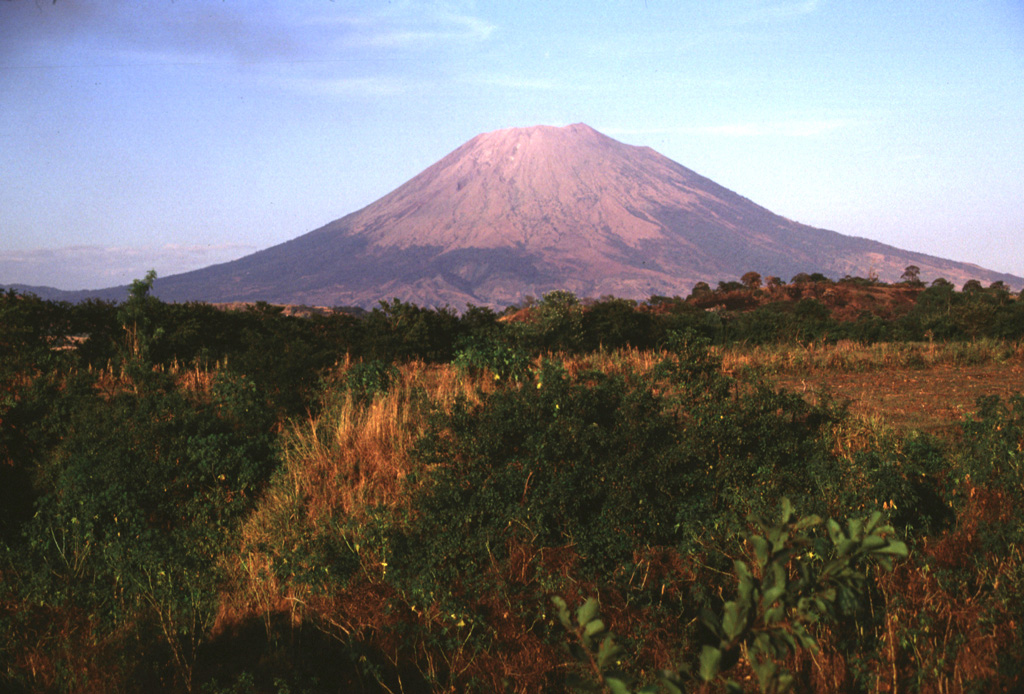
Geological Summary. Galeras, a stratovolcano with a large breached caldera located immediately west of the city of Pasto, is one of Colombia's most frequently active volcanoes. The dominantly andesitic complex has been active for more than 1 million years, and two major caldera collapse eruptions took place during the late Pleistocene. Long-term extensive hydrothermal alteration has contributed to large-scale edifice collapse on at least three occasions, producing debris avalanches that swept to the west and left a large open caldera inside which the modern cone has been constructed. Major explosive eruptions since the mid-Holocene have produced widespread tephra deposits and pyroclastic flows that swept all but the southern flanks. A central cone slightly lower than the caldera rim has been the site of numerous small-to-moderate eruptions since the time of the Spanish conquistadors.

Source: Servicio Geológico Colombiano (SGC)