

Report on Cleveland (United States) — 18 October-24 October 2017
Smithsonian Institution / US Geological Survey
Weekly Volcanic Activity Report, 18 October-24 October 2017
Managing Editor: Sally Sennert.
Please cite this report as:
Global Volcanism Program, 2017. Report on Cleveland (United States) (Sennert, S, ed.). Weekly Volcanic Activity Report, 18 October-24 October 2017. Smithsonian Institution and US Geological Survey.
Cleveland
United States
52.825°N, 169.944°W; summit elev. 1730 m
All times are local (unless otherwise noted)
AVO reported that the lava dome in Cleveland's summit crater continued to grow, and by 15 October it covered an area of about 9,500 square meters with dimensions of 125 x 100 m. No significant change in the size of the dome was identified in satellite data from 15 to 19 October. During 16 and 21-23 October satellite data showed moderately elevated surface temperatures and a small steam plume was visible in web camera images. The Aviation Color Code remained at Orange and the Volcano Alert Level remained at Watch.
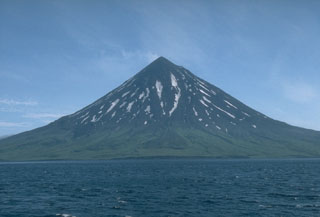
Geological Summary. The beautifully symmetrical Mount Cleveland stratovolcano is situated at the western end of the uninhabited Chuginadak Island. It lies SE across Carlisle Pass strait from Carlisle volcano and NE across Chuginadak Pass strait from Herbert volcano. Joined to the rest of Chuginadak Island by a low isthmus, Cleveland is the highest of the Islands of the Four Mountains group and is one of the most active of the Aleutian Islands. The native name, Chuginadak, refers to the Aleut goddess of fire, who was thought to reside on the volcano. Numerous large lava flows descend the steep-sided flanks. It is possible that some 18th-to-19th century eruptions attributed to Carlisle should be ascribed to Cleveland (Miller et al., 1998). In 1944 it produced the only known fatality from an Aleutian eruption. Recent eruptions have been characterized by short-lived explosive ash emissions, at times accompanied by lava fountaining and lava flows down the flanks.
Source: US Geological Survey Alaska Volcano Observatory (AVO)