

Report on Kick 'em Jenny (Grenada) — 27 August-2 September 2025
Smithsonian Institution / US Geological Survey
Weekly Volcanic Activity Report, 27 August-2 September 2025
Managing Editor: Sally Sennert.
Please cite this report as:
Global Volcanism Program, 2025. Report on Kick 'em Jenny (Grenada) (Sennert, S, ed.). Weekly Volcanic Activity Report, 27 August-2 September 2025. Smithsonian Institution and US Geological Survey.
Kick 'em Jenny
Grenada
12.3°N, 61.64°W; summit elev. -185 m
All times are local (unless otherwise noted)
The University of the West Indies (UWI) Seismic Research Centre (SRC) and the National Disaster Management Agency (NaDMA) reported a period of increased seismicity at Kick 'em Jenny during 27-30 August. A seismic swarm began at around 1000 on 27 August and by 0800 on 28 August the seismic network had recorded around 800 tremors. The largest events were M 2.2-2.4; no reports were received of felt earthquakes in Grenada. Seismicity began to decline through the day. During 1200 on 28 August and 0830 on 29 August the network recorded 72 events, or an average of 3-4 per hour, reflecting decreasing unrest. The largest events were M 1.4-1.8. Unrest further declined and by 1200 on 30 August only one or two tremors per hour were detected. The Alert Level remained at Yellow (the second lowest level on a four-color scale) and the maritime exclusion zone did not change from the radius of 1.5 km.
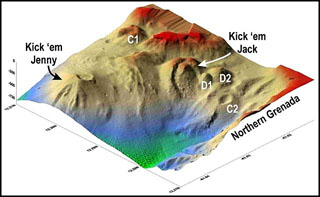
Geological Summary. Kick 'em Jenny, an active submarine volcano 8 km off the N shore of Grenada, rises 1,300 m from the sea floor. Recent bathymetric surveys have shown evidence for a major arcuate collapse structure, which was the source of a submarine debris avalanche that traveled more than 15 km W. Bathymetry also revealed another submarine cone to the SE, Kick 'em Jack, and submarine lava domes to its S. These and subaerial tuff rings and lava flows at Ile de Caille and other nearby islands may represent a single large volcanic complex. Numerous eruptions have occurred since 1939, mostly documented by acoustic signals. Prior to the 1939 eruption, when an eruption cloud rose 275 m above the ocean and was witnessed by a large number of people in northern Grenada, there had been no written mention of the volcano. Eruptions have involved both explosive activity and the quiet extrusion of lava flows and lava domes in the summit crater; deep rumbling noises have sometimes been heard onshore. Recent eruptions have modified the morphology of the summit crater.
Source: University of the West Indies Seismic Research Centre (UWI-SRC)
