

Report on Nevado del Ruiz (Colombia) — 12 November-18 November 2025
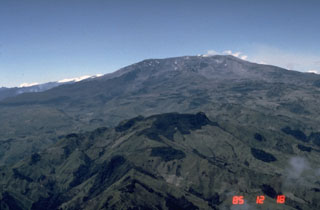
Smithsonian Institution / US Geological Survey
Weekly Volcanic Activity Report, 12 November-18 November 2025
Managing Editor: Sally Sennert.
Please cite this report as:
Global Volcanism Program, 2025. Report on Nevado del Ruiz (Colombia) (Sennert, S, ed.). Weekly Volcanic Activity Report, 12 November-18 November 2025. Smithsonian Institution and US Geological Survey.
Nevado del Ruiz
Colombia
4.892°N, 75.324°W; summit elev. 5279 m
All times are local (unless otherwise noted)
The Servicio Geológico Colombiano’s (SGC) Observatorio Vulcanológico y Sismológico de Manizales reported that eruptive activity at Nevado del Ruiz continued during 11-17 November, though weather conditions sometimes obscured visual observations. Seismic data indicated that events associated with fluid movement increased in both number and intensity compared to the previous week, though levels were low overall. Some of the seismic events were associated with pulsating ash emissions, including some with higher-temperature ejecta. Gas, steam, and ash emissions generally rose as high as 500 m above the summit and mainly drifted W, though some plumes drifted NW and WSW. At 2358 on 14 November an ash plume rose as high as 2 km above the crater rim. Ashfall was reported in the Parque Nacional Natural Los Nevados and in Manizales (28 km NW). Seismicity associated with rock fracturing slightly increased in number but decreased in intensity compared to the previous week. The earthquakes were low magnitude (less than M1) and mainly located at depths of 2-6 km below Arenas Crater and below the SW flank within 5 km. Daily sulfur dioxide emissions fluctuated and were slightly higher than the previous week. Low-level thermal anomalies at the bottom of the crater were periodically identified in satellite images, though weather clouds mostly hindered views. The Alert Level remained at Yellow (the second level on a four-level scale).
Geological Summary. Nevado del Ruiz is a broad, glacier-covered volcano in central Colombia that covers more than 200 km2. Three major edifices, composed of andesitic and dacitic lavas and andesitic pyroclastics, have been constructed since the beginning of the Pleistocene. The modern cone consists of a broad cluster of lava domes built within the caldera of an older edifice. The 1-km-wide, 240-m-deep Arenas crater occupies the summit. The prominent La Olleta pyroclastic cone located on the SW flank may also have been active in historical time. Steep headwalls of massive landslides cut the flanks. Melting of its summit icecap during historical eruptions, which date back to the 16th century, has resulted in devastating lahars, including one in 1985 that was South America's deadliest eruption.
