Recently Published Bulletin Reports
Agung (Indonesia) Three eruptive events reported in April, May, and December 2022
Tengger Caldera (Indonesia) Minor ash emission in December 2023; persistent weak thermal anomaly in the Bromo crater
Saunders (United Kingdom) Persistent thermal anomalies from the summit crater lava lake during February 2023-January 2024
Shishaldin (United States) New eruption with significant Strombolian explosions, ash plumes, and ashfall
Ioto (Japan) New eruption with discolored water, ejecta, and floating pumice during October-December 2023
Purace (Colombia) Gas-and-ash emission on 16 November 2023
Suwanosejima (Japan) Eruption plumes, crater incandescence, and occasional explosions during July-October 2023
Etna (Italy) Strombolian explosions, lava fountains, and lava flows during July-August 2023
Aira (Japan) Explosions, ash plumes, ash fall, and crater incandescence during July-October 2023
Nishinoshima (Japan) Gray emissions during October 2023
Kilauea (United States) Strong lava fountains, lava flows, and spatter at Halema’uma’u during January-September 2023
Tinakula (Solomon Islands) Continued lava flows and thermal activity during June through November 2023
Agung (Indonesia) — January 2024  Cite this Report
Agung
Indonesia
8.343°S, 115.508°E; summit elev. 2997 m
All times are local (unless otherwise noted)
Three eruptive events reported in April, May, and December 2022
Mount Agung, located on the E end of the island of Bali, Indonesia, rises above the SE rim of the Batur caldera. The summit area extends 1.5 km E-W, with the highest point on the W and a steep-walled 800-m-wide crater on the E. Recorded eruptions date back to the early 19th century. A large and deadly explosive and effusive eruption occurred during 1963-64, which was characterized by voluminous ashfall, pyroclastic flows, and lahars that caused extensive damage and many fatalities. More recent activity was documented during November 2017-June 2019 that consisted of multiple explosions, significant ash plumes, lava flows at the summit crater, and incandescent ejecta. This report covers activity reported during April-May 2022 and December 2022 based on data from the Darwin Volcanic Ash Advisory Center (VAAC).
Activity during 2022 was relatively low and mainly consisted of a few ash plumes during April-May and December. An ash plume on 3 April rising to 3.7 km altitude (700 m above the summit) and drifting N was reported in a Darwin VAAC notice based on a ground report, with ash seen in HIMAWARI-8 visible imagery. Another ash plume was reported at 1120 on 27 May that rose to 5.5 km altitude (2.5 m above the summit); the plume was not visible in satellite or webcam images due to weather clouds. An eruption was reported based on seismic data at 0840 on 13 December, with an estimated plume altitude of 3.7 km; however, no ash was seen using satellite imagery in clear conditions before weather clouds obscured the summit.
Geologic Background. Symmetrical Agung stratovolcano, Bali's highest and most sacred mountain, towers over the eastern end of the island. The volcano, whose name means "Paramount," rises above the SE rim of the Batur caldera, and the northern and southern flanks extend to the coast. The summit area extends 1.5 km E-W, with the high point on the W and a steep-walled 800-m-wide crater on the E. The Pawon cone is located low on the SE flank. Only a few eruptions dating back to the early 19th century have been recorded in historical time. The 1963-64 eruption, one of the largest in the 20th century, produced voluminous ashfall along with devastating pyroclastic flows and lahars that caused extensive damage and many fatalities.
Information Contacts: Darwin Volcanic Ash Advisory Centre (VAAC), Bureau of Meteorology, Northern Territory Regional Office, PO Box 40050, Casuarina, NT 0811, Australia (URL: http://www.bom.gov.au/info/vaac/).
Tengger Caldera (Indonesia) — February 2024 Cite this Report
Tengger Caldera
Indonesia
7.942°S, 112.95°E; summit elev. 2329 m
All times are local (unless otherwise noted)
Minor ash emission in December 2023; persistent weak thermal anomaly in the Bromo crater
Tengger Caldera, located at the N end of a volcanic massif in Indonesia’s East Java, consists of five overlapping stratovolcanoes. The youngest and only active cone in the 16-km-wide caldera is Bromo, which typically produces gas-and-steam plumes, occasional ash plumes and explosions, and weak thermal signals (BGVN 44:05, 47:01). This report covers activity during January 2022-December 2023, consisting of mostly white gas-and-steam emissions and persistent weak thermal anomalies. Information was provided by the Pusat Vulkanologi dan Mitigasi Bencana Geologi (PVMBG, also known as Indonesian Center for Volcanology and Geological Hazard Mitigation, CVGHM) and satellite imagery. The Alert Level remained at 2 (on a scale of 1-4), and visitors were warned to stay at least 1 km from the crater.
Activity was generally low during the reporting period, similar to that in 2021. According to almost daily images from MAGMA Indonesia (a platform developed by PVMBG), white emissions and plumes rose from 50 to 900 m above the main crater during this period (figure 24). During several days in March and June 2022, white plumes reached heights of 1-1.2 km above the crater.
After an increase in activity at 2114 on 3 February 2023, a PVMBG team that was sent to observe white emissions rising as high as 300 m during 9-12 February and heard rumbling noises. A sulfur dioxide odor was also strong near the crater and measurements indicated that levels were above the healthy (non-hazardous) threshold of 5 parts per million; differential optical absorption spectroscopy (DOAS) measurements indicated an average flux of 190 metric tons per day on 11 February. Incandescence originating from a large fumarole in the NNW part of the crater was visible at night. The team observed that vegetation on the E caldera wall was yellow and withered. The seismic network recorded continuous tremor and deep and shallow volcanic earthquakes.
According to a PVMBG press release, activity increased on 13 December 2023 with white, gray, and brown emissions rising as high as 900 m above Bromo’s crater rim and drifting in multiple directions (figure 25). The report noted that tremor was continuous and was accompanied in December by three volcanic earthquakes. Deformation data indicated inflation in December. There was no observable difference in the persistent thermal anomaly in the crater between 11 and 16 December 2023.
All clear views of the Bromo crater throughout this time, using Sentinel-2 infrared satellite images, showed a weak persistent thermal anomaly; none of the anomalies were strong enough to cause MODVOLC Thermal Alerts. A fire in the SE part of the caldera in early September 2023 resulted in a brief period of strong thermal anomalies.
Geologic Background. The 16-km-wide Tengger caldera is located at the northern end of a volcanic massif extending from Semeru volcano. The massive volcanic complex dates back to about 820,000 years ago and consists of five overlapping stratovolcanoes, each truncated by a caldera. Lava domes, pyroclastic cones, and a maar occupy the flanks of the massif. The Ngadisari caldera at the NE end of the complex formed about 150,000 years ago and is now drained through the Sapikerep valley. The most recent of the calderas is the 9 x 10 km wide Sandsea caldera at the SW end of the complex, which formed incrementally during the late Pleistocene and early Holocene. An overlapping cluster of post-caldera cones was constructed on the floor of the Sandsea caldera within the past several thousand years. The youngest of these is Bromo, one of Java's most active and most frequently visited volcanoes.
Information Contacts: Pusat Vulkanologi dan Mitigasi Bencana Geologi (PVMBG, also known as Indonesian Center for Volcanology and Geological Hazard Mitigation, CVGHM), Jalan Diponegoro 57, Bandung 40122, Indonesia (URL: http://www.vsi.esdm.go.id/); MAGMA Indonesia, Kementerian Energi dan Sumber Daya Mineral (URL: https://magma.esdm.go.id/v1); Copernicus Browser, Copernicus Data Space Ecosystem, European Space Agency (URL: https://dataspace.copernicus.eu/browser/); Hawai'i Institute of Geophysics and Planetology (HIGP) - MODVOLC Thermal Alerts System, School of Ocean and Earth Science and Technology (SOEST), Univ. of Hawai'i, 2525 Correa Road, Honolulu, HI 96822, USA (URL: http://modis.higp.hawaii.edu/).
Saunders (United Kingdom) — February 2024 Cite this Report
Saunders
United Kingdom
57.8°S, 26.483°W; summit elev. 843 m
All times are local (unless otherwise noted)
Persistent thermal anomalies from the summit crater lava lake during February 2023-January 2024
Saunders is one of eleven islands that comprise the South Sandwich Islands in the South Atlantic. The active Mount Michael volcano has been in almost continuous eruption since November 2014 (BGVN 48:02). Recent activity has resulted in intermittent thermal anomalies and gas-and-steam emissions (BGVN 47:03, 48:02). Visits are infrequent due to its remote location, and cloud cover often prevents satellite observations. Satellite thermal imagery and visual observation of incandescence during a research expedition in 2019 (BGVN 28:02 and 44:08) and a finding confirmed by a National Geographic Society research team that summited Michael in November 2022 reported the presence of a lava lake.
Although nearly constant cloud cover during February 2023 through January 2024 greatly limited satellite observations, thermal anomalies from the lava lake in the summit crater were detected on clear days, especially around 20-23 August 2023. Anomalies similar to previous years (eg. BGVN 48:02) were seen in both MIROVA (Middle InfraRed Observation of Volcanic Activity) data from MODIS instruments and in Sentinel 2 infrared imagery. The only notable sulfur dioxide plume detected near Saunders was on 25 September 2023, with the TROPOMI instrument aboard the Sentinel-5P satellite.
Geologic Background. Saunders Island consists of a large central volcanic edifice intersected by two seamount chains, as shown by bathymetric mapping (Leat et al., 2013). The young Mount Michael stratovolcano dominates the glacier-covered island, while two submarine plateaus, Harpers Bank and Saunders Bank, extend north. The symmetrical Michael has a 500-m-wide summit crater and a remnant of a somma rim to the SE. Tephra layers visible in ice cliffs surrounding the island are evidence of recent eruptions. Ash clouds were reported from the summit crater in 1819, and an effusive eruption was inferred to have occurred from a N-flank fissure around the end of the 19th century and beginning of the 20th century. A low ice-free lava platform, Blackstone Plain, is located on the north coast, surrounding a group of former sea stacks. A cluster of cones on the SE flank, the Ashen Hills, appear to have been modified since 1820 (LeMasurier and Thomson, 1990). Analysis of satellite imagery available since 1989 (Gray et al., 2019; MODVOLC) suggests frequent eruptive activity (when weather conditions allow), volcanic clouds, steam plumes, and thermal anomalies indicative of a persistent, or at least frequently active, lava lake in the summit crater. Due to this observational bias, there has been a presumption when defining eruptive periods that activity has been ongoing unless there is no evidence for at least 10 months.
Information Contacts: MIROVA (Middle InfraRed Observation of Volcanic Activity), a collaborative project between the Universities of Turin and Florence (Italy) supported by the Centre for Volcanic Risk of the Italian Civil Protection Department (URL: http://www.mirovaweb.it/); NASA Global Sulfur Dioxide Monitoring Page, Atmospheric Chemistry and Dynamics Laboratory, NASA Goddard Space Flight Center (NASA/GSFC), 8800 Greenbelt Road, Goddard MD 20771, USA (URL: https://so2.gsfc.nasa.gov/); Copernicus Browser (URL: https://dataspace.copernicus.eu/browser).
Shishaldin (United States) — December 2023 Cite this Report
Shishaldin
United States
54.756°N, 163.97°W; summit elev. 2857 m
All times are local (unless otherwise noted)
New eruption with significant Strombolian explosions, ash plumes, and ashfall
Shishaldin is located on the eastern half of Unimak Island, one of the Aleutian Islands. Frequent explosive activity, primarily consisting of Strombolian ash eruptions from the small summit crater, but sometimes producing lava flows, has been recorded since the 18th century. The previous eruption ended in May 2020 and was characterized by intermittent thermal activity, increased seismicity and surface temperatures, ash plumes, and ash deposits (BGVN 45:06). This report covers a new eruption during July through November 2023, which consisted of significant explosions, ash plumes, ashfall, and lava fountaining. Information comes from daily, weekly, and special reports from the Alaska Volcano Observatory (AVO) and various satellite data. AVO monitors the volcano using local seismic and infrasound sensors, satellite data, web cameras, and remote infrasound and lightning networks.
AVO reported that intermittent tremor and low-frequency earthquakes had gradually become more regular and consistent during 10-13 July. Strongly elevated surface temperatures at the summit were identified in satellite images during 10-13 July. On 11 July AVO raised the Aviation Color Code (ACC) to Yellow (the second color on a four-color scale) and Volcano Alert Level (VAL) to Advisory (the second level on a four-level scale) at 1439. Later in the day on 11 July summit crater incandescence was observed in webcam images. Observations of the summit suggested that lava was likely present at the crater, which prompted AVO to raise the ACC to Orange (the second highest color on a four-color scale) and the VAL to Watch (the second highest level on a four-level scale). The US Coast Guard conducted an overflight on 12 July and confirmed that lava was erupting from the summit. That same day, sulfur dioxide emissions were detected in satellite images.
A significant explosion began at 0109 on 14 July that produced an ash plume that rose to 9-12 km altitude and drifted S over the Pacific Ocean (figure 43). Webcam images and photos taken around 0700 from a ship SW off Unimak Island showed small lahar deposits, which were the result of the interaction of hot pyroclastic material and snow and ice on the flanks. There was also ashfall on the SW and N flanks. A smaller explosion at 0710 generated an ash plume that rose to 4.5 km altitude. Webcam images and pilot reports showed continued low-level ash emissions during the morning, rising to less than 4.6 km altitude; those emissions included a small ash plume near the summit around 1030 resulting from a small explosion.
Seismic tremor amplitude began increasing at around 1700 on 15 July; strongly elevated surface temperatures were also reported. An ash plume rose to 4.6 km altitude and drifted SSE at 2100, based on a satellite image. A continuous ash plume during 2150 through 2330 rose to 5 km altitude and extended 125 km S. At 2357 AVO raised the ACC to Red (the highest color on a four-color scale) and the VAL to Warning (the highest level on a four-level scale), noting that seismicity remained elevated for more than six hours and explosion signals were frequently detected by regional infrasound (pressure sensor) networks. Explosions generated an ash plume that rose to 4.9 km altitude and drifted as far as 500 km SE. Activity throughout the night declined and by 0735 the ACC was lowered to Orange and the VAL to Watch. High-resolution satellite images taken on 16 July showed pyroclastic deposits extending as far as 3 km from the vent; these deposits generated lahars that extended further down the drainages on the flanks. Ash deposits were mainly observed on the SSE flank and extended to the shore of Unimak Island. During 16-17 July lava continued to erupt at the summit, which caused strongly elevated surface temperatures that were visible in satellite imagery.
Lava effusion increased at 0100 on 18 July, as noted in elevated surface temperatures identified in satellite data, increasing seismic tremor, and activity detected on regional infrasound arrays. A significant ash plume at 0700 rose to 7 km altitude and continued until 0830, eventually reaching 9.1 km altitude and drifting SSE (figure 44). As a result, the ACC was raised to Red and the VAL to Warning. By 0930 the main plume detached, but residual low-level ash emissions continued for several hours, remaining below 3 km altitude and drifting S. The eruption gradually declined and by 1208 the ACC was lowered to Orange and the VAL was lowered to Watch. High-resolution satellite images showed ash deposits on the SW flank and pyroclastic deposits on the N, E, and S flanks, extending as far as 3 km from the vent; lahars triggered by the eruption extended farther down the flanks (figure 45). Lava continued to erupt from the summit crater on 19 July.
Elevated surface temperatures were detected in satellite images during 19-25 July, despite occasional weather cloud cover, which was consistent with increased lava effusion. During 22-23 July satellite observations acquired after the eruption from 18 July showed pyroclastic flow and lahar deposits extending as far as 3 km down the N, NW, and NE flanks and as far as 1.5 km down the S and SE flanks. Ash deposits covered the SW and NE flanks. No lava flows were observed outside the crater. On 22 July a sulfur dioxide plume was detected in satellite data midday that had an estimated mass of 10 kt. In a special notice issued at 1653 on 22 July AVO noted that eruptive activity had intensified over the previous six hours, which was characterized by an hours-long steady increase in seismic tremor, intermittent infrasound signals consistent with small explosions, and an increase in surface temperatures that were visible in satellite data. Pilots first reported low-level ash plumes at around 1900. At 2320 an ash plume had risen to 9 km altitude based on additional pilot reports and satellite images. The ACC was increased to Red and the VAL to Warning at 2343. Satellite images indicated growth of a significantly higher ash plume that rose to 11 km altitude continued until 0030 and drifted NE. During the early morning hours of 23 July ash plumes had declined to 4.6 k altitude. Seismic tremor peaked at 0030 on 23 July and began to rapidly decline at 0109; active ash emissions were no longer visible in satellite data by 0130. The ACC was lowered to Orange and the VAL to Watch at 0418; bursts of increased seismicity were recorded throughout the morning, but seismicity generally remained at low levels. Elevated surface temperatures were visible in satellite data until about 0600. On 24 July pilots reported seeing vigorous gas-and-steam plumes rising to about 3 km altitude; the plumes may have contained minor amounts of ash.
During 24-25 July low level seismicity and volcanic tremor were detected at low levels following the previous explosion on 23 July. Strongly elevated surface temperatures were observed at the summit crater in satellite data. Around 2200 on 25 July seismicity began to increase, followed by infrasound signals of explosions after 0200 on 26 July. An ash plume rose to 3 km altitude at 0500 and drifted ENE, along with an associated sulfur dioxide plume that drifted NE and had an estimated mass of 22 kt. Diffuse ash emissions were visible in satellite data and rose to 6.1-7.6 km altitude and extended 125 km from the volcano starting around 1130. These ash events were preceded by about seven hours of seismic tremor, infrasound detections of explosions, and five hours of increased surface temperatures visible in satellite data. Activity began to decline around 1327, which included low-frequency earthquakes and decreased volcanic tremor, and infrasound data no longer detected significant explosions. Surface temperatures remained elevated through the end of the month.
Seismicity, volcanic tremor, and ash emissions remained at low levels during early August. Satellite images on 1 August showed that some slumping had occurred on the E crater wall due to the recent explosive activity. Elevated surface temperatures continued, which was consistent with cooling lava. On 2 August small explosive events were detected, consistent with low-level Strombolian activity. Some episodes of volcanic tremor were reported, which reflected low-level ash emissions. Those ash emissions rose to less than 3 km altitude and drifted as far as 92.6 km N. Pilots that were located N of the volcano observed an ash plume that rose to 2.7 km altitude. Seismicity began to increase in intensity around 0900 on 3 August. Seismicity continued to increase throughout the day and through the night with strongly elevated surface temperatures, which suggested that lava was active at the surface.
An ash cloud that rose to 7.6-7.9 km altitude and drifted 60-75 km NE was visible in a satellite image at 0520 on 4 August. Pilots saw and reported the plume at 0836 (figure 46). By 0900 the plume had risen to 9.1 km altitude and extended over 100 km NE. AVO raised the ACC to Red and the VAL to Warning as a result. Seismic tremor levels peaked at 1400 and then sharply declined at 1500 to slightly elevated levels; the plume was sustained during the period of high tremor and drifted N and NE. The ACC was lowered to Orange and the VAL to Watch at 2055. During 5-14 August seismicity remained low and surface temperatures were elevated based on satellite data due to cooling lava. On 9 August a small lava flow was observed that extended from the crater rim to the upper NE flank. It had advanced to 55 m in length and appeared in satellite imagery on 11 August. Occasional gas-and-steam plumes were noted in webcam images. At 1827 AVO noted that seismic tremor had steadily increased during the afternoon and erupting lava was visible at the summit in satellite images.
Strong explosion signals were detected at 0200 on 15 August. An ash cloud that was visible in satellite data extended 100 km NE and may have risen as high as 11 km altitude around 0240. By 0335 satellite images showed the ash cloud rising to 7.6 km altitude and drifting NE. Significant seismicity and explosions were detected by the local AVO seismic and infrasound networks, and volcanic lightning was detected by the World Wide Lightning Location Network (WWLLN). A sulfur dioxide plume associated with the eruption drifted over the S Bering Sea and parts of Alaska and western Canada. Seismicity was significantly elevated during the eruption but had declined by 1322. A pilot reported that ash emissions continued, rising as high as 4.9 km altitude. Elevated surface temperatures detected in satellite data were caused by hot, eruptive material (pyroclastic debris and lava) that accumulated around the summit. Eruptive activity declined by 16 August and the associated sulfur dioxide plume had mostly dissipated; remnants continued to be identified in satellite images at least through 18 August. Surface temperatures remained elevated based on satellite images, indicating hot material on the upper parts of the volcano. Small explosions were detected in infrasound data on the morning of 19 August and were consistent with pilot reports of small, short-lived ash plumes that rose to about 4.3 km altitude. Low-level explosive activity was reported during 20-24 August, according to seismic and infrasound data, and weather clouds sometimes prevented views. Elevated surface temperatures were observed in satellite images, which indicated continued hot material on the upper parts of the volcano.
Seismic tremor began to increase at around 0300 on 25 August and was followed by elevated surface temperatures identified in satellite images, consistent with erupting lava. Small explosions were recorded in infrasound data. The ACC was raised to Red and the VAL to Warning at 1204 after a pilot reported an ash plume that rose to 9.1 km altitude. Seismicity peaked at 1630 and began to rapidly decline at around 1730. Ash plumes rose as high as 10 km altitude and drifted as far as 400 km NE. By 2020 the ash plumes had declined to 6.4 km altitude and continued to drift NE. Ash emissions were visible in satellite data until 0000 on 26 August and seismicity was at low levels. AVO lowered the ACC to Orange and the VAL to Watch at 0030. Minor explosive activity within the summit crater was detected during 26-28 August and strongly elevated surface temperatures were still visible in satellite imagery through the rest of the month. An AVO field crew working on Unimak Island observed a mass flow that descended the upper flanks beginning around 1720 on 27 August. The flow produced a short-lived ash cloud that rose to 4.5 km altitude and rapidly dissipated. The mass flow was likely caused by the collapse of spatter that accumulated on the summit crater rim.
Similar variable explosive activity was reported in September, although weather observations sometimes prevented observations. A moderate resolution satellite image from the afternoon of 1 September showed gas-and-steam emissions filling the summit crater and obscuring views of the vent. In addition, hot deposits from the previous 25-26 August explosive event were visible on the NE flank near the summit, based on a 1 September satellite image. On 2 and 4 September seismic and infrasound data showed signals of small, repetitive explosions. Variable gas-and-steam emissions from the summit were visible but there was no evidence of ash. Possible summit crater incandescence was visible in nighttime webcam images during 3-4 September.
Seismicity began to gradually increase at around 0300 on 5 September and activity escalated at around 0830. A pilot reported an ash plume that rose to 7.6 km altitude at 0842 and continued to rise as high as possibly 9.7 km altitude and drifted SSE based on satellite images (figure 47). The ACC was raised to Red and the VAL to Warning at 0900. In addition to strong tremor and sustained explosions, the eruption produced volcanic lightning that was detected by the WWLLN. Around 1100 seismicity decreased and satellite data confirmed that the altitude of the ash emissions had declined to 7.6 km altitude. By 1200 the lower-altitude portion of the ash plume had drifted 125 km E. Significant ash emissions ended by 1330 based on webcam images. The ACC was lowered to Orange and the VAL to Watch at 1440. Satellite images showed extensive pyroclastic debris flows on most of the flanks that extended 1.2-3.3 km from the crater rim.
During 6-13 September elevated surface temperatures continued to be observed in satellite data, seismicity remained elevated with weak but steady tremor, and small, low-frequency earthquakes and small explosions were reported, except on 12 September. On 6 September a low-level ash plume rose to 1.5-1.8 km altitude and drifted SSE. Occasional small and diffuse gas-and-steam emissions at the summit were visible in webcam images. Around 1800 on 13 September seismic tremor amplitudes began to increase, and small explosions were detected in seismic and infrasound data. Incandescent lava at the summit was seen in a webcam image taken at 0134 on 14 September during a period of elevated tremor. No ash emissions were reported during the period of elevated seismicity. Lava fountaining began around 0200, based on webcam images. Satellite-based radar observations showed that the lava fountaining activity led to the growth of a cone in the summit crater, which refilled most of the crater. By 0730 seismicity significantly declined and remained at low levels.
Seismic tremor began to increase around 0900 on 15 September and rapidly intensified. An explosive eruption began at around 1710, which prompted AVO to raise the ACC to Red and the VAL to Warning. Within about 30 minutes ash plumes drifted E below a weather cloud at 8.2 km altitude. The National Weather Service estimated that an ash-rich plume rose as high as 12.8 km altitude and produced volcanic lightning. The upper part of the ash plume detached from the vent around 1830 and drifted E, and was observed over the Gulf of Alaska. Around the same time, seismicity dramatically decreased. Trace ashfall was reported in the community of False Pass (38 km ENE) between 1800-2030 and also in King Cove and nearby marine waters. Activity declined at around 1830 although seismicity remained elevated, ash emissions, and ashfall continued until 2100. Lightning was again detected beginning around 1930, which suggested that ash emissions continued. Ongoing explosions were detected in infrasound data, at a lower level than during the most energetic phase of this event. Lightning was last detected at 2048. By 2124 the intensity of the eruption had decreased, and ash emissions were likely rising to less than 6.7 km altitude. Seismicity returned to pre-eruption levels. On 16 September the ACC was lowered to Orange and the VAL to Watch at 1244; the sulfur dioxide plume that was emitted from the previous eruption event was still visible over the northern Pacific Ocean. Elevated surface temperatures, gas-and-steam emissions from the vent, and new, small lahars were reported on the upper flanks based on satellite and webcam images. Minor deposits were reported on the flanks which were likely the result of collapse of previously accumulated lava near the summit crater.
Elevated seismicity with tremor, small earthquakes, and elevated surface temperatures were detected during 17-23 September. Minor gas-and-steam emissions were visible in webcam images. On 20 September small volcanic debris flows were reported on the upper flanks. On 21 September a small ash deposit was observed on the upper flanks extending to the NE based on webcam images. Seismic tremor increased significantly during 22-23 September. Regional infrasound sensors suggested that low-level eruptive activity was occurring within the summit crater by around 1800 on 23 September. Even though seismicity was at high levels, strongly elevated surface temperatures indicating lava at the surface were absent and no ash emissions were detected; weather clouds at 0.6-4.6 km altitude obscured views. At 0025 on 24 September AVO noted that seismicity continued at high levels and nearly continuous small infrasound signals began, likely from low-level eruptive activity. Strongly elevated surface temperatures were identified in satellite images by 0900 and persisted throughout the day; the higher temperatures along with infrasound and seismic data were consistent with lava erupting at the summit. Around 1700 similarly elevated surface temperatures were detected from the summit in satellite data, which suggested that more vigorous lava fountaining had started. Starting around 1800 low-level ash emissions rose to altitudes less than 4.6 km altitude and quickly dissipated.
Beginning at midnight on 25 September, a series of seismic signals consistent with volcanic flows were recorded on the N side of the volcano. A change in seismicity and infrasound signals occurred around 0535 and at 0540 a significant ash cloud formed and quickly reached 14 km altitude and drifted E along the Alaska Peninsula. The cloud generated at least 150 lightning strokes with thunder that could be heard by people in False Pass. Seismicity rapidly declined to near background levels around 0600. AVO increased the ACC to Red and the VAL to Warning at 0602. The ash cloud detached from the volcano at around 0700, rose to 11.6 km altitude, and drifted ESE. Trace to minor amounts of ashfall were reported by the communities of False Pass, King Cove, Cold Bay, and Sand Point around 0700. Ash emissions continued at lower altitudes of 6-7.6 km altitude at 0820. Small explosions at the vent area continued to be detected in infrasound data and likely represented low-level eruptive activity near the vent. Due to the significant decrease in seismicity and ash emissions the ACC was lowered to Orange and the VAL to Watch at 1234. Radar data showed significant collapses of the crater that occurred on 25 September. Satellite data also showed significant hot, degassing pyroclastic and lahar deposits on all flanks, including more extensive flows on the ENE and WSW sections below two new collapse scarps. Following the significant activity during 24-25 September, only low-level activity was observed. Seismicity decreased notably near the end of the strong activity on 25 September and continued to decrease through the end of the month, though tremor and small earthquakes were still reported. No explosive activity was detected in infrasound data through 2 October. Gas-and-steam emissions rose to 3.7 km altitude, as reported by pilots and seen in satellite images. Satellite data from 26 September showed that significant collapses had occurred at the summit crater and hot, steaming deposits from pyroclastic flows and lahars were present on all the flanks, particularly to the ENE and WSW. A small ash cloud was visible in webcam images on 27 September, likely from a collapse at the summit cone. High elevated surface temperatures were observed in satellite imagery during 27-28 September, which were likely the result of hot deposits on the flanks erupted on 25 September. Minor steaming at the summit crater and from an area on the upper flanks was visible in webcam images on 28 September.
During October, explosion events continued between periods of low activity. Seismicity significantly increased starting at around 2100 on 2 October; around the same time satellite images showed an increase in surface temperatures consistent with lava fountaining. Small, hot avalanches of rock and lava descended an unspecified flank. In addition, a distinct increase in infrasound, seismicity, and lightning detections was followed by an ash plume that rose to 12.2 km altitude and drifted S and E at 0520 on 3 October, based on satellite images. Nighttime webcam images showed incandescence due to lava fountaining at the summit and pyroclastic flows descending the NE flank. AVO reported that a notable explosive eruption started at 0547 and lasted until 0900 on 3 October, which prompted a rise in the ACC to Red and the VAL to Warning. Subsequent ash plumes rose to 6-7.6 km altitude by 0931. At 1036 the ACC was lowered back to Orange and the VAL to Watch since both seismic and infrasound data quieted substantially and were slightly above background levels. Gas-and-steam emissions were observed at the summit, based on webcam images. Trace amounts of ashfall were observed in Cold Bay. Resuspended ash was present at several kilometers altitude near the volcano. During the afternoon, low-level ash plumes were visible at the flanks, which appeared to be largely generated by rock avalanches off the summit crater following the explosive activity. These ash plumes rose to 3 km altitude and drifted W. Trace amounts of ashfall were reported by observers in Cold Bay and Unalaska and flights to these communities were disrupted by the ash cloud. Satellite images taken after the eruption showed evidence of pyroclastic flows and lahar deposits in drainages 2 km down the SW flank and about 3.2 km down the NE flank, and continued erosion of the crater rim. Small explosion craters at the end of the pyroclastic flows on the NE flank were noted for the first time, which may have resulted from gas-and-steam explosions when hot deposits interact with underlying ice.
During 4 October seismicity, including frequent small earthquakes, remained elevated, but was gradually declining. Ash plumes were produced for over eight hours until around 1400 that rose to below 3.7 km altitude. These ash plumes were primarily generated off the sides of the volcano where hot rock avalanches from the crater rim had entered drainages to the SW and NE. Two explosion craters were observed at the base of the NE deposits about 3.2 km from the crater rim. Webcam images showed the explosion craters were a source of persistent ash emissions; occasional collapse events also generated ash. Seismicity remained elevated with sulfur dioxide emissions that had a daily average of more than 1,000 tons per day, and frequent small earthquakes through the end of the month. Frequent elevated surface temperatures were identified in satellite images and gas-and-steam plumes were observed in webcam images, although weather conditions occasionally prevented clear views of the summit. Emissions were robust during 14-16 October and were likely generated by the interaction of hot material and snow and ice. During the afternoon of 21 October a strong gas-and-steam plume rose to 3-4.6 km altitude and extended 40 km WSW, based on satellite images and reports from pilots. On 31 October the ACC was lowered to Yellow and the VAL was lowered to Advisory.
Activity in November was characterized by elevated seismicity with ongoing seismic tremor and small, low-frequency earthquakes, elevated surface temperatures, and gas-and-steam emissions. There was an increase in seismic and infrasound tremor amplitudes starting at 1940 on 2 November. As a result, the ACC was again raised to Orange and the VAL was increased to Watch, although ash was not identified in satellite data. An ash cloud rose to 6.1 km altitude and drifted W according to satellite data at 2000. By 0831 on 3 November ash emissions were no longer visible in satellite images. On 6 and 9 November air pressure sensors detected signals consistent with small explosions. Small explosions were detected in infrasound data consistent with weak Strombolian activity on 19 and 21 November. Seismicity started to decrease on 21 November. On 25 November gas-and-steam emissions were emitted from the vent as well as from a scarp on the NE side of the volcano near the summit. A gas-and-steam plume extended about 50 km SSE and was observed in satellite and webcam images on 26 November. On 28 November small explosions were observed in seismic and local infrasound data and gas-and-steam emissions were visible from the summit and from the upper NE collapse scarp based on webcam images. Possible small explosions were observed in infrasound data on 30 November. Weakly elevated surface temperatures and a persistent gas-and-steam plume from the summit and collapse scarps on the upper flanks. A passing aircraft reported the gas-and-steam plume rose to 3-3.4 km altitude on 30 November, but no significant ash emissions were detected.
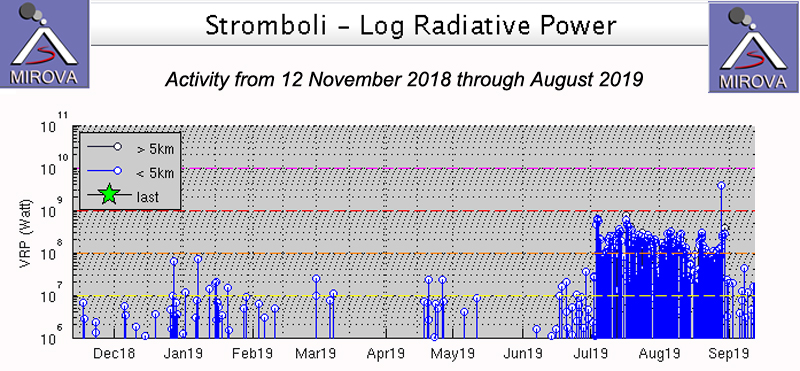
Satellite data. MODIS thermal anomaly data provided through MIROVA (Middle InfraRed Observation of Volcanic Activity) showed a strong pulse of thermal activity beginning in July 2023 that continued through November 2023 (figure 48). This strong activity was due to Strombolian explosions and lava fountaining events at the summit crater. According to data from MODVOLC thermal alerts, a total of 101 hotspots were detected near the summit crater in July (11-14, 16-19, 23-24 and 26), August (4, 25-26, and 29), September (5, 12, and 17), and October (3, 4, and 8). Infrared satellite data showed large lava flows descending primarily the northern and SE flanks during the reporting period (figure 49). Sulfur dioxide plumes often exceeded two Dobson Units (DUs) and drifted in different directions throughout the reporting period, based on satellite data from the TROPOMI instrument on the Sentinel-5P satellite (figure 50).
Geologic Background. The symmetrical glacier-covered Shishaldin in the Aleutian Islands is the westernmost of three large stratovolcanoes in the eastern half of Unimak Island. The Aleuts named the volcano Sisquk, meaning "mountain which points the way when I am lost." Constructed atop an older glacially dissected edifice, it is largely basaltic in composition. Remnants of an older edifice are exposed on the W and NE sides at 1,500-1,800 m elevation. There are over two dozen pyroclastic cones on its NW flank, which is covered by massive aa lava flows. Frequent explosive activity, primarily consisting of Strombolian ash eruptions from the small summit crater, but sometimes producing lava flows, has been recorded since the 18th century. A steam plume often rises from the summit crater.
Information Contacts: Alaska Volcano Observatory (AVO), a cooperative program of a) U.S. Geological Survey, 4200 University Drive, Anchorage, AK 99508-4667 USA (URL: https://avo.alaska.edu/), b) Geophysical Institute, University of Alaska, PO Box 757320, Fairbanks, AK 99775-7320, USA, and c) Alaska Division of Geological & Geophysical Surveys, 794 University Ave., Suite 200, Fairbanks, AK 99709, USA (URL: http://dggs.alaska.gov/); MIROVA (Middle InfraRed Observation of Volcanic Activity), a collaborative project between the Universities of Turin and Florence (Italy) supported by the Centre for Volcanic Risk of the Italian Civil Protection Department (URL: http://www.mirovaweb.it/); Hawai'i Institute of Geophysics and Planetology (HIGP) - MODVOLC Thermal Alerts System, School of Ocean and Earth Science and Technology (SOEST), Univ. of Hawai'i, 2525 Correa Road, Honolulu, HI 96822, USA (URL: http://modis.higp.hawaii.edu/); NASA Global Sulfur Dioxide Monitoring Page, Atmospheric Chemistry and Dynamics Laboratory, NASA Goddard Space Flight Center (NASA/GSFC), 8800 Greenbelt Road, Goddard, Maryland, USA (URL: https://so2.gsfc.nasa.gov/); Copernicus Browser, Copernicus Data Space Ecosystem, European Space Agency (URL: https://dataspace.copernicus.eu/browser/).
Ioto
Japan
24.751°N, 141.289°E; summit elev. 169 m
All times are local (unless otherwise noted)
New eruption with discolored water, ejecta, and floating pumice during October-December 2023
Ioto (Iwo-jima), located about 1,200 km S of Tokyo, lies within a 9-km-wide submarine caldera along the Izu-Bonin-Mariana volcanic arc. Previous eruptions date back to 1889 and have consisted of dominantly phreatic explosions, pumice deposits during 2001, and discolored water. A submarine eruption during July through December 2022 was characterized by discolored water, pumice deposits, and gas emissions (BGVN 48:01). This report covers a new eruption during October through December 2023, which consisted of explosions, black ejecta, discolored water, and floating pumice, based on information from the Japan Meteorological Association (JMA), the Japan Coast Guard (JCG), and satellite data.
JMA reported that an eruption had been occurring offshore of Okinahama on the SE side of the island since 21 October, which was characterized by volcanic tremor, according to the Japan Maritime Self-Defense Force (JMSDF) Iwo Jima Air Base (figure 22). According to an 18 October satellite image a plume of discolored water at the site of this new eruption extended NE (figure 23). During an overflight conducted on 30 October, a vent was identified about 1 km off the coast of Okinahama. Observers recorded explosions every few minutes that ejected dark material about 20 m above the ocean and as high as 150 m. Ejecta from the vent formed a black-colored island about 100 m in diameter, according to observations conducted from the air by the Earthquake Research Institute of the University of Tokyo in cooperation with the Mainichi newspaper (figure 24). Occasionally, large boulders measuring more than several meters in size were also ejected. Observations from the Advanced Land Observing Satellite Daichi-2 and Sentinel-2 satellite images also confirmed the formation of this island (figure 23). Brown discolored water and floating pumice were present surrounding the island.
The eruption continued during November. During an overflight on 3 November observers photographed the island and noted that material was ejected 169 m high, according to a news source. Explosions gradually became shorter, and, by the 3rd, they occurred every few seconds; dark and incandescent material were ejected about 800 m above the vent. On 4 November eruptions were accompanied by explosive sounds. Floating, brown-colored pumice was present in the water surrounding the island. There was a brief increase in the number of volcanic earthquakes during 8-14 November and 24-25 November. The eruption temporarily paused during 9-11 November and by 12 November eruptions resumed to the W of the island. On 10 November dark brown-to-dark yellow-green discolored water and a small amount of black floating material was observed (figure 25). A small eruption was reported on 18 November off the NE coast of the island, accompanied by white gas-and-steam plumes (figure 23). Another pause was recorded during 17-19 November, which then resumed on 20 November and continued erupting intermittently. According to a field survey conducted by the National Institute for Disaster Prevention Science and Technology on 19 November, a 30-m diameter crater was visible on the NE coast where landslides, hot water, and gray volcanic ash containing clay have occurred and been distributed previously. Erupted blocks about 10 cm in diameter were distributed about 90-120 m from the crater. JCG made observations during an overflight on 23 November and reported a phreatomagmatic eruption. Explosions at the main vent generated dark gas-and-ash plumes that rose to 200 m altitude and ejected large blocks that landed on the island and in the ocean (figure 26). Discolored water also surrounded the island. The size of the new island had grown to 450 m N-S x 200 m E-W by 23 November, according to JCG.
The eruption continued through 11 December, followed by a brief pause in activity, which then resumed on 31 December, according to JMA. Intermittent explosions produced 100-m-high black plumes at intervals of several minutes to 30 minutes during 1-10 December. Overflights were conducted on 4 and 15 December and reported that the water surrounding the new island was discolored to dark brown-to-dark yellow-green (figure 27). No floating material was reported during this time. In comparison to the observations made on 23 November, the new land had extended N and part of it had eroded away. In addition, analysis by the Geospatial Information Authority of Japan using SAR data from Daichi-2 also confirmed that the area of the new island continued to decrease between 4 and 15 December. Ejected material combined with wave erosion transformed the island into a “J” shape, 500-m-long and with the curved part about 200 m offshore of Ioto. The island was covered with brown ash and blocks, and the surrounding water was discolored to greenish-brown and contained an area of floating pumice. JCG reported from an overflight on 4 December that volcanic ash-like material found around the S vent on the NE part of the island was newly deposited since 10 November (figure 28). By 15 December the N part of the “J” shaped island had separated and migrated N, connecting to the Okinahama coast and the curved part of the “J” had eroded into two smaller islands (figure 27).
References. Ukawa, M., Fujita, E., Kobayashi, T., 2002, Recent volcanic activity of Iwo Jima and the 2001 eruption, Monthly Chikyu, Extra No. 39, 157-164.
Geologic Background. Ioto, in the Volcano Islands of Japan, lies within a 9-km-wide submarine caldera. The volcano is also known as Ogasawara-Iojima to distinguish it from several other "Sulfur Island" volcanoes in Japan. The triangular, low-elevation, 8-km-long island narrows toward its SW tip and has produced trachyandesitic and trachytic rocks that are more alkalic than those of other volcanoes in this arc. The island has undergone uplift for at least the past 700 years, accompanying resurgent doming of the caldera; a shoreline landed upon by Captain Cook's surveying crew in 1779 is now 40 m above sea level. The Motoyama plateau on the NE half of the island consists of submarine tuffs overlain by coral deposits and forms the island's high point. Many fumaroles are oriented along a NE-SW zone cutting through Motoyama. Numerous recorded phreatic eruptions, many from vents on the W and NW sides of the island, have accompanied the uplift.
Information Contacts: Japan Meteorological Agency (JMA), 1-3-4 Otemachi, Chiyoda-ku, Tokyo 100-8122, Japan (URL: http://www.jma.go.jp/jma/indexe.html); Japan Coast Guard (JCG) Volcano Database, Hydrographic and Oceanographic Department, 3-1-1, Kasumigaseki, Chiyoda-ku, Tokyo 100-8932, Japan (URL: https://www1.kaiho.mlit.go.jp/GIJUTSUKOKUSAI/kaiikiDB/kaiyo22-2.htm); Copernicus Browser, Copernicus Data Space Ecosystem, European Space Agency (URL: https://dataspace.copernicus.eu/browser/); Asahi, 5-3-2, Tsukiji, Chuo Ward, Tokyo, 104-8011, Japan (URL: https://www.asahi.com/ajw/articles/15048458).
Purace (Colombia) — December 2023 Cite this Report
Purace
Colombia
2.3095°N, 76.3948°W; summit elev. 4650 m
All times are local (unless otherwise noted)
Gas-and-ash emission on 16 November 2023
Puracé, located in Colombia, is a stratovolcano that contains a 500-m-wide summit crater. It is part of the Los Coconucos volcanic chain that is a NW-SE trending group of seven cones and craters. The most recent eruption occurred during March 2022 that was characterized by frequent seismicity and gas-and-steam emissions (BGVN 47:06). This report covers a brief eruption during November 2023 based on monthly reports from the Popayán Observatory, part of the Servicio Geologico Colombiano (SGC).
Activity during November 2022 through November 2023 primarily consisted of seismicity: VT-type events, LP-type events, HB-type events, and TR-type events (table 4). Maximum sulfur dioxide values were measured weekly and ranged from 259-5,854 tons per day (t/d) during November 2022 through April 2023. White gas-and-steam emissions were also occasionally reported.
SGC issued a report on 25 October that noted a significant increase in the number of earthquakes associated with rock fracturing. These earthquakes were located SE of the crater between Puracé and Piocollo at depths of 1-4 km. There were no reported variations in sulfur dioxide values, but SGC noted high carbon dioxide values, compared to those recorded in the first half of 2023.
SGC reported that at 1929 on 16 November the seismic network detected a signal that was possibly associated with a gas-and-ash emission, though it was not confirmed in webcam images due to limited visibility. On 17 November an observer confirmed ash deposits on the N flank. Webcam images showed an increase in degassing both inside the crater and from the NW flank, rising 700 m above the crater.
Table 4. Seismicity at Puracé during November 2022-November 2023. Volcano-tectonic (VT), long-period (LP), hybrid (HB), and tremor (TR) events are reported each month. Courtesy of SGC.
| Month |
Volcano-tectonic |
Long-period |
Hybrid |
Tremor |
| Nov 2022 |
429 |
2,023 |
5 |
831 |
| Dec 2022 |
423 |
1,390 |
9 |
834 |
| Jan 2023 |
719 |
1,622 |
0 |
957 |
| Feb 2023 |
598 |
1,701 |
2 |
1,124 |
| Mar 2023 |
331 |
2,408 |
147 |
607 |
| Apr 2023 |
614 |
4,427 |
33 |
148 |
| May 2023 |
620 |
3,717 |
170 |
109 |
| Jun 2023 |
467 |
3,293 |
86 |
148 |
| Jul 2023 |
1,116 |
5,809 |
183 |
542 |
| Aug 2023 |
692 |
2,927 |
94 |
321 |
| Sep 2023 |
887 |
1,505 |
82 |
848 |
| Oct 2023 |
2,373 |
2,949 |
135 |
692 |
| Nov 2023 |
1,212 |
2,302 |
69 |
293 |
Geologic Background. Puracé is an active andesitic volcano with a 600-m-diameter summit crater at the NW end of the Los Coconucos Volcanic Chain. This volcanic complex includes nine composite and five monogenetic volcanoes, extending from the Puracé crater more than 6 km SE to the summit of Pan de Azúcar stratovolcano. The dacitic massif which the complex is built on extends about 13 km NW-SE and 10 km NE-SW. Frequent small to moderate explosive eruptions reported since 1816 CE have modified the morphology of the summit crater, with the largest eruptions in 1849, 1869, and 1885.
Information Contacts: Servicio Geologico Colombiano (SGC), Diagonal 53 No. 34-53 - Bogotá D.C., Colombia (URL: https://www.sgc.gov.co/volcanes).
Suwanosejima (Japan) — December 2023 Cite this Report
Suwanosejima
Japan
29.638°N, 129.714°E; summit elev. 796 m
All times are local (unless otherwise noted)
Eruption plumes, crater incandescence, and occasional explosions during July-October 2023
Suwanosejima is an 8-km-long island that consists of a stratovolcano and two active summit craters, located in the northern Ryukyu Islands, Japan. Volcanism over the past century has been characterized by Strombolian explosions, ash plumes, and ashfall. The current eruption began in October 2004 and has more recently consisted of frequent eruption plumes, explosions, and incandescent ejecta (BGVN 48:07). This report covers similar activity of ash plumes, explosions, and crater incandescence during July through October 2023 using monthly reports from the Japan Meteorological Agency (JMA) and satellite data.
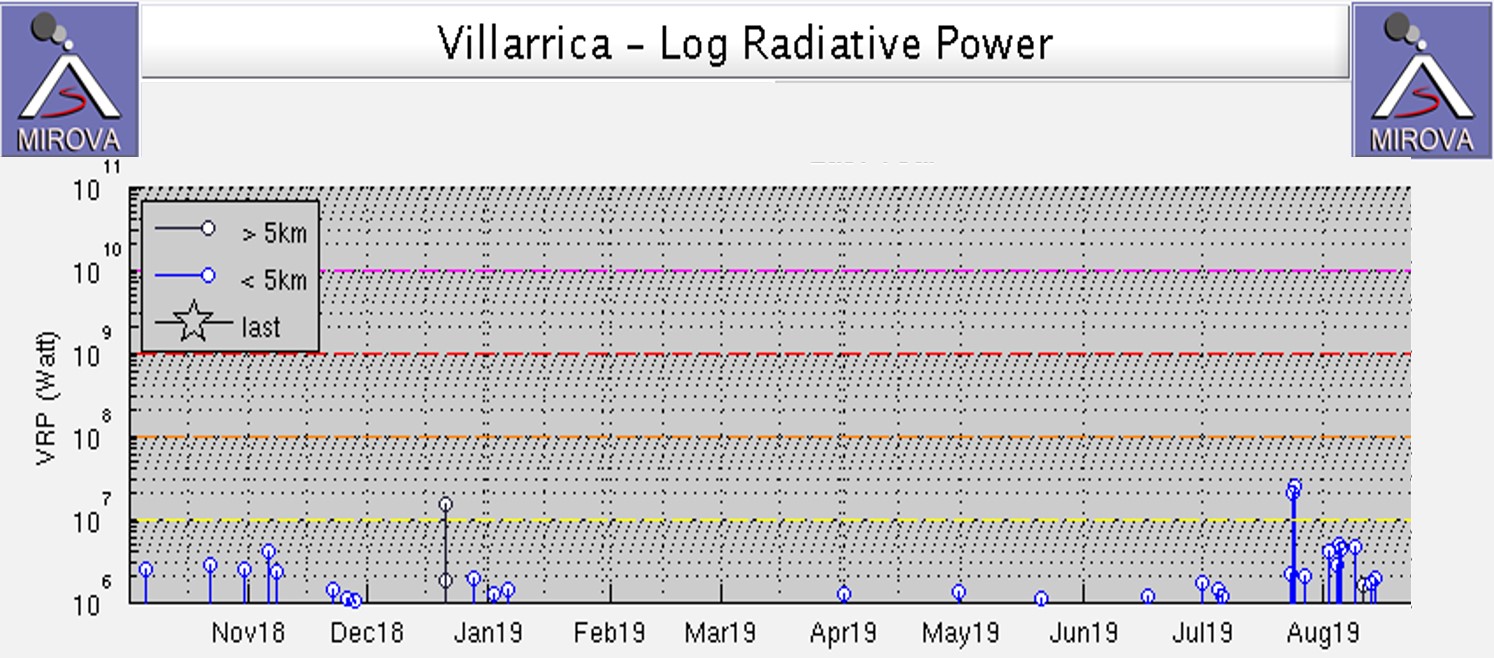
Thermal activity during the reporting period was relatively low; only one low-power thermal anomaly was detected during mid-July and one during early August, based on a MIROVA (Middle InfraRed Observation of Volcanic Activity) Log Radiative Power graph of the MODIS thermal anomaly data. On two clear weather days, a thermal anomaly was visible in infrared satellite images (figure 81).
Low-level activity was reported at the Otake crater during July and no explosions were detected. Eruption plumes rose as high as 1.8 km above the crater. On 13 July an ash plume rose 1.7 km above the crater rim, based on a webcam image. During the night of the 28th crater incandescence was visible in a webcam image. An eruptive event reported on 31 July produced an eruption plume that rose 2.1 km above the crater. Seismicity consisted of 11 volcanic earthquakes on the W flank, the number of which had decreased compared to June (28) and 68 volcanic earthquakes near the Otake crater, which had decreased from 722 in the previous month. According to observations conducted by the University of Tokyo Graduate School of Science, Kyoto University Disaster Prevention Research Institute, Toshima Village, and JMA, the amount of sulfur dioxide emissions released during the month was 400-800 tons per day (t/d).
Eruptive activity in the Otake crater continued during August and no explosions were reported. An eruptive event produced a plume that rose 1 km above the crater at 1447 on 12 August. Subsequent eruptive events were recorded at 0911 on 16 August, at 1303 on 20 August, and at 0317 on 21 August, which produced ash plumes that rose 1-1.1 km above the crater and drifted SE, SW, and W. On 22 August an ash plume was captured in a webcam image rising 1.4 km above the crater (figure 82). Multiple eruptive events were detected on 25 August at 0544, 0742, 0824, 1424, and 1704, which generated ash plumes that rose 1.1-1.2 km above the crater and drifted NE, W, and SW. On 28 August a small amount of ashfall was observed as far as 1.5 km from the crater. There were 17 volcanic earthquakes recorded on the W flank of the volcano and 79 recorded at the Otake crater during the month. The amount of sulfur dioxide emissions released during the month was 400-800 t/d.
Activity continued at the Otake crater during September. Occasionally, nighttime crater incandescence was observed in webcam images and ashfall was reported. An eruptive event at 1949 on 4 September produced an ash plume that rose 1 km above the crater and drifted SW. On 9 September several eruption events were detected at 0221, 0301, and 0333, which produced ash plumes that rose 1.1-1.4 km above the crater rim and drifted W; continuous ash emissions during 0404-0740 rose to a maximum height of 2 km above the crater rim (figure 83). More eruptive events were reported at 1437 on 10 September, at 0319 on 11 September, and at 0511 and 1228 on 15 September, which generated ash plumes that rose 1-1.8 km above the crater. During 25, 27, and 30 September, ash plumes rose as high as 1.3 km above the crater rim. JMA reported that large blocks were ejected as far as 300 m from the center of the crater. There were 18 volcanic earthquakes detected beneath the W flank and 82 volcanic earthquakes detected near the Otake crater. The amount of sulfur dioxide released during the month ranged from 600 to 1,600 t/d.
Activity during early-to-mid-October consisted of occasional explosions, a total number of 13, and ash plumes that rose as high as 1.9 km above the Otake crater rim on 29 October (figure 84). These explosions are the first to have occurred since June 2023. Continuous ash emissions were reported during 0510-0555 on 1 October. Explosions were recorded at 0304, 2141, and 2359 on 2 October, at 0112 on 3 October, and at 1326 on 6 October, which produced ash plumes that rose as high as 1 km above the crater rim and drifted SW and W. An explosion was noted at 0428 on 3 October, but emission details were unknown. A total of eight explosions were recorded by the seismic network at 1522 on 14 October, at 0337, 0433, 0555, 1008, and 1539 on 15 October, and at 0454 and 0517 on 16 October. Ash plumes from these explosions rose as high as 900 m above the crater and drifted SE. Eruptive events during 25-27 and 29-30 October generated plumes that rose as high as 1.9 km above the crater and drifted SE, S, and SW. Ash was deposited in Toshima village (3.5 km SSW). Eruptive activity occasionally ejected large volcanic blocks as far as 600 m from the crater. Nighttime crater incandescence was visible in webcams. Intermittent ashfall was reported as far as 1.5 km from the crater. There were 43 volcanic earthquakes detected on the W flank during the month, and 184 volcanic earthquakes detected near the Otake crater. The amount of sulfur dioxide emitted ranged between 400 and 900 t/d.
Geologic Background. The 8-km-long island of Suwanosejima in the northern Ryukyu Islands consists of an andesitic stratovolcano with two active summit craters. The summit is truncated by a large breached crater extending to the sea on the E flank that was formed by edifice collapse. One of Japan's most frequently active volcanoes, it was in a state of intermittent Strombolian activity from Otake, the NE summit crater, between 1949 and 1996, after which periods of inactivity lengthened. The largest recorded eruption took place in 1813-14, when thick scoria deposits covered residential areas, and the SW crater produced two lava flows that reached the western coast. At the end of the eruption the summit of Otake collapsed, forming a large debris avalanche and creating an open collapse scarp extending to the eastern coast. The island remained uninhabited for about 70 years after the 1813-1814 eruption. Lava flows reached the eastern coast of the island in 1884. Only about 50 people live on the island.
Information Contacts: Japan Meteorological Agency (JMA), 1-3-4 Otemachi, Chiyoda-ku, Tokyo 100-8122, Japan (URL: http://www.jma.go.jp/jma/indexe.html); MIROVA (Middle InfraRed Observation of Volcanic Activity), a collaborative project between the Universities of Turin and Florence (Italy) supported by the Centre for Volcanic Risk of the Italian Civil Protection Department (URL: http://www.mirovaweb.it/); Hawai'i Institute of Geophysics and Planetology (HIGP) - MODVOLC Thermal Alerts System, School of Ocean and Earth Science and Technology (SOEST), Univ. of Hawai'i, 2525 Correa Road, Honolulu, HI 96822, USA (URL: http://modis.higp.hawaii.edu/); Copernicus Browser, Copernicus Data Space Ecosystem, European Space Agency (URL: https://dataspace.copernicus.eu/browser/).
Etna
Italy
37.748°N, 14.999°E; summit elev. 3357 m
All times are local (unless otherwise noted)
Strombolian explosions, lava fountains, and lava flows during July-August 2023
Etna, located on the Italian island of Sicily, has had documented eruptions dating back to 1500 BCE. Activity typically originates from multiple cones at the summit, where several craters have formed and evolved. The currently active craters are Northeast Crater (NEC), Voragine (VOR), and Bocca Nuova (BN), and the Southeast Crater (SEC); VOR and BN were previously referred to as the “Central Crater”. The original Southeast crater formed in 1978, and a second eruptive site that opened on its SE flank in 2011 was named the New Southeast Crater (NSEC). Another eruptive site between the SEC and NSEC developed during early 2017 and was referred to as the "cono della sella" (saddle cone). The current eruption period began in November 2022 and has been characterized by intermittent Strombolian activity, lava flows, and ash plumes (BGVN 48:08). This report updates activity during July through October 2023, which includes primarily gas-and-steam emissions; during July and August Strombolian explosions, lava fountains, and lava flows were reported, based on weekly and special reports by the Osservatorio Etneo (OE), part of the Catania Branch of Italy's Istituo Nazionale di Geofisica e Vulcanologica (INGV) and satellite data.
Variable fumarolic degassing was reported at all summit craters (BN, VOR, NEC, and SEC) throughout the entire reporting period (table 15). The MIROVA (Middle InfraRed Observation of Volcanic Activity) volcano hotspot detection system based on the analysis of MODIS data showed frequent low-to-moderate power thermal anomalies during the reporting period (figure 399). During mid-August there was a pulse in activity that showed an increase in the power of the anomalies due to Strombolian activity, lava fountains, and lava flows. Infrared satellite imagery captured strong thermal anomalies at the central and southeast summit crater areas (figure 400). Accompanying thermal activity were occasional sulfur dioxide plumes that exceeded 2 Dobson Units (DUs) recorded by the TROPOMI instrument on the Sentinel-5P satellite (figure 401).
Table 15. Summary of activity at the four primary crater areas at the summit of Etna during July-October 2023. Information is from INGV weekly reports.
| Month |
Bocca Nuova (BN) |
Voragine (VOR) |
Northeast Crater (NEC) |
Southeast Crater (SEC) |
| Jul 2023 |
Continuous degassing. |
No observations. |
Weak gas emissions. |
Continuous degassing. Sporadic and weak-to-moderate ash emissions. Strombolian explosions. |
| Aug 2023 |
Continuous degassing. |
No observations. |
No observations. |
Continuous degassing. Occasional ash emissions. Strombolian activity, lava fountaining, and lava flows. |
| Sep 2023 |
Variable degassing. Crater incandescence. |
Weak fumarolic activity. |
Weak fumarolic activity. |
Variable degassing. |
| Oct 2023 |
Continuous degassing. |
Weak fumarolic activity. |
Weak fumarolic activity. |
Continuous degassing. |
Activity during July and August was relatively low and mainly consisted of degassing at the summit craters, particularly at SEC and BN. Cloudy weather prevented clear views of the summit during early July. During the night of 2 July some crater incandescence was visible at SEC. Explosive activity resumed at SEC during 9-10 July, which was characterized by sporadic and weak ash emissions that rapidly dispersed in the summit area (figure 402). INGV reported moderate Strombolian activity began at 2034 on 14 July and was confined to the inside of the crater and fed by a vent located in the E part of SEC. An ash emission was detected at 2037. A new vent opened on 15 July in the SE part of BN and began to produce continuous gas-and-steam emissions. During an inspection carried out on 28 July pulsating degassing, along with audible booms, were reported at two active vents in BN. Vigorous gas-and-steam emissions intermittently generated rings. On rare occasions, fine, reddish ash was emitted from BN1 and resuspended by the gas-and-steam emissions.
Around 2000 on 13 August INGV reported a sudden increase in volcanic tremor amplitude. Significant infrasonic activity coincided with the tremor increase. Incandescent flashes were visible through the cloud cover in webcam images of SEC (figure 403). Strombolian activity at SEC began to gradually intensify starting at 2040 as seismicity continued to increase. The Aviation Color Code (ACC) was raised to Yellow (the second lowest-level on a four-color scale) at 2126 and then to Orange (the second highest-level on a four-color scale) at 2129 due to above-background activity. The activity rapidly transitioned from Strombolian activity to lava fountains around 2333 that rose 300-400 m above the crater (figure 403). Activity was initially focused on the E vent of the crater, but then the vent located above the S flank of the cone also became active. A lava flow from this vent traveled SW into the drainage created on 10 February 2022, overlapping with previous flows from 10 and 21 February 2022 and 21 May 2023, moving between Monte Barbagallo and Monte Frumento Supino (figure 404). The lava flow was 350 m long, oriented NNE-SSW, and descended to an elevation of 2.8 km. Flows covered an area of 300,000 m2 and had an estimated volume of 900,000 m3. The ACC was raised to Red at 2241 based on strong explosive activity and ashfall in Rifugio Sapienza-Piano Vetore at 1.7 km elevation on the S flank. INGV reported that pyroclastic flows accompanied this activity.
Activity peaked between 0240 and 0330 on 14 August, when roughly 5-6 vents erupted lava fountains from the E to SW flank of SEC. The easternmost vents produced lava fountains that ejected material strongly to the E, which caused heavy fallout of incandescent pyroclastic material on the underlying flank, triggering small pyroclastic flows. This event was also accompanied by lightning both in the ash column and in the ash clouds that were generated by the pyroclastic flows. A fracture characterized by a series of collapse craters (pit craters) opened on the upper SW flank of SEC. An ash cloud rose a few kilometers above the crater and drifted S, causing ash and lapilli falls in Rifugio Sapienza and expanding toward Nicolosi, Mascalucia, Catania, and up to Syracuse. Ashfall resulted in operational problems at the Catania airport (50 km S), which lasted from 0238 until 2000. By 0420 the volcanic tremor amplitude values declined to background levels. After 0500 activity sharply decreased, although the ash cloud remained for several hours and drifted S. By late morning, activity had completely stopped. The ACC was lowered to Orange as volcanic ash was confined to the summit area. Sporadic, minor ash emissions continued throughout the day. At 1415 the ACC was lowered to Yellow and then to Green at 1417.
During the night of 14-15 August only occasional flashes were observed, which were more intense during avalanches of material inside the eruptive vents. Small explosions were detected at SEC at 2346 on 14 August and at 0900 on 26 August that each produced ash clouds which rapidly dispersed into the atmosphere (figure 405). According to a webcam image, an explosive event detected at 2344 at SEC generated a modest ash cloud that was rapidly dispersed by winds. The ACC was raised to Yellow at 2355 on 14 August due to increasing unrest and was lowered to Green at 0954 on 15 August.
Activity during September and October was relatively low and mainly characterized by variable degassing from BN and SEC. Intense, continuous, and pulsating degassing was accompanied by roaring sounds and flashes of incandescence at BN both from BN1 and the new pit crater that formed during late July (figure 406). The degassing from the new pit crater sometimes emitted vapor rings. Cloudy weather during 6-8 September prevented observations of the summit craters .
Geologic Background. Mount Etna, towering above Catania on the island of Sicily, has one of the world's longest documented records of volcanism, dating back to 1500 BCE. Historical lava flows of basaltic composition cover much of the surface of this massive volcano, whose edifice is the highest and most voluminous in Italy. The Mongibello stratovolcano, truncated by several small calderas, was constructed during the late Pleistocene and Holocene over an older shield volcano. The most prominent morphological feature of Etna is the Valle del Bove, a 5 x 10 km caldera open to the east. Two styles of eruptive activity typically occur, sometimes simultaneously. Persistent explosive eruptions, sometimes with minor lava emissions, take place from one or more summit craters. Flank vents, typically with higher effusion rates, are less frequently active and originate from fissures that open progressively downward from near the summit (usually accompanied by Strombolian eruptions at the upper end). Cinder cones are commonly constructed over the vents of lower-flank lava flows. Lava flows extend to the foot of the volcano on all sides and have reached the sea over a broad area on the SE flank.
Information Contacts: Sezione di Catania - Osservatorio Etneo, Istituto Nazionale di Geofisica e Vulcanologia (INGV), Sezione di Catania, Piazza Roma 2, 95123 Catania, Italy (URL: http://www.ct.ingv.it/it/); MIROVA (Middle InfraRed Observation of Volcanic Activity), a collaborative project between the Universities of Turin and Florence (Italy) supported by the Centre for Volcanic Risk of the Italian Civil Protection Department (URL: http://www.mirovaweb.it/); NASA Global Sulfur Dioxide Monitoring Page, Atmospheric Chemistry and Dynamics Laboratory, NASA Goddard Space Flight Center (NASA/GSFC), 8800 Greenbelt Road, Goddard MD 20771, USA (URL: https://so2.gsfc.nasa.gov/); Copernicus Browser, Copernicus Data Space Ecosystem, European Space Agency (URL: https://dataspace.copernicus.eu/browser/).
Aira
Japan
31.5772°N, 130.6589°E; summit elev. 1117 m
All times are local (unless otherwise noted)
Explosions, ash plumes, ash fall, and crater incandescence during July-October 2023
Aira caldera, located in the northern half of Kagoshima Bay, Japan, contains the post-caldera Sakurajima volcano. Eruptions typically originate from the Minamidake crater, and since the 8th century, ash deposits have been recorded in the city of Kagoshima (10 km W), one of Kyushu’s largest cities. The Minamidake summit cone and crater has had persistent activity since 1955; the Showa crater on the E flank has also been intermittently active since 2006. The current eruption period began during March 2017 and has recently been characterized by intermittent explosions, eruption plumes, and ashfall (BGVN 48:07). This report updates activity during July through October 2023 and describes explosive events, ash plumes, nighttime crater incandescence, and ashfall, according to monthly activity reports from the Japan Meteorological Agency (JMA) and satellite data.
Thermal activity remained at low levels during this reporting period, according to the MIROVA (Middle InfraRed Observation of Volcanic Activity) system (figure 149). There was a slight increase in the number of anomalies during September through October. Occasional thermal anomalies were visible in infrared satellite images mainly at the Minamidake crater (Vent A is located to the left and Vent B is located to the right) (figure 150).
Table 30. Number of monthly explosive events, days of ashfall, area of ash covered, and sulfur dioxide emissions from Sakurajima’s Minamidake crater at Aira during July-October 2023. Note that smaller ash events are not listed. Ashfall days were measured at Kagoshima Local Meteorological Observatory and ashfall amounts represent material covering all the Kagoshima Prefecture. Data courtesy of JMA monthly reports.
| Month |
Explosive events |
Days of ashfall |
Ashfall amount (g/m2) |
SO2 emissions (tons/day) |
| Jul 2023 |
3 |
0 |
0 |
1,600-3,200 |
| Aug 2023 |
3 |
10 |
7 |
1,800-3,300 |
| Sep 2023 |
3 |
7 |
3 |
1,600-2,300 |
| Oct 2023 |
33 |
8 |
61 |
2,200-4,200 |
JMA reported that during July, there were eight eruptions, three of which were explosion events in the Showa crater. Large blocks were ejected as far as 600 m from the Showa crater. Very small eruptions were occasionally reported at the Minamidake crater. Nighttime incandescence was observed in both the Showa and Minamidake crater. Explosions were reported on 16 July at 2314 and on 17 July at 1224 and at 1232 (figure 151). Resulting eruption plumes rose 700-2,500 m above the crater and drifted N. On 23 July the number of volcanic earthquakes on the SW flank of the volcano increased. A strong Mw 3.1 volcanic earthquake was detected at 1054 on 26 July. The number of earthquakes recorded throughout the month was 545, which markedly increased from 73 in June. No ashfall was observed at the Kagoshima Regional Meteorological Observatory during July. According to a field survey conducted during the month, the daily amount of sulfur dioxide emissions was 1,600-3,200 tons per day (t/d).
There were three eruptions reported at the Minamidake crater during August, each of which were explosive. The explosions occurred on 9 August at 0345, on 13 August at 2205, and on 31 August at 0640, which generated ash plumes that rose 800-2,000 m above the crater and drifted W. There were two eruptions detected at Showa crater; on 4 August at 2150 ejecta traveled 800 m from the Showa crater and associated eruption plumes rose 2.3 km above the crater. The explosion at 2205 on 13 August generated an ash plume that rose 2 km above the crater and was accompanied by large blocks that were ejected 600 m from the Minamidake crater (figure 152). Nighttime crater incandescence was visible in a high-sensitivity surveillance camera at both craters. Seismicity consisted of 163 volcanic earthquakes, 84 of which were detected on the SW flank. According to the Kagoshima Regional Meteorological Observatory there was a total of 7 g/m2 of ashfall over the course of 10 days during the month. According to a field survey, the daily amount of sulfur dioxide emitted was 1,800-3,300 t/d.
During September, four eruptions were reported, three of which were explosion events. These events occurred at 1512 on 9 September, at 0018 on 11 September, and at 2211 on 13 September. Resulting ash plumes generally rose 800-1,100 m above the crater. An explosion produced an ash plume at 2211 on 13 September that rose as high as 1.7 km above the crater. Large volcanic blocks were ejected 600 m from the Minamidake crater. Smaller eruptions were occasionally observed at the Showa crater. Nighttime crater incandescence was visible at the Minamidake crater. Seismicity was characterized by 68 volcanic earthquakes, 28 of which were detected beneath the SW flank. According to the Kagoshima Regional Meteorological Observatory there was a total of 3 g/m2 of ashfall over the course of seven days during the month. A field survey reported that the daily amount of sulfur dioxide emitted was 1,600-2,300 t/d.
Eruptive activity during October consisted of 69 eruptions, 33 of which were described as explosive. These explosions occurred during 4 and 11-21 October and generated ash plumes that rose 500-3,600 m above the crater and drifted S, E, SE, and N. On 19 October at 1648 an explosion generated an ash plume that rose 3.6 km above the crater (figure 153). No eruptions were reported in the Showa crater; white gas-and-steam emissions rose 100 m above the crater from a vent on the N flank. Nighttime incandescence was observed at the Minamidake crater. On 24 October an eruption was reported from 0346 through 0430, which included an ash plume that rose 3.4 km above the crater. Ejected blocks traveled 1.2 km from the Minamidake crater. Following this eruption, small amounts of ashfall were observed from Arimura (4.5 km SE) and a varying amount in Kurokami (4 km E) (figure 154). The number of recorded volcanic earthquakes during the month was 190, of which 14 were located beneath the SW flank. Approximately 61 g/m2 of ashfall was reported over eight days of the month. According to a field survey, the daily amount of sulfur dioxide emitted was 2,200-4,200 t/d.
Geologic Background. The Aira caldera in the northern half of Kagoshima Bay contains the post-caldera Sakurajima volcano, one of Japan's most active. Eruption of the voluminous Ito pyroclastic flow accompanied formation of the 17 x 23 km caldera about 22,000 years ago. The smaller Wakamiko caldera was formed during the early Holocene in the NE corner of the caldera, along with several post-caldera cones. The construction of Sakurajima began about 13,000 years ago on the southern rim and built an island that was joined to the Osumi Peninsula during the major explosive and effusive eruption of 1914. Activity at the Kitadake summit cone ended about 4,850 years ago, after which eruptions took place at Minamidake. Frequent eruptions since the 8th century have deposited ash on the city of Kagoshima, located across Kagoshima Bay only 8 km from the summit. The largest recorded eruption took place during 1471-76.
Information Contacts: Japan Meteorological Agency (JMA), 1-3-4 Otemachi, Chiyoda-ku, Tokyo 100-8122, Japan (URL: http://www.jma.go.jp/jma/indexe.html); MIROVA (Middle InfraRed Observation of Volcanic Activity), a collaborative project between the Universities of Turin and Florence (Italy) supported by the Centre for Volcanic Risk of the Italian Civil Protection Department (URL: http://www.mirovaweb.it/); Copernicus Browser, Copernicus Data Space Ecosystem, European Space Agency (URL: https://dataspace.copernicus.eu/browser/).
Nishinoshima (Japan) — November 2023 Cite this Report
Nishinoshima
Japan
27.247°N, 140.874°E; summit elev. 100 m
All times are local (unless otherwise noted)
Gray emissions during October 2023
Nishinoshima is a small island in the Ogasawara Arc, about 1,000 km S of Tokyo, Japan. It contains prominent submarine peaks to the S, W, and NE. Recorded eruptions date back to 1973, with the current eruption period beginning in October 2022. Eruption plumes and fumarolic activity characterize recent activity (BGVN 48:10). This report covers the end of the eruption for September through October 2023, based on information from monthly reports of the Japan Meteorological Agency (JMA) monthly reports, and satellite data.
No eruptive activity was reported during September 2023, although JMA noted that the surface temperature was slightly elevated compared to the surrounding area since early March 2023. The Japan Coast Guard (JCG) conducted an overflight on 20 September and reported white gas-and-steam plumes rising 3 km above the central crater of the pyroclastic cone, as well as multiple white gas-and-steam emissions emanating from the N, E, and S flanks of the crater to the coastline. In addition, dark reddish brown-to-green discolored water was distributed around almost the entire circumference of the island.
Similar low-level activity was reported during October. Multiple white gas-and-steam emissions rose from the N, E, and S flanks of the central crater of the pyroclastic cone and along the coastline; these emissions were more intense compared to the previous overflight observations. Dark reddish brown-to-green discolored water remained visible around the circumference of the island. On 4 October aerial observations by JCG showed a small eruption consisting of continuous gas-and-steam emissions emanating from the central crater, with gray emissions rising to 1.5 km altitude (figure 129). According to observations from the marine weather observation vessel Keifu Maru on 26 October, white gas-and-steam emissions persisted from the center of the pyroclastic cone, as well as from the NW, SW, and SE coasts of the island for about five minutes. Slightly discolored water was visible up to about 1 km.
Frequent low-to-moderate power thermal anomalies were recorded in the MIROVA graph (Middle InfraRed Observation of Volcanic Activity) during September (figure 130). Occasional anomalies were detected during October, and fewer during November through December. A thermal anomaly was visible in the crater using infrared satellite imagery on 6, 8, 11, 16, 18, 21, and 23 September and 8, 13, 21, 26, and 28 October (figure 131).
Geologic Background. The small island of Nishinoshima was enlarged when several new islands coalesced during an eruption in 1973-74. Multiple eruptions that began in 2013 completely covered the previous exposed surface and continued to enlarge the island. The island is the summit of a massive submarine volcano that has prominent peaks to the S, W, and NE. The summit of the southern cone rises to within 214 m of the ocean surface 9 km SSE.
Information Contacts: Japan Meteorological Agency (JMA), 1-3-4 Otemachi, Chiyoda-ku, Tokyo 100-8122, Japan (URL: http://www.jma.go.jp/jma/indexe.html); MIROVA (Middle InfraRed Observation of Volcanic Activity), a collaborative project between the Universities of Turin and Florence (Italy) supported by the Centre for Volcanic Risk of the Italian Civil Protection Department (URL: http://www.mirovaweb.it/); Copernicus Browser, Copernicus Data Space Ecosystem, European Space Agency (URL: https://dataspace.copernicus.eu/browser/).
Kilauea (United States) — October 2023 Cite this Report
Kilauea
United States
19.421°N, 155.287°W; summit elev. 1222 m
All times are local (unless otherwise noted)
Strong lava fountains, lava flows, and spatter at Halema’uma’u during January-September 2023
Kīlauea is on the island of Hawai’i and overlaps the E flank of the Mauna Loa volcano. Its East Rift Zone (ERZ) has been intermittently active for at least 2,000 years. An extended eruption period began in January 1983 and was characterized by open lava lakes and lava flows from the summit caldera and the East Rift Zone. During May 2018 magma migrated into the Lower East Rift Zone (LERZ) and opened 24 fissures along a 6-km-long NE-trending fracture zone that produced lava flows traveling in multiple directions. As lava emerged from the fissures, the lava lake at Halema'uma'u drained and explosions sent ash plumes to several kilometers altitude (BGVN 43:10).
The current eruption period started during September 2021 and has been characterized by low-level lava effusions in the active Halema’uma’u lava lake (BGVN 48:01). This report covers three notable eruption periods during February, June, and September 2023 consisting of lava fountaining, lava flows, and spatter during January through September 2023 using information from daily reports, volcanic activity notices, and abundant photo, map, and video data from the US Geological Survey's (USGS) Hawaiian Volcano Observatory (HVO).
Activity during January 2023. Small earthquake swarms were recorded on 2 January 2023; increased seismicity and changes in the pattern of deformation were noted on the morning of 5 January. At around 1500 both the rate of deformation and seismicity drastically increased, which suggested magma movement toward the surface. HVO raised the Volcano Alert Level (VAL) to Watch (the second highest level on a four-level scale) and the Aviation Color Code (ACC) to Orange (the second highest color on a four-color scale) at 1520.
Multiple lava fountains and lava effusions from vents in the central eastern portion of the Halema’uma’u crater began on 5 January around 0434; activity was confined to the eastern half of the crater and within the basin of the western half of the crater, which was the focus of the eruption in 2021-2022 (figure 525). Incandescence was visible in webcam images at 1634 on 5 January, prompting HVO to raise the VAL to Warning (the highest level on a four-level scale) and the ACC to Red (the highest color on a four-color scale). Lava fountains initially rose as high as 50 m above the vent at the onset of the eruption (figure 526) but then declined to a more consistent 5-6 m height in the proceeding days. By 1930 that same day, lava had covered most of the crater floor (an area of about 1,200,000 m2) and the lava lake had a depth of 10 m. A higher-elevation island that formed during the initial phase of the December 2020 eruption remained exposed, appearing darker in images, along with a ring of older lava around the lava lake that was active prior to December 2022. Overnight during 5-6 January the lava fountains continued to rise 5 m high, and the lava effusion rate had slowed.
On 6 January at 0815 HVO lowered the VAL to Watch and the ACC to Orange due to the declining effusion rates. Sulfur dioxide emission rates ranged from 3,000-12,500 tonnes per day (t/d), the highest value of which was recorded on 6 January. Lava continued to erupt from the vents during 6-8 January, although the footprint of the active area had shrunk; a similar progression has been commonly observed during the early stages of recent eruptions at Halema’uma’u. On 9 January HVO reported one dominant lava fountain rising 6-7 m high in the E half of the crater. Lava flows built up the margins of the lake, causing the lake to be perched. On 10 January the eastern lava lake had an area of approximately 120,000 m2 that increased to 250,000 m2 by 17 January. During 13-31 January several small overflows occurred along the margins of the E lake. A smaller area of lava was active within the basin in the W half of the crater that had been the focus of activity during 2021-2022. On 19 January just after 0200 a small ooze-out was observed on the crater’s W edge.
Activity during February 2023. Activity continued in the E part of Halema’uma’u crater, as well as in a smaller basin in the W part of the 2021-2022 lava lake (figure 527). The E lava lake contained a single lava fountain and frequent overflows. HVO reported that during the morning of 1 February the large E lava lake began to cool and crust over in the center of the lake; two smaller areas of lava were observed on the N and S sides by the afternoon. The dominant lava fountain located in the S part of the lava lake paused for roughly 45 minutes at 2315 and resumed by midnight, rising 1-2 m. At 0100 on 2 February lava from the S part was effusing across the entire E lava lake area, covering the crusted over portion in the center of the lake and continuing across the majority of the previously measured 250,000 m2 by 0400. A small lava pond near the E lake produced an overflow around 0716 on 2 February. On 3 February some lava crust began to form against the N and E levees, which defined the 250,000 m2 eastern lava lake. The small S lava fountain remained active, rising 1-6 m high during 3-9 February; around 0400 on 5 February occasional bursts doubled the height of the lava fountain.
A large breakout occurred overnight during 2100 on 4 February to 0900 on 5 February on the N part of the crater floor, equal to or slightly larger in size than the E lava lake. A second, smaller lava fountain appeared in the same area of the E lava lake between 0300 and 0700 on 5 February and was temporarily active. This large breakout continued until 7 February. A small, brief breakout was reported in the S of the E lava lake around midnight on 7 February. In the W lake, as well as the smaller lava pond in the central portion of the crater floor, contained several overflows during 7-10 February and intermittent fountaining. Activity at the S small lava pond and the small S lava fountain within the E lake declined during 9-10 February. The lava pond in the central portion of the crater floor had nearly continuous, expansive flows during 10-13 February; channels from the small central lava pond seemed to flow into the larger E lake. During 13-18 February a small lava fountain was observed in the small lava pond in the central portion of the crater floor. Continuous overflows persisted during this time.
Activity in the eastern and central lakes began to decline in the late afternoon of 17 February. By 18 February HVO reported that the lava effusions had significantly declined, and that the eastern and central lakes were no longer erupting. The W lake in the basin remained active but at a greatly reduced level that continued to decline. HVO reported that this decrease in activity is attributed to notable deflationary tilt that began early on the morning of 17 February and lasted until early 19 February. By 19 February the W lake was mostly crusted over although some weak lava flows remained, which continued through 28 February. The sulfur dioxide emission rates ranged 250-2,800 t/d, the highest value of which was recorded on 6 February.
Activity during March 2023. The summit eruption at Halema’uma’u crater continued at greatly reduced levels compared to the previous two months. The E and central vents stopped effusing lava, and the W lava lake remained active with weak lava flows; the lake was mostly crusted over, although slowly circulating lava intermittently overturned the crust. By 6 March the lava lake in the W basin had stopped because the entire surface was crusted over. The only apparent surface eruptive activity during 5-6 March was minor ooze-outs of lava onto the crater floor, which had stopped by 7 March. Several hornitos on the crater floor still glowed through 12 March according to overnight webcam images, but they did not erupt any lava. A small ooze-out of lava was observed just after 1830 in the W lava lake on 8 March, which diminished overnight. The sulfur dioxide emission rate ranged from 155-321 t/d on 21 March. The VAL was lowered to Advisory, and the ACC was lowered to Yellow (the second lowest on a four-color scale) on 23 March due to a pause in the eruption since 7 March.
Activity during April-May 2023. The eruption at Halema’uma’u crater was paused; no lava effusions were visible on the crater floor. Sulfur dioxide emission rates ranged from 75-185 t/d, the highest of which was measured on 22 April. During May and June summit seismicity was elevated compared to seismicity that preceded the activity during January.
Activity during June 2023. Earthquake activity and changes in the patterns of ground deformation beneath the summit began during the evening of 6 June. The data indicated magma movement toward the surface, prompting HVO to raise the VAL to Watch and the ACC to Orange. At about 0444 on 7 June incandescence in Halema’uma’u crater was visible in webcam images, indicating that a new eruption had begun. HVO raised the VAL to Warning and the ACC to Red (the highest color on a four-color scale). Lava flowed from fissures that had opened on the crater floor. Multiple minor lava fountains were active in the central E portion of the Halema’uma’u crater, and one vent opened on the W wall of the caldera (figure 528). The eruptive vent on the SW wall of the crater continued to effuse into the lava lake in the far SW part of the crater (figure 529). The largest lava fountain consistently rose 15 m high; during the early phase of the eruption, fountain bursts rose as high as 60 m. Lava flows inundated much of the crater floor and added about 6 m depth of new lava within a few hours, covering approximately 10,000 m2. By 0800 on 7 June lava filled the crater floor to a depth of about 10 m. During 0800-0900 the sulfur dioxide emission rate was about 65,000 t/d. Residents of Pahala (30 km downwind of the summit) reported minor deposits of fine, gritty ash and Pele’s hair. A small spatter cone had formed at the vent on the SW wall by midday, and lava from the cone was flowing into the active lava lake. Fountain heights had decreased from the onset of the eruption and were 4-9 m high by 1600, with occasional higher bursts. Inflation switched to deflation and summit earthquake activity greatly diminished shortly after the eruption onset.
At 0837 on 8 June HVO lowered the VAL to Watch and the ACC to Orange because the initial high effusion rates had declined, and no infrastructure was threatened. The surface of the lava lake had dropped by about 2 m, likely due to gas loss by the morning of 8 June. The drop left a wall of cooled lava around the margins of the crater floor. Lava fountain heights decreased during 8-9 June but continued to rise to 10 m high. Active lava and vents covered much of the W half of Halema’uma’u crater in a broad, horseshoe-shape around a central, uplifted area (figure 530). The preliminary average effusion rate for the first 24 hours of the eruption was about 150 cubic meters per second, though the estimate did not account for vesiculated lava and variations in crater floor topography. The effusion rate during the very earliest phases of the eruption appeared significantly higher than the previous three summit eruptions based on the rapid coverage of the entire crater floor. An active lava lake, also referred to as the “western lava lake” was centered within the uplifted area and was fed by a vent in the NE corner. Two small active lava lakes were located just SE from the W lava lake and in the E portion of the crater floor.
During 8-9 June the lava in the central lava lake had a thickness of approximately 1.5 m, based on measurements from a laser rangefinder. During 9-12 June the height of the lava fountains decreased to 9 m high. HVO reported that the previously active lava lake in the E part of the crater appeared stagnant during 10-11 June. The surface of the W lake rose approximately 1 m overnight during 11-12 June, likely due to the construction of a levee around it. Only a few small fountains were active during 12-13 June; the extent of the active lava had retreated so that all activity was concentrated in the SW and central parts of Halema’uma’u crater. Intermittent spattering from the vent on the SW wall was visible in overnight webcam images during 13-18 June. On the morning of 14 June a weak lava effusion originated from near the western eruptive vent, but by 15 June there were no signs of continued activity. HVO reported that other eruptive vents in the SW lava lake had stopped during this time, following several days of waning activity; lava filled the lake by about 0.5 m. Lava circulation continued in the central lake and no active lava was reported in the northern or eastern parts of the crater. Around 0800 on 15 June the top of the SW wall spatter cone collapsed, which was followed by renewed and constant spattering from the top vent and a change in activity from the base vent; several new lava flows effused from the top of the cone, as well as from the pre-existing tube-fed flow from its base. Accumulation of lava on the floor resulted in a drop of the central basin relative to the crater floor, allowing several overflows from the SW lava lake to cascade into the basin during the night of 15 June into the morning of 16 June.
Renewed lava fountaining was reported at the eruptive vent on the SW side of the crater during 16-19 June, which effused lava into the far SW part of the crater. This activity was described as vigorous during midday on 16 June; a group of observatory geologists estimated that the lava was consistently ejected at least 10 m high, with some spatter ejected even higher and farther. Deposits from the fountain further heightened and widened the spatter cone built around the original eruptive vent in the lower section of the crater wall. Multiple lava flows from the base of the cone were fed into the SW lava lake and onto the southwestern-most block from the 2018 collapse within Halema’uma’u on 17 June (figure 531); by 18 June they focused into a single flow feeding into the SW lava lake. On the morning of 19 June a second lava flow from the base of the eruptive cone advanced into the SW lava lake.
Around 1600 on 19 June there was a rapid decline in lava fountaining and effusion at the eruptive vent on the SW side of the crater; vent activity had been vigorous up to that point (figure 532). Circulation in the lava lake also slowed, and the lava lake surface dropped by several meters. Overnight webcam images showed some previously eruptive lava still flowing onto the crater floor, which continued until those flows began to cool. By 21 June no lava was erupting in Halema’uma’u crater. Overnight webcam images during 29-30 June showed some incandescence from previously erupted lava flows as they continued to cool. Seismicity in the crater declined to low levels. Sulfur dioxide emission rates ranged 160-21,000 t/d throughout the month, the highest measurement of which was recorded on 8 June. On 30 June the VAL was lowered to Advisory (the second level on a four-level scale) and the ACC was lowered to Yellow. Gradual inflation was detected at summit tiltmeters during 19-30 June.
Activity during July-August 2023. During July, the eruption paused; no lava was erupting in Halema’uma’u crater. Nighttime webcam images showed some incandescence from previously erupted lava as it continued to cool on the crater floor. During the week of 14 August HVO reported that the rate in seismicity increased, with 467 earthquakes of Mw 3.2 and smaller occurring. Sulfur dioxide emission rates remained low, ranging from 75-86 t/d, the highest of which was recorded on 10 and 15 August. On 15 August beginning at 0730 and lasting for several hours, a swarm of approximately 50 earthquakes were detected at a depth of 2-3 km below the surface and about 2 km long directly S of Halema’uma’u crater. HVO reported that this was likely due to magma movement in the S caldera region. During 0130-0500 and 1700-2100 on 21 August two small earthquake swarms of approximately 20 and 25 earthquakes, respectively, occurred at the same location and at similar depths. Another swarm of 50 earthquakes were recorded during 0430-0830 on 23 August. Elevated seismicity continued in the S area through the end of the month.
Activity during September 2023. Elevated seismicity persisted in the S summit with occasional small, brief seismic swarms. Sulfur dioxide measurements were relatively low and were 70 t/d on 8 September. About 150 earthquakes occurred during 9-10 September, and tiltmeter and Global Positioning System (GPS) data showed inflation in the S portion of the crater.
At 0252 on 10 September HVO raised the VAL to Watch and the ACC to Orange due to increased earthquake activity and changes in ground deformation that indicated magma moving toward the surface. At 1515 the summit eruption resumed in the E part of the caldera based on field reports and webcam images. Fissures opened on the crater floor and produced multiple minor lava fountains and flows (figure 533). The VAL and ACC were raised to Warning and Red, respectively. Gas-and-steam plumes rose from the fissures and drifted downwind. A line of eruptive vents stretched approximately 1.4 km from the E part of the crater into the E wall of the down dropped block by 1900. The lava fountains at the onset of the eruption had an estimated 50 m height, which later rose 20-25 m high. Lava erupted from fissures on the down dropped block and expanded W toward Halema’uma’u crater. Data from a laser rangefinder recorded about 2.5 m thick of new lava added to the W part of the crater. Sulfur dioxide emissions were elevated in the eruptive area during 1600-1500 on 10 September, measuring at least 100,000 t/d.
At 0810 on 11 September HVO lowered the VAL and ACC back to Watch and Orange due to the style of eruption and the fissure location had stabilized. The initial extremely high effusion rates had declined (but remained at high levels) and no infrastructure was threatened. An eruption plume, mainly comprised of sulfur dioxide and particulates, rose as high as 3 km altitude. Several lava fountains were active on the W side of the down dropped block during 11-15 September, while the easternmost vents on the down dropped block and the westernmost vents in the crater became inactive on 11 September (figure 534). The remaining vents spanned approximately 750 m and trended roughly E-W. The fed channelized lava effusions flowed N and W into Halema’uma’u. The E rim of the crater was buried by new lava flows; pahoehoe lava flows covered most of the crater floor except areas of higher elevation in the SW part of the crater. The W part of the crater filled about 5 m since the start of the eruption, according to data from a laser rangefinder during 11-12 September. Lava fountaining continued, rising as high as 15 m by the morning of 12 September. During the morning of 13 September active lava flows were moving on the N and E parts of the crater. The area N of the eruptive vents that had active lava on its surface became perched and was about 3 m higher than the surrounding ground surface. By the morning of 14 September active lava was flowing on the W part of the down dropped block and the NE parts of the crater. The distances of the active flows progressively decreased. Spatter had accumulated on the S (downwind) side of the vents, forming ramparts about 20 m high.
Vigorous spattering was restricted to the westernmost large spatter cone with fountains rising 10-15 m high. Minor spattering occurred within the cone to the E of the main cone, but HVO noted that the fountains remained mostly below the rim of the cone. Lava continued to effuse from these cones and likely from several others as well, traveled N and W, confined to the W part of the down-dropped block and the NE parts of Halema’uma’u. Numerous ooze-outs of lava were visible over other parts of the crater floor at night. Laser range-finder measurements taken of the W part of the crater during 14-15 September showed that lava filled the crater by 10 m since the start of the eruption. Sulfur dioxide emissions remained elevated after the onset of the eruption, ranging 20,000-190,000 t/d during the eruption activity, the highest of which occurred on 10 September.
Field crews observed the eruptive activity on 15 September; they reported a notable decrease or stop in activity at several vents. Webcam images showed little to no fountaining since 0700 on 16 September, though intermittent spattering continued from the westernmost large cone throughout the night of 15-16 September. Thermal images showed that lava continued to flow onto the crater floor. On 16 September HVO reported that the eruption stopped around 1200 and that there was no observable activity anywhere overnight or on the morning of 17 September. HVO field crews reported that active lava was no longer flowing onto Halema’uma’u crater floor and was restricted to a ponded area N of the vents on the down dropped block. They reported that spattering stopped around 1115 on 16 September. Nighttime webcam images showed some incandescence on the crater floor as lava continued to cool. Field observations supported by geophysical data showed that eruptive tremor in the summit region decreased over 15-16 September and returned to pre-eruption levels by 1700 on 16 September. Sulfur dioxide emissions were measured at a rate of 800 t/d on 16 September while the eruption was waning, and 200 t/d on 17 September, which were markedly lower compared to measurements taken the previous week of 20,000-190,000 t/d.
Geologic Background. Kilauea overlaps the E flank of the massive Mauna Loa shield volcano in the island of Hawaii. Eruptions are prominent in Polynesian legends; written documentation since 1820 records frequent summit and flank lava flow eruptions interspersed with periods of long-term lava lake activity at Halemaumau crater in the summit caldera until 1924. The 3 x 5 km caldera was formed in several stages about 1,500 years ago and during the 18th century; eruptions have also originated from the lengthy East and Southwest rift zones, which extend to the ocean in both directions. About 90% of the surface of the basaltic shield volcano is formed of lava flows less than about 1,100 years old; 70% of the surface is younger than 600 years. The long-term eruption from the East rift zone between 1983 and 2018 produced lava flows covering more than 100 km2, destroyed hundreds of houses, and added new coastline.
Information Contacts: Hawaiian Volcano Observatory (HVO), U.S. Geological Survey, PO Box 51, Hawai'i National Park, HI 96718, USA (URL: http://hvo.wr.usgs.gov/).
Tinakula (Solomon Islands) — December 2023 Cite this Report
Tinakula
Solomon Islands
10.386°S, 165.804°E; summit elev. 796 m
All times are local (unless otherwise noted)
Continued lava flows and thermal activity during June through November 2023
Tinakula is a remote 3.5 km-wide island in the Solomon Islands, located 640 km ESE of the capital, Honiara. The current eruption period began in December 2018 and has more recently been characterized by intermittent lava flows and thermal activity (BGVN 48:06). This report covers similar activity during June through November 2023 using satellite data.
During clear weather days (20 July, 23 September, 23 October, and 12 November), infrared satellite imagery showed lava flows that mainly affected the W side of the island and were sometimes accompanied by gas-and-steam emissions (figure 54). The flow appeared more intense during July and September compared to October and November. According to the MODVOLC thermal alerts, there were a total of eight anomalies detected on 19 and 21 July, 28 and 30 October, and 16 November. Infrared MODIS satellite data processed by MIROVA (Middle InfraRed Observation of Volcanic Activity) detected a small cluster of thermal activity occurring during late July, followed by two anomalies during August, two during September, five during October, and five during November (figure 55).
Geologic Background. The small 3.5-km-wide island of Tinakula is the exposed summit of a massive stratovolcano at the NW end of the Santa Cruz islands. It has a breached summit crater that extends from the summit to below sea level. Landslides enlarged this scarp in 1965, creating an embayment on the NW coast. The Mendana cone is located on the SE side. The dominantly andesitic volcano has frequently been observed in eruption since the era of Spanish exploration began in 1595. In about 1840, an explosive eruption apparently produced pyroclastic flows that swept all sides of the island, killing its inhabitants. Recorded eruptions have frequently originated from a cone constructed within the large breached crater. These have left the upper flanks and the steep apron of lava flows and volcaniclastic debris within the breach unvegetated.
Information Contacts: MIROVA (Middle InfraRed Observation of Volcanic Activity), a collaborative project between the Universities of Turin and Florence (Italy) supported by the Centre for Volcanic Risk of the Italian Civil Protection Department (URL: http://www.mirovaweb.it/); Hawai'i Institute of Geophysics and Planetology (HIGP) - MODVOLC Thermal Alerts System, School of Ocean and Earth Science and Technology (SOEST), Univ. of Hawai'i, 2525 Correa Road, Honolulu, HI 96822, USA (URL: http://modis.higp.hawaii.edu/); Copernicus Browser, Copernicus Data Space Ecosystem, European Space Agency (URL: https://dataspace.copernicus.eu/browser/).
Search Bulletin Archive by Publication Date
Select a month and year from the drop-downs and click "Show Issue" to have that issue displayed in this tab.
The default month and year is the latest issue available.
Bulletin of the Global Volcanism Network - Volume 44, Number 09 (September 2019)
Asamayama (Japan)
Ashfall from phreatic eruptions on 7 and 25 August 2019
Lengai, Ol Doinyo (Tanzania)
Multiple lava flows within the summit crater, September 2018-August 2019
Popocatepetl (Mexico)
Frequent explosions continue during March-August 2019
Santa Maria (Guatemala)
Persistent explosions with local ashfall, March-August 2019; frequent lahars during June; increased explosions in early July
Semeru (Indonesia)
Intermittent activity continues during March-August 2019; ash plumes and thermal anomalies
Semisopochnoi (United States)
Small explosions detected between 16 July and 24 August 2019
Stromboli (Italy)
Major explosions on 3 July and 28 August 2019; hiker killed by ejecta
Ubinas (Peru)
Intermittent ash explosions in June-August 2019
Ulawun (Papua New Guinea)
Explosions on 26 June and 3 August 2019 send plumes above 19 km altitude
Villarrica (Chile)
Strombolian activity continued during March-August 2019 with an increase in July
Asamayama (Japan) — September 2019 Cite this Report
Asamayama
Japan
36.406°N, 138.523°E; summit elev. 2568 m
All times are local (unless otherwise noted)
Ashfall from phreatic eruptions on 7 and 25 August 2019
Asamayama (also known as Asama), located in the Kanto-Chubu Region of Japan, previously erupted in June 2015. Activity included increased volcanic seismicity, small eruptions which occasionally resulted in ashfall, and SO2 gas emissions (BGVN 41:10). This report covers activity through August 2019, which describes small phreatic eruptions, volcanic seismicity, faint incandescence and commonly white gas plumes, and fluctuating SO2 emissions. The primary source of information for this report is provided by the Japan Meteorological Agency (JMA).
Activity during October 2016-May 2019. From October 2016 through December 2017, a high-sensitivity camera captured faint incandescence at night accompanied by white gas plumes rising above the crater to an altitude ranging 100-800 m (figure 44). A thermal anomaly and faint incandescence accompanied by a white plume near the summit was observed at night on 6-7 and 21 January 2017. These thermal anomalies were recorded near the central part of the crater bottom in January, February, and November 2017, and in May 2019. After December 2017 the faint incandescence was not observed, with an exception on 18 July 2018.
Field surveys on 6, 16, and 28 December 2016 reported an increased amount of SO2 gas emissions from November 2016 (100-600 tons/day) to March 2017 (1,300-3,200 tons/day). In April 2017 the SO2 emissions decreased (600-1,500 tons/day). Low-frequency shallow volcanic tremors decreased in December 2016; none were observed in January 2017. From February 2017 through June 2018 volcanic tremors occurred more intermittently. According to the monthly JMA Reports on February 2017 and December 2018 and data from the Geographical Survey Institute's Global Navigation Satellite Systems (GNSS), a slight inflation between the north and south baseline was recorded starting in fall 2016 through December 2018. This growth become stagnant at some of the baselines in October 2017.
Activity during August 2019. On 7 August 2019 a small phreatic eruption occurred at the summit crater and continued for about 20 minutes, resulting in an ash plume that rose to a maximum altitude of 1.8 km, drifting N and an associated earthquake and volcanic tremor (figure 45). According to the Tokyo Volcanic Ash Advisory (VAAC), this plume rose 4.6 km, based on satellite data from HIMAWARI-8. A surveillance camera observed a large volcanic block was ejected roughly 200 m from the crater. According to an ashfall survey conducted by the Mobile Observation Team on 8 August, slight ashfall occurred in the Tsumagoi Village (12 km N) and Naganohara Town (19 km NE), Gunma Prefecture (figure 46 and 47). About 2 g/m2 of ash deposit was measured by the Tokyo Institute of Technology. Immediately after the eruption on 7 August, seismicity, volcanism, and SO2 emissions temporarily increased and then decreased that same day.
Another eruption at the summit crater on 25 August 2019 was smaller than the one on 7 August. JMA reported the resulting ash plume rose to an altitude of 600 m and drifted E. However, the Tokyo VAAC reported that the altitude of the plume up to 3.4 km, according to satellite data from HIMAWARI-8. A small amount of ashfall occurred in Karuizawa-machi, Nagano (4 km E), according to interview surveys and the Tokyo Institute of Technology.
Geologic Background. Asamayama, Honshu's most active volcano, overlooks the resort town of Karuizawa, 140 km NW of Tokyo. The volcano is located at the junction of the Izu-Marianas and NE Japan volcanic arcs. The modern Maekake cone forms the summit and is situated east of the remnant of an older andesitic volcano, Kurofuyama, which was destroyed by a late-Pleistocene landslide about 20,000 years before present (BP). Growth of a dacitic shield volcano was accompanied by pumiceous pyroclastic flows, the largest of which occurred about 14,000-11,000 BP, and by growth of the Ko-Asamayama lava dome on the east flank. Maekake, capped by the Kamayama pyroclastic cone that forms the present summit, is probably only a few thousand years old and has observed activity dating back at least to the 11th century CE. Maekake has had several major Plinian eruptions, the last two of which occurred in 1108 (Asamayama's largest Holocene eruption) and 1783 CE.
Information Contacts: Japan Meteorological Agency (JMA), 1-3-4 Otemachi, Chiyoda-ku, Tokyo 100-8122, Japan (URL: http://www.jma.go.jp/jma/indexe.html); Tokyo Volcanic Ash Advisory Center (VAAC), 1-3-4 Otemachi, Chiyoda-ku, Tokyo 100-8122, Japan (URL: http://ds.data.jma.go.jp/svd/vaac/data/).
Ol Doinyo Lengai (Tanzania) — September 2019 Cite this Report
Ol Doinyo Lengai
Tanzania
2.764°S, 35.914°E; summit elev. 2962 m
All times are local (unless otherwise noted)
Multiple lava flows within the summit crater, September 2018-August 2019
Frequent historical eruptions from Tanzania's Ol Doinyo Lengai have been recorded since the late 19th century. Located near the southern end of the East African Rift in the Gregory Rift Valley, the unique low-temperature carbonatitic lavas have been the focus of numerous volcanological studies; the volcano has also long been a cultural icon central to the Maasai people who live in the region. Following explosive eruptions in the mid-1960s and early 1980s the volcano entered a phase of effusive activity with the effusion of small, fluid, natrocarbonatitic lava flows within its active north summit crater. From 1983 to early 2007 the summit crater was the site of numerous often-changing hornitos (or spatter cones) and lava flows that slowly filled the crater. Lava began overflowing various flanks of the crater in 1993; by 2007 most flanks had been exposed to flows from the crater.
Seismic and effusive activity increased in mid-2007, and a new phase of explosive activity resumed in September of that year. The explosive activity formed a new pyroclastic cone inside the crater; repeated ash emissions reached altitudes greater than 10 km during March 2008, causing relocation of several thousand nearby villagers. Explosive activity diminished by mid-April 2008; by September new hornitos with small lava flows were again forming on the crater floor. Periodic eruptions of lava from fissures, spatter cones, and hornitos within the crater were witnessed throughout the next decade by scientists and others occasionally visiting the summit. Beginning in 2017, satellite imagery has become a valuable data source, providing information about both the thermal activity and the lava flows in the form of infrared imagery and the color contrast of black fresh lava and whiter cooled lava that is detectable in visible imagery (BGVN 43:10). The latest expeditions in 2018 and 2019 have added drone technology to the research tools. This report covers activity from September 2018 through August 2019 with data and images provided from satellite information and from researchers and visitors to the volcano.
Summary and data from satellite imagery. Throughout September 2018 to August 2019, evidence for repeated small lava flows was recorded in thermal data, satellite imagery, and from a few visits to or overflights of the summit crater by researchers. Intermittent low-level pulses of thermal activity appeared in MIROVA data a few times during the period (figure 187). Most months, Sentinel-2 satellite imagery generated six images with varying numbers of days that had a clear view of the summit and showed black and white color contrasts from fresh and cooled lava and/or thermal anomalies (table 27, figures 188-191). Lava flows came from multiple source vents within the crater, produced linear flows, and covered large areas of the crater floor. Thermal anomalies were located in different areas of the crater; multiple anomalies from different source vents were visible many months.
Table 27. The number of days each month with Sentinel-2 images of Ol Doinyo Lengai, days with clear views of the summit showing detectable color contrasts between black and white lava, and days with detectable thermal anomalies within the summit crater. A clear summit means more than half the summit visible or features identifiable through diffuse cloud cover. Information courtesy of Sentinel Hub Playground.
| Month |
Sentinel-2 Images |
Clear Summit with Lava Color Contrasts |
Thermal anomalies |
| Sep 2018 |
6 |
5 |
5 |
| Oct 2018 |
7 |
4 |
3 |
| Nov 2018 |
6 |
2 |
0 |
| Dec 2018 |
5 |
1 |
1 |
| Jan 2019 |
6 |
5 |
3 |
| Feb 2019 |
6 |
5 |
6 |
| Mar 2019 |
6 |
5 |
5 |
| Apr 2019 |
6 |
1 |
0 |
| May 2019 |
6 |
3 |
2 |
| Jun 2019 |
6 |
3 |
3 |
| Jul 2019 |
6 |
5 |
5 |
| Aug 2019 |
6 |
5 |
3 |
Information from site visits and overflights. Minor steam and gas emissions were visible from the summit crater during an overflight on 29 September 2018. Geologist Cin-Ty Lee captured excellent images of the W flank on 20 October 2018 (figure 192). The large circular crater at the base of the flank is the 'Oldoinyo' Maar (Graettinger, 2018a and 2018b). A view into the crater from an overflight that day (figure 193) showed clear evidence of at least five areas of dark, fresh lava. An effusive eruption was visible on the crater floor on 2 March 2019 (figure 194).
Research expedition in July-August 2019. In late July and early August 2019 an expedition, sponsored by the Deep Carbon Observatory (DCO) and led by researchers Kate Laxton and Emma Liu (University College London), made gas measurements, collected lava samples for the first time in 12 years, and deployed drones to gather data and images. The Ol Doinyo Lengai sampling team included Papkinye Lemolo, Boni Kicha, Ignas Mtui, Boni Mawe, Amedeus Mtui, Emma Liu, Arno Van Zyl, Kate Laxton, and their driver, Baraka. They collected samples by lowering devices via ropes and pulleys into the crater and photographed numerous active flows emerging from vents and hornitos on the crater floor (figure 195). By analyzing the composition of the first lava samples collected since the volcano's latest explosive activity in 2007, they hope to learn about recent changes to its underground plumbing system. A comparison of the satellite image taken on 28 July with a drone image of the summit crater taken by them the next day (figure 196) confirms the effectiveness of both the satellite imagery in identifying new flow features on the crater floor, and the drone imagery in providing outstanding details of activity.
With the drone technology, they were able to make close-up observations of features on the north crater floor such as the large hornito on the inner W wall of the crater (figure 197), an active lava pond near the center of the crater (figure 198), and several flows resurfacing the floor of the crater while they were there (figure 199). A large crack that rings the base of the N cone had enlarged significantly since last measured in 2014 (figure 200).
The color of the flows on the crater floor changed from grays and browns to blues and greens after a night of rainfall on 31 July 2019 (figure 201). Much of the lava pond surface was crusted over that day, but the large hornito in the NW quadrant was still active (figure 202), and both the pond and another hornito produced flows that merged onto the crater floor (figure 203).
On 1 August 2019 much of the crater floor was resurfaced by a brown lava that flowed from a hornito E of the lava pond (figure 204). Images of unusual, ephemeral features such as "spatter pots," "frozen jets," and "frothy flows" (figure 205) help to characterize the unusual magmatic activity at this unique volcano (figure 206).
References: Graettinger, A. H., 2018a, MaarVLS database version 1, (URL: https://vhub.org/resources/4365).
Graettinger, A. H., 2018b, Trends in maar crater size and shape using the global Maar Volcano Location and Shape (MaarVLS) database. Journal of Volcanology and Geothermal Research, v. 357, p. 1-13. https://doi.org/10.1016/j.jvolgeores.2018.04.002.
Geologic Background. The symmetrical Ol Doinyo Lengai is the only volcano known to have erupted carbonatite tephras and lavas in historical time. The prominent stratovolcano, known to the Maasai as "The Mountain of God," rises abruptly above the broad plain south of Lake Natron in the Gregory Rift Valley. The cone-building stage ended about 15,000 years ago and was followed by periodic ejection of natrocarbonatitic and nephelinite tephra during the Holocene. Historical eruptions have consisted of smaller tephra ejections and emission of numerous natrocarbonatitic lava flows on the floor of the summit crater and occasionally down the upper flanks. The depth and morphology of the northern crater have changed dramatically during the course of historical eruptions, ranging from steep crater walls about 200 m deep in the mid-20th century to shallow platforms mostly filling the crater. Long-term lava effusion in the summit crater beginning in 1983 had by the turn of the century mostly filled the northern crater; by late 1998 lava had begun overflowing the crater rim.
Information Contacts: Cin-Ty Lee, Department of Earth, Environmental and Planetary Sciences, Rice University, 6100 Main St., Houston, TX 77005-1827, USA (URL: https://twitter.com/CinTyLee1, images at https://twitter.com/CinTyLee1/status/1054337204577812480, https://earthscience.rice.edu/directory/user/106/); Emma Liu, University College London, UCL Hazards Centre (Volcanology), Gower Street, London, WC1E 6BT, United Kingdom (URL: https://twitter.com/EmmaLiu31, https://www.ucl.ac.uk/earth-sciences/people/academic/dr-emma-liu); Kate Laxton, University College London, UCL Earth Sciences, Gower Street, London, WC1E 6BT, United Kingdom (URL: https://twitter.com/KateLaxton, https://www.ucl.ac.uk/earth-sciences/people/research-students/kate-laxton); Deep Carbon Observatory, Carnegie Institution for Science, 5251 Broad Branch Road NW, Washington, DC 20015-1305, USA (URL: https://deepcarbon.net/field-report-ol-doinyo-lengai-volcano-tanzania); Sentinel Hub Playground (URL: https://www.sentinel-hub.com/explore/sentinel-playground); MIROVA (Middle InfraRed Observation of Volcanic Activity), a collaborative project between the Universities of Turin and Florence (Italy) supported by the Centre for Volcanic Risk of the Italian Civil Protection Department (URL: http://www.mirovaweb.it/); Aman Laizer, Volcanologist, Arusha, Tanzania (URL: https://twitter.com/amanlaizerr, image at https://twitter.com/amanlaizerr/status/1102483717384216576).
Popocatepetl (Mexico) — September 2019 Cite this Report
Popocatepetl
Mexico
19.023°N, 98.622°W; summit elev. 5393 m
All times are local (unless otherwise noted)
Frequent explosions continue during March-August 2019
The current eruptive period of Popocatépetl began on 9 January 2005 and it has since been producing frequent explosions accompanied by ash plumes, gas emissions, and ballistic ejecta that can impact several kilometers away from the crater, as well as dome growth and destruction. This activity continued through March-August 2019 with an increase in volcano alert level during 28 March-6 May. This report summarizes activity during this period and is based on information from Centro Nacional de Prevención de Desastres (CENAPRED), Universidad Nacional Autónoma de México (UNAM), and various webcam and remote sensing data.
An overflight on 28 February confirmed that dome 82, which was first observed on 14 February, was still present and was 200 m in diameter. During March there were 3,291 observed low-intensity emissions, and 33 larger explosions that produced ash plumes to a maximum height of 5 km, accompanied by near-continuous emission of water vapor and volcanic gases. Explosions ejected blocks that fell on the flanks out to 1.2-2 km on 1, 10, 13, 17, 26, 27, and 29 March. The events on the 17th and 27th resulted in vegetation fires. Frequent sulfur dioxide (SO2) plumes were detected by TropOMI (figure 130). An overflight on 7 March showed intense degassing and an ash plume at 1142, preventing visibility into the crater (figure 131). On 13 March Strombolian activity was observed for approximately 15 minutes at 0500, accompanied by incandescent ejecta that deposited mainly on the ESE flank.
An overflight on 15 March was taken by CENAPRED and UNAM personnel to observe changes to the crater after explosions on the 13th and 14th. They reported that dome 82 had been destroyed and the crater maintained its previous dimensions of 300 m in diameter and 130 m deep. An explosion on the 27th ejected incandescent rocks out to 2 km from the crater and produced a 3-km-high ash plume that dispersed to the NE. Ashfall was reported in Santa Cruz, Atlixco, San Pedro, San Andrés, Santa Isabel Cholula, San Pedro Benito Juárez, and in the municipalities of Puebla, Hueyapan, Tetela del Volcán, and Morelos.
On 28 March an explosion at 0650 generated a 2.5-km-high ash plume and ejecta out to 1 km from the crater, and a 130-minute-long event produced gas and ah plumes (figure 132). On this day the volcano alert level was increased from Yellow Phase 2 to Yellow Phase 3. On the 29th an ash plume rose to 3 km and was accompanied by ejecta that reached 2 km away from the crater. Later that day a 20-minute-long event produced ash and gas. During a surveillance flight on 30 March a view into the crater showed no dome present, and the crater size had increased to 350 m in width and 250-300 m in depth after recent explosions (figure 131). On this day Strombolian activity was also observed lasting for 14 minutes, producing an ash plume to 800 m and ejecta out to 300 m from the crater. Incandescence at the crater was often seen during nighttime throughout the month.
There was a decrease in events during the next two months with 1,119 recorded low-intensity emissions and no larger ash explosions throughout April, followed by 1,210 low-intensity emissions and seven larger ash explosions through May (figure 133). Water vapor and volcanic gas emissions were frequently observed through this time and incandescence was observed some nights. A surveillance overflight on 26 April noted no new dome within the crater. On 6 May the alert level was lowered back to Yellow Phase 2. Another overflight on 9 May showed no change in the crater. An explosion at 1910 on 22 May produced an ash plume to 3.5 km above the crater with ashfall reported in Ozumba, Temamatla, Atlautla, Cocotitlán, Ayapango, Ecatzingo, Tenango del Aire and Tepetlixpa.
Through the month of June there were 2,820 low-intensity emissions and 21 larger ash explosions recorded. Gas emissions were observed throughout the month. Two explosions on 3 June produced ash plumes up to 3.5 and 2.8 km, with ejecta out to 2 km S during the first explosion. On 11 June an explosion produced an ash plume to 1 km above the crater and ballistic ejecta out to 1 km E. Observers on a surveillance overflight on the 12th reported no changes within the crater
Explosions with estimated plume heights of 5 km occurred on the 14th and 15th, with the latter producing ashfall in the municipalities of San Pablo del Monte, Tenancingo, Papantla, San Cosme Mazatencocho, San Luis Teolocholco, Acuamanala, Nativitas, Tepetitla, Santa Apolonia Teacalco, Santa Isabel Tetlatlahuaca, and Huamantla, in the state of Tlaxcala, as well as in Nealtican, San Nicolás de los Ranchos, Calpan, San Pedro Cholula, Juan C. Bonilla, Coronango, Atoyatempan, and Coatzingo, in the state of Puebla.
On 17 June an explosion produced an ash plume that reached 8 km above the crater and dispersed towards the SW. An ash plume rising 2.5 km high was accompanied by incandescent ejecta impacting a short distance from the crater on the 21st, and another ash plume reached 2.5 km on the 22nd. Explosions on 26, 29, and 30 June resulted in ash plumes reaching 1.5 km above the crater and ballistic ejecta impacting on the flanks out to 1 km.
For the month of July there was an increased total of 5,637 recorded low-intensity emissions, and 173 larger ash explosions (figure 134). On 8 July an explosion produced ballistic ejecta out to 1.5 km and an ash plume up to 1 km above the crater. An ash plume up to 2.6 km was produced on the 12th. On 19 July a surveillance overflight observed a new dome (dome 83) with a diameter of 70 m and a thickness of 15 m (figure 135). Explosions on 20 July produced ashfall, and minor explosions that ejected incandescent ballistics onto the slopes. An event on the 24th produced an ash plume that reached 1.2 km, and ash plumes the following day reached 1 km. An overflight on 27 July confirmed that these explosions destroyed dome 83, and the crater dimensions remained the same (figure 136). The following day, ash plumes reached up to 1.6 km above the crater, and up to 2 km on the 29th. Minor ashfall was reported in the municipality of Ozumba on 30 June.
Throughout August the number of recorded events was higher than previous months, with 5,091 low-intensity emissions and 204 larger ash explosions (figure 137). Two explosions generated ash plumes and incandescent ejecta on 2 August, the first with a plume up to 1.5 km with ejecta impacting the slopes, and the second with an 800 m plume and ejecta landing back in the crater. Ashfall from the events was reported in in the municipalities of Tenango del Aire, Ayapango and Amecameca. On the 14th ashfall was reported in Juchitepec, Ayapango, and Ozumba. Explosions on 16 August produced ash plumes up to 2 km that dispersed to the WSW. Over the following two days ash plumes reached 1.2 km and resulted in ashfall in Cuernavaca, Tepoztlán, Tlalnepantla, Morelos, Ozumba, and Ecatzingo. Over 30-31 August ash plumes reached between 1-2 km above the crater and ashfall was reported in Amecameca, Atlautla, Ozumba, and Tlalmanalco. Incandescence was sometimes observed at the crater through the month.
The MODVOLC algorithm for MODIS thermal anomalies registered thermal alerts through this period, with 22 in March, three in May, five in July, and one in August. The MIROVA system showed that the frequency of thermal anomalies at Popocatépetl was higher in March, sporadic in April and May, low in June, and had increased again in July and August (figure 138). Elevated temperatures were frequently visible in Sentinel-2 thermal satellite data when clouds and plumes were not covering the crater (figure 139).
Geologic Background. Volcán Popocatépetl, whose name is the Aztec word for smoking mountain, rises 70 km SE of Mexico City to form North America's 2nd-highest volcano. The glacier-clad stratovolcano contains a steep-walled, 400 x 600 m wide crater. The generally symmetrical volcano is modified by the sharp-peaked Ventorrillo on the NW, a remnant of an earlier volcano. At least three previous major cones were destroyed by gravitational failure during the Pleistocene, producing massive debris-avalanche deposits covering broad areas to the south. The modern volcano was constructed south of the late-Pleistocene to Holocene El Fraile cone. Three major Plinian eruptions, the most recent of which took place about 800 CE, have occurred since the mid-Holocene, accompanied by pyroclastic flows and voluminous lahars that swept basins below the volcano. Frequent historical eruptions, first recorded in Aztec codices, have occurred since Pre-Columbian time.
Information Contacts: Centro Nacional de Prevención de Desastres (CENAPRED), Av. Delfín Madrigal No.665. Coyoacan, México D.F. 04360, México (URL: http://www.cenapred.unam.mx/); Universidad Nacional Autónoma de México (UNAM), University City, 04510 Mexico City, Mexico (URL: https://www.unam.mx/); MIROVA (Middle InfraRed Observation of Volcanic Activity), a collaborative project between the Universities of Turin and Florence (Italy) supported by the Centre for Volcanic Risk of the Italian Civil Protection Department (URL: http://www.mirovaweb.it/); Hawai'i Institute of Geophysics and Planetology (HIGP) - MODVOLC Thermal Alerts System, School of Ocean and Earth Science and Technology (SOEST), Univ. of Hawai'i, 2525 Correa Road, Honolulu, HI 96822, USA (URL: http://modis.higp.hawaii.edu/); Global Sulfur Dioxide Monitoring Page, Atmospheric Chemistry and Dynamics Laboratory, NASA Goddard Space Flight Center (NASA/GSFC), 8800 Greenbelt Road, Goddard, Maryland, USA (URL: https://SO2.gsfc.nasa.gov/); Sentinel Hub Playground (URL: https://www.sentinel-hub.com/explore/sentinel-playground); Webcams de Mexico (URL: http://www.webcamsdemexico.com/); Agence France-Presse (URL: http://www.afp.com/).
Santa Maria (Guatemala) — September 2019 Cite this Report
Santa Maria
Guatemala
14.757°N, 91.552°W; summit elev. 3745 m
All times are local (unless otherwise noted)
Persistent explosions with local ashfall, March-August 2019; frequent lahars during June; increased explosions in early July
The dacitic Santiaguito lava-dome complex on the W flank of Guatemala's Santa María volcano has been growing and actively erupting since 1922. The youngest of the four vents in the complex, Caliente, has been erupting with ash explosions, pyroclastic, and lava flows for more than 40 years. A lava dome that appeared within the summit crater of Caliente in October 2016 has continued to grow, producing frequent block avalanches down the flanks. Daily explosions of steam and ash also continued during March-August 2019, the period covered in this report, with information primarily from Guatemala's INSIVUMEH (Instituto Nacional de Sismologia, Vulcanologia, Meterologia e Hidrologia) and the Washington VAAC (Volcanic Ash Advisory Center).
Activity at Santa Maria continued with little variation from previous months during March-August 2019, except for a short-lived increase in the frequency and intensity of explosions during early July that produced minor pyroclastic flows. Plumes of steam with minor magmatic gases rose continuously from both the S rim of the Caliente crater and from the summit of the growing dome throughout the period. They usually rose 100-700 m above the summit, generally drifting W or SW, and occasionally SE, before dissipating. In addition, daily explosions with varying amounts of ash rose to altitudes of around 2.8-3.5 km and usually extended no more than 25 km before dissipating. Most of the plumes drifted SW or SE; minor ashfall occurred in the adjacent hills almost daily and was reported at the fincas located within 10 km in those directions several times each month. Continued growth of the Caliente lava dome resulted in daily block avalanches descending its flanks to the base of the dome. The MIROVA plot of thermal energy during this time shows a consistent level of heat from early December 2018 through April 2019, very little activity during May and June, and a short-lived spike in activity from late June through early July that coincides with the increase in explosion rate and intensity. Activity decreased later in July and into August (figure 95).
Explosive activity increased slightly during March 2019 to 474 events from 409 events during February, averaging about 15 per day; the majority of explosions were weak to moderate in strength. The moderate explosions generated small block avalanches daily that sent debris 300 m down the flanks of Caliente dome; the explosions contained low levels of ash and large quantities of steam. Daily activity consisted mostly of degassing around the southern rim of the crater and within the central dome, with plumes rising about 100 m from the S rim, and pulsating between 100-400 m above the central dome, usually white and sometimes blue with gases; steam plumes drifted as far as 10 km. The weak ash emissions resulted in ashfall close to the volcano, primarily to the W and SW in the mountainous areas of El Faro, Patzulín, La Florida, and Monte Bello farms. During mid-March, residents of the villages of Las Marías and El Viejo Palmar, located S of the dome, reported the smell of sulfur. The seismic station STG3 registered 8-23 explosions daily that produced ash plumes which rose to altitudes between 2.7 and 3.3 km altitude. Explosions from the S rim were usually steam rich, while reddish oxidized ash was more common from the NE edge of the growing dome in the summit crater (figure 96). The constant block avalanches were generated by viscous lava slowly emerging from the growing summit dome, and also from the explosive activity. On the steep S flank of Santa Maria, blocks up to 3 m in diameter often produce small plumes of ash and debris as they fall.
Late on 4 March 2019 an explosion was heard 10 km away that generated incandescence 100 m above the crater and block avalanches that descended to the base of the Caliente dome; it also resulted in ashfall around the perimeter of the volcano. Powerful block avalanches were reported in Santa María creek on 8 March. Ashfall was reported in the villages of San Marcos and Loma Linda Palajunoj on 14 March. Ash plumes on 18 March drifted W and caused ashfall in the villages of Santa María de Jesús and Calaguache. A small amount of ashfall was reported on 26 March around San Marcos Palajunoj. The Washington VAAC reported volcanic ash drifting W from the summit on 8 March at 4.6 km altitude. A small ash plume was visible in satellite imagery moving WSW on 11 March at 4.6 km altitude. On 20 March a plume was detected drifting SW at 3.9 km altitude for a short time before dissipating.
Explosion rates of 10-14 per day were typical for April 2019. Ash plumes rose to 2.7-3.2 km altitude. Block avalanches reached the base of the Caliente dome each day. Steam and gas plumes pulsated 100-400 m above the S rim of the crater (figure 97). Ashfall in the immediate vicinity of the volcano, generally on the W and SW flanks was also a daily feature. The Washington VAAC reported multiple small ash emissions on 2 April moving W and dissipating quickly at 4.9 km altitude. An ash plume from two emissions drifted WSW at 4.3 km altitude on 10 April, and on 22 April two small discrete emissions were observed in satellite images moving SE at 4.6 km altitude. Ashfall was reported on 13 and 14 April in the nearby mountains and areas around Finca San José to the SE. On 15 and 23 April, ash plumes drifted W and ashfall was reported in the area of San Marcos and Loma Lina Palajunoj.
Constant degassing continued from the S rim of the crater during May 2019 while pulses of steam and gas rose 100-500 m from the dome at the center of the summit crater. Weak to moderate explosions continued at a rate of 8-12 per day. White and gray plumes of steam and ash rose 300-700 m above the crater daily. A moderate-size lahar on 16 May descended the Rio San Isisdro; it was 20 m wide and carried blocks 2 m in diameter. Ashfall was reported on the W flank around the area of San Marcos and Loma Lina Palajunoj on 21 and 24 May. INSIVIUMEH reported on 29 and 30 May that seismic station STG8 recorded moderate lahars descending the Rio San Isidro (a drainage to the Rio Tambor). The thick, pasty lahars transported blocks 1-3 m in diameter, branches, and tree trunks. They were 20 m wide and 1.5-2 m deep.
Weak to moderate explosions continued during June 2019 at a rate of 9-12 per day, producing plumes of ash and steam that rose 300-700 m above the Caliente crater. On 1 June explosions produced ashfall to the E over the areas of Calaguache, Las Marías and other nearby communities. Ash plumes commonly reached 3.0-3.3 km altitude and drifted W and SW, and block avalanches constantly descended the E and SE flanks from the dome at the top of Caliente. Ashfall was reported at the Santa María de Jesús community on 7 June. Ashfall to the W in San Marcos and Loma Linda Palajunoj was reported on 10, 15, 18, 20, and 22 June. Ashfall to the SE in Fincas Monte Claro and El Patrocinio was reported on 26 June. A few of the explosions on 28 June were heard up to 10 km away. On 29 June ash dispersed to the W again over the farms of San Marcos, Monte Claro, and El Patrocinio in the area of Palajunoj; the next day, ash was reported in Loma Linda and finca Monte Bello to the SW. The Washington VAAC reported ash emissions on 29 June that rose to 4.3 km and drifted W; two ash clouds were observed, one was 35 km from Santa Maria and the second drifted 55 km before dissipating.
With the onset of the rainy season, eight lahars were reported during June. The Rio Cabello de Ángel, a tributary of Río Nimá I (which flows into Rio Samalá) on the SE flank experienced lahars on 3, 5, 11, 12, 21, and 30 June (figure 98). The lahars were 15-20 m wide, 1-2 m deep, and carried branches, tree trunks and blocks 1-3 m in diameter. On 12 and 15 June, lahars descended the Río San Isidro on the SW flank. They were 1.5 m deep, 15-20 m wide and carried tree trunks and blocks up to 2 m in diameter.
An increase in the frequency and intensity of seismic events was noted beginning on 28 June that lasted through 6 July 2019. Explosions occurred at a rate of 5-6 per hour, reaching 40-45 events per day instead of the 12-15 typical of previous months. Ash plumes rose to 3.5-3.8 km altitude and drifted W, SW, and S as far as 10 km, and ashfall was reported in San Marcos Palajunoj, Loma Linda villages, Monte Bello farms, El Faro, La Mosqueta, La Florida, and Monte Claro. Activity decreased after 7 July back to similar levels of the previous months. As a result of the increased activity during the first week of July, several small pyroclastic flows (also known as pyroclastic density currents or PDC's) were generated that traveled up to 1 km down the S, SE, and E flanks during 2-5 and 13 July, in addition to the constant block avalanches from the dome extrusion and explosions (figure 99). As activity levels decreased after 6 July, the ash plume heights lowered to 3.3 km altitude, while pulsating degassing continued from the summit dome, rising 100-500 m.
The Washington VAAC reported an ash plume on 2 July from a series of emissions that rose to 3.9 km altitude and drifted W. Satellite imagery on 4 July showed a puff of ash moving W from the summit at 4.3 km altitude. The next day an ash emission was observed in satellite imagery moving W at 4.9 km altitude. A plume on 11 July drifted W at 4.3 km for several hours before dissipating. Ashfall was reported on 2 July at the San Marcos farm and in the villages of Monte Claro and El Patrocinio in the Palajunoj area. On 4 and 6 July ash fell to the SW and W in San Marcos and Loma Linda Palajunoj. On 5 July there were reports of ashfall in Monte Claro and areas around San Marcos Palajunoj and some explosions were heard 5 km away. In Monte Claro to the SW ash fell on 7 July and sounds were heard 5 km away every three minutes. Incandescence was observed in the early morning on the SE and NE flanks of the dome. During 8 and 9 July, four to eight weak explosions per hour were noted and ash dispersed SW, especially over Monte Claro; pulsating degassing noises were heard every two minutes. Monte Bello and Loma Linda reported ashfall on 12, 16, 17, 19, and 20 July. On 15, 22, 26, and 29 July ash was reported in San Marcos and Loma Linda Palajunoj; 33 explosions occurred on 25 July. Two lahars were reported on 8 July. A strong one in the Rio San Isidro was more than 2 m deep, and 20-25 m wide with blocks as large as 3 m in diameter. A more moderate lahar affected Rio Cabello de Angel and was also 2 m deep. It was 15-20 m wide and had blocks 1-2 m in diameter.
Activity declined further during August 2019. Constant degassing continued from the S rim of the crater, but only occasional pulses of steam and gas rose from the central dome. Weak to moderate explosions occurred at a rate of 15-20 per day. White and gray plumes with small amounts of ash rose 300-800 m above the summit daily. Block avalanches descended to the base of the dome and sent fine ash particles down the SE and S flanks. Ashfall was common within 5 km of the summit, generally on the SW flank, near Monte Bello farm, Loma Linda village and San Marcos Palajunoj. Explosions rates decreased to 10-11 per day during the last week of the month. Degassing and ash plumes rose to 2.9-3.2 km altitude throughout the month.
On 1 August ash plumes drifted 10-15 km SW, causing ashfall in that direction. On 3 and 27 August ashfall occurred at Monte Claro and El Patrocinio in the Palajunoj area to the SW. On 7 and 31 August ashfall was reported in Monte Claro. San Marcos and Loma Linda Palajunoj reported ash on 11, 16, 19, and 23 August. On 21 August ashfall was reported to the SE around Finca San José. The Washington VAAC reported an ash plume visible in satellite imagery on 10 August 2019 drifting W at 4.3 km altitude a few kilometers from the summit which dissipated quickly. On 27 August a plume was observed 25 km W of the summit at 3.9 km altitude, dissipating rapidly. On 3 August a moderate lahar descended the Rio Cabello de Ángel that was 1 m deep, 15 m wide and carried blocks up to 1 m in diameter along with branches and tree trunks. A large lahar on 20 August descended Río Cabello de Ángel; it was 2-3 m high, 15 m wide and carried blocks 1-2 m diameter, causing erosion along the flanks of the drainage (figure 100).
Geologic Background. Symmetrical, forest-covered Santa María volcano is part of a chain of large stratovolcanoes that rise above the Pacific coastal plain of Guatemala. The sharp-topped, conical profile is cut on the SW flank by a 1.5-km-wide crater. The oval-shaped crater extends from just below the summit to the lower flank, and was formed during a catastrophic eruption in 1902. The renowned Plinian eruption of 1902 that devastated much of SW Guatemala followed a long repose period after construction of the large basaltic andesite stratovolcano. The massive dacitic Santiaguito lava-dome complex has been growing at the base of the 1902 crater since 1922. Compound dome growth at Santiaguito has occurred episodically from four vents, with activity progressing E towards the most recent, Caliente. Dome growth has been accompanied by almost continuous minor explosions, with periodic lava extrusion, larger explosions, pyroclastic flows, and lahars.
Information Contacts: Instituto Nacional de Sismologia, Vulcanologia, Meteorologia e Hydrologia (INSIVUMEH), Unit of Volcanology, Geologic Department of Investigation and Services, 7a Av. 14-57, Zona 13, Guatemala City, Guatemala (URL: http://www.insivumeh.gob.gt/); MIROVA (Middle InfraRed Observation of Volcanic Activity), a collaborative project between the Universities of Turin and Florence (Italy) supported by the Centre for Volcanic Risk of the Italian Civil Protection Department (URL: http://www.mirovaweb.it/); Washington Volcanic Ash Advisory Center (VAAC), Satellite Analysis Branch (SAB), NOAA/NESDIS OSPO, NOAA Science Center Room 401, 5200 Auth Rd, Camp Springs, MD 20746, USA (URL: www.ospo.noaa.gov/Products/atmosphere/vaac, archive at: http://www.ssd.noaa.gov/VAAC/archive.html).
Semeru (Indonesia) — September 2019 Cite this Report
Semeru
Indonesia
8.108°S, 112.922°E; summit elev. 3657 m
All times are local (unless otherwise noted)
Intermittent activity continues during March-August 2019; ash plumes and thermal anomalies
The ongoing eruption at Semeru weakened in intensity during 2018, with occasional ash plumes and thermal anomalies (BGVN 44:04); this reduced but ongoing level of activity continued through August 2019. The volcano is monitored by the Pusat Vulkanologi dan Mitigasi Bencana Geologi (PVMBG, also known as Indonesian Center for Volcanology and Geological Hazard Mitigation, CVGHM) and the Darwin Volcanic Ash Advisory Centre (VAAC). The current report summarizes activity from 1 March to 31 August 2019. The Alert Level remained at 2 (on a scale from 1-4); the public was warned to stay 1 km away from the active crater and 4 km away on the SSE flank.
Based on analysis of satellite images, the Darwin VAAC reported that ash plumes rose to an altitude of 4-4.3 km on 19 April, 20 June, 10 July, and 13 July, drifting in various directions. In addition, PVMBG reported that at 0830 on 26 June an explosion produced an ash plume that rose around 600 m above the summit and drifted SW. A news article (Tempo.com) dated 12 August cited PVMBG as stating that the volcano had erupted 17 times since 8 August.
During March-August 2019 thermal anomalies were detected with the MODIS satellite instruments analyzed using the MODVOLC algorithm only on 5 July and 22 August. No explosions were recorded on those two days. Scattered thermal anomalies within 5 km of the volcano were detected by the MIROVA (Middle InfraRed Observation of Volcanic Activity) system, also based on analysis of MODIS data: one at the end of March and 3-6 hotspots over the following months, almost all of low radiative power. Satellite imagery intermittently showed thermal activity in the Jonggring-Seloko crater (figure 37), sometimes with material moving down the SE-flank ravine.
Geologic Background. Semeru, the highest volcano on Java, and one of its most active, lies at the southern end of a volcanic massif extending north to the Tengger caldera. The steep-sided volcano, also referred to as Mahameru (Great Mountain), rises above coastal plains to the south. Gunung Semeru was constructed south of the overlapping Ajek-ajek and Jambangan calderas. A line of lake-filled maars was constructed along a N-S trend cutting through the summit, and cinder cones and lava domes occupy the eastern and NE flanks. Summit topography is complicated by the shifting of craters from NW to SE. Frequent 19th and 20th century eruptions were dominated by small-to-moderate explosions from the summit crater, with occasional lava flows and larger explosive eruptions accompanied by pyroclastic flows that have reached the lower flanks of the volcano.
Information Contacts: Pusat Vulkanologi dan Mitigasi Bencana Geologi (PVMBG, also known as Indonesian Center for Volcanology and Geological Hazard Mitigation, CVGHM), Jalan Diponegoro 57, Bandung 40122, Indonesia (URL: http://www.vsi.esdm.go.id/); Darwin Volcanic Ash Advisory Centre (VAAC), Bureau of Meteorology, Northern Territory Regional Office, PO Box 40050, Casuarina, NT 0811, Australia (URL: http://www.bom.gov.au/info/vaac/); MIROVA (Middle InfraRed Observation of Volcanic Activity), a collaborative project between the Universities of Turin and Florence (Italy) supported by the Centre for Volcanic Risk of the Italian Civil Protection Department (URL: http://www.mirovaweb.it/); Hawai'i Institute of Geophysics and Planetology (HIGP) - MODVOLC Thermal Alerts System, School of Ocean and Earth Science and Technology (SOEST), Univ. of Hawai'i, 2525 Correa Road, Honolulu, HI 96822, USA (URL: http://modis.higp.hawaii.edu/); Sentinel Hub Playground (URL: https://www.sentinel-hub.com/explore/sentinel-playground); Tempo.com (URL: https://www.tempo.com/).
Semisopochnoi (United States) — September 2019 Cite this Report
Semisopochnoi
United States
51.93°N, 179.58°E; summit elev. 1221 m
All times are local (unless otherwise noted)
Small explosions detected between 16 July and 24 August 2019
The remote island of Semisopochnoi in the western Aleutians is dominated by a caldera measuring 8 km in diameter that contains a small lake (Fenner Lake) and a number of post-caldera cones and craters. A small (100 m diameter) crater lake in the N cone of Semisopochnoi's Cerberus three-cone cluster has persisted since January 2019. An eruption at Sugarloaf Peak in 1987 included an ash plume (SEAN 12:04). Activity during September-October 2018 included increased seismicity and small explosions (BGVN 44:02). The primary source of information for this reporting period of July-August 2019 comes from the Alaska Volcano Observatory (AVO), when there were two low-level eruptions.
Seismicity rose above background levels on 5 July 2019. AVO reported that data from local seismic and infrasound sensors likely detected a small explosion on 16 July. A strong tremor on 17 July generated airwaves that were detected on an infrasound array 260 km E on Adak Island. In addition to this, a small plume extended 18 km WSW from the Cerberus vent, but no ash signals were detected in satellite data. Seismicity decreased abruptly on 18 July after a short-lived eruption. Seismicity increased slightly on 23 July and remained elevated through August.
On 24 July 2019 AVO reported that satellite data showed that the crater lake was gone and a new, shallow inner crater measuring 80 m in diameter had formed on the crater floor, though no lava was identified. Satellite imagery indicated that the crater of the Cerberus N cone had been replaced by a smooth, featureless area of either tephra or water at a level several meters below the previous floor. Satellite imagery detected faint steam plumes rising to 5-10 km altitude and minor SO2 emissions on 27 July. Satellite data showed a steam plume rising from Semisopochnoi on 18 August and SO2 emissions on 21-22 August. Ground-coupled airwaves identified in seismic data on 23-24 August was indicative of additional explosive activity.
Geologic Background. Semisopochnoi, the largest subaerial volcano of the western Aleutians, is 20 km wide at sea level and contains an 8-km-wide caldera. It formed as a result of collapse of a low-angle, dominantly basaltic volcano following the eruption of a large volume of dacitic pumice. The high point of the island is Anvil Peak, a double-peaked late-Pleistocene cone that forms much of the island's northern part. The three-peaked Mount Cerberus (renamed Mount Young in 2023) was constructed within the caldera during the Holocene. Each of the peaks contains a summit crater; lava flows on the N flank appear younger than those on the south side. Other post-caldera volcanoes include the symmetrical Sugarloaf Peak SSE of the caldera and Lakeshore Cone, a small cinder cone at the edge of Fenner Lake in the NE part of the caldera. Most documented eruptions have originated from Young, although Coats (1950) considered that both Sugarloaf and Lakeshore Cone could have been recently active.
Information Contacts: Alaska Volcano Observatory (AVO), a cooperative program of a) U.S. Geological Survey, 4200 University Drive, Anchorage, AK 99508-4667 USA (URL: https://avo.alaska.edu/), b) Geophysical Institute, University of Alaska, PO Box 757320, Fairbanks, AK 99775-7320, USA, and c) Alaska Division of Geological & Geophysical Surveys, 794 University Ave., Suite 200, Fairbanks, AK 99709, USA (URL: http://dggs.alaska.gov/).
Stromboli (Italy) — September 2019 Cite this Report
Stromboli
Italy
38.789°N, 15.213°E; summit elev. 924 m
All times are local (unless otherwise noted)
Major explosions on 3 July and 28 August 2019; hiker killed by ejecta
Near-constant fountains of lava at Stromboli have served as a natural beacon in the Tyrrhenian Sea for at least 2,000 years. Eruptive activity at the summit consistently occurs from multiple vents at both a north crater area (N area) and a southern crater group (CS area) on the Terrazza Craterica at the head of the Sciara del Fuoco, a large scarp that runs from the summit down the NW side of the volcano-island. Periodic lava flows emerge from the vents and flow down the scarp, sometimes reaching the sea; occasional large explosions produce ash plumes and pyroclastic flows. Thermal and visual cameras that monitor activity at the vents are located on the nearby Pizzo Sopra La Fossa, above the Terrazza Craterica, and at multiple locations on the flanks of the volcano. Detailed information for Stromboli is provided by Italy's Istituto Nazionale di Geofisica e Vulcanologia (INGV) as well as other satellite sources of data; March-August 2019 is covered in this report.
Typical eruptive activity recorded at Stromboli by INGV during March-June 2019 was similar to activity of the past few years (table 6); two major explosions occurred in July and August with a fatality during the 3 July event. In the north crater area, both vents N1 and N2 emitted fine (ash) ejecta, occasionally mixed with coarser lapilli and bombs; most explosions rose less than 80 m above the vents, some reached 150 m. Average explosion rates ranged from 1 to 12 per hour. In the CS crater area continuous degassing and occasional intense spattering were typical at vent C, vent S1 was a low-intensity incandescent jet throughout the period. Explosions from vent S2 produced 80-150 m high ejecta of ash, lapilli, and bombs at average rates of 2-17 per hour.
After a high-energy explosion and lava flow on 25 June, a major explosion with an ash plume and pyroclastic flow occurred on 3 July 2019; ejecta was responsible for the death of a hiker lower down on the flank and destroyed monitoring equipment near the summit. After the explosion on 3 July, coarse ejecta and multiple lava flows and spatter cones emerged from the N area, and explosion rates increased to 4-19 per hour. At the CS area, lava flows emerged from all the vents and spatter cones formed. Explosion intensity ranged from low to very high with the finer ash ejecta rising over 250 m from the vents and causing ashfall in multiple places on the island. This was followed by about 7 weeks of heightened unrest and lava flows from multiple vents. A second major explosion with an ash plume and pyroclastic flow on 28 August reshaped the summit area yet again and scattered pyroclastic debris over the communities on the SW flank near the ocean.
Table 6. Summary of activity levels at Stromboli, March-August 2019. Low-intensity activity indicates ejecta rising less than 80 m, medium-intensity is ejecta rising less than 150 m, and high-intensity is ejecta rising over 200 m above the vent. Data courtesy of INGV.
| Month |
North (N) Area Activity |
Central-South (CS) Area Activity |
| Mar 2019 |
Low- to medium-intensity explosions at both N1 and N2. Coarse-grained ejecta (lapilli and bombs) from N1, fine-grained ash mixed with coarse material from N2. Explosion rates of 3-12 per hour. |
Medium-intensity explosions from both S area vents, lapilli and bombs mixed with ash, 2-9 explosions per hour. |
| Apr 2019 |
Low- to medium-intensity explosions at both N1 and N2. Coarse-grained ejecta (lapilli and bombs) from N1, fine-grained ash from N2. Explosion rates of 5-12 per hour. |
Continuous degassing from C, low-intensity incandescent jets form S1, up to 4 emission points from S2, mostly fine-grained ejecta, 4-15 explosions per hour. |
| May 2019 |
Low- to medium-intensity explosions at both N1 and N2. Mostly fine-grained ejecta, occasionally mixed with coarser material. Explosion rates of 2-8 per hour. |
Continuous degassing from C, low-intensity incandescent jets form S1, low- to medium-intensity explosions from C, S1, and S2. Mostly fine-grained ejecta, occasionally mixed with coarser material. Explosion rates of 5-16 per hour. |
| June 2019 |
Low- to medium-intensity explosions at both N1 and N2. Mostly fine-grained ejecta, occasionally mixed with coarser material. Explosion rates of 1-12 per hour. |
Continuous degassing at C and sporadic short duration spattering events, low- to medium-intensity incandescent jets at S1, multiple emission points from S2. Ejecta of larger lapilli and bombs mixed with ash. Explosion rates of 2-17 per hour. High-energy explosion on 25 June. |
| Jul 2019 |
Low- to medium-intensity explosions at both N1 and N2. Coarse ejecta after major explosion on 3 July. Intermittent intense spattering. Explosions rates of 4-19 per hour. Lava flows from all vents. |
Major explosion and pyroclastic flow, 3 July, with fatality from falling ejecta. Lava flows from all vents. Continuous degassing and variable intensity explosions from low to very high (over 200 m). Coarse ejecta until 20 July; followed by mostly ash. |
| Aug 2019 |
Low- to medium-intensity explosions from the N area, coarse ejecta and occasional intense spattering. Explosion rates of 7-17 per hour. Lava flows. |
Low- to high-intensity explosions; ash ejecta over 200 m; ashfall during week 1 in S. Bartolo area, Scari, and Piscità. Major explosion on 28 August, with 4-km-high ash plume and pyroclastic flow; lava flows. Explosion rates of 4-16 per hour. |
Thermal activity was low from March through early June 2019 as recorded in the MIROVA Log Radiative Power data from MODIS infrared satellite information. A sharp increase in thermal energy coincided with a large explosion and the emergence of numerous lava flows from the summit beginning in late June (figure 144). High heat-flow continued through the end of August and dropped back down at the beginning of September 2019 after the major 28 August explosion.
Activity during March-June 2019. Activity was low during March 2019. Low- to medium-intensity explosions occurred at both vents N1 and N2 in the north area. Ejecta was mostly coarse grained (lapilli and bombs) from N1 and fine-grained ash mixed with some coarse material from N2. Intense spattering activity was reported from N2 on 29 March. Explosion rates were reported at 5-12 per hour. At the CS area, medium-intensity explosions from both south area vents produced lapilli and bombs mixed with ash at a rate of 2-9 explosions per hour.
During a visit to the Terrazza Craterica on 2 April 2019, degassing was visible from vents N1, N2, C, and S2; activity continued at similar levels to March throughout the month. Low- and medium-intensity explosions with coarse ejecta, averaging 3-12 per hour, were typical at vent N1 while low-intensity explosions with fine-grained (ash) ejecta occurred at a similar rate from N2. Continuous degassing was observed at the C vent, and low-intensity incandescent jets were present at S1 throughout the month. Multiple emission points from S2 (as many as 4) produced low- to medium-intensity explosions at rates of 4-14 explosions per hour; the ejecta was mostly fine-grained mixed with some coarse material. Frequent explosions on 19 April produced abundant pyroclastic material in the summit area.
Low to medium levels of explosive activity at all of the vents continued during May 2019. Emissions consisted mostly of ash occasionally mixed with coarser material (lapilli and bombs). Rates of explosion were 2-8 per hour in the north area, and 5-16 per hour in the CS Area. Explosions of low-intensity continued from all the vents during the first part of June at rates averaging 2-12 per hour, although brief periods of high-frequency explosions (more than 21 events per hour) were reported during the week of 10 June. Strong degassing was observed from crater C during an inspection on 12 June (figure 145); by the third week, continuous degassing was interrupted at C by sporadic short-duration spattering events.
Late on 25 June 2019, a high-energy explosion that lasted for 28 seconds affected vent C in the CS area. The ejecta covered a large part of the Terrazza Craterica, with abundant material landing in the Valle della Luna. An ash plume rose over 250 m after the explosion and drifted S. After that, explosion frequency varied from medium-high (17/hour) on 25 June to high (25/hour) on 28 June. On 29 June researchers inspected the summit and noted changes from the explosive events. Thermal imagery indicated that the magma level at N1 was almost at the crater rim. The magma level at N2 was lower and explosive activity was less intense. At vent C, near-constant Strombolian activity with sporadic, more intense explosions produced black ash around the enlarged vent. At vent S2, a pyroclastic cone at the center of the crater produced vertical jets of gas, lapilli, and bombs that exceeded 100 m in height (figure 146).
Activity during July 2019. A large explosion accompanied by lava and pyroclastic flows affected the summit and western flank of Stromboli on 3 July 2019. Around 1400 local time an explosion from the CS area generated a lava flow that spilled onto the upper part of the Sciara del Fuoco. Just under an hour later several events took place: lava flows emerged from the C vent and headed E, from the N1 and N2 vents and flowed N towards Bastimento, and from vent S2 (figure 147). The emergence of the flows was followed a minute later by two lateral blasts from the CS area, and a major explosion that involved the entire Terrazza Craterica lasted for about one minute (figure 148). Within seconds, the pyroclastic debris had engulfed and destroyed the thermal camera located above the Terrazza Craterica on the Pizzo Sopra La Fossa and sent a plume of debris across the W flank of the island (figure 149). Two seismic stations were also destroyed in the event. The Toulouse VAAC reported a plume composed mostly of SO2 at 9.1 km altitude shortly after the explosion. They noted that ash was present in the vicinity of the volcano, but no significant ashfall was expected. INGV scientists observed the ash plume at 4 km above the summit.
Two pyroclastic flows were produced as a result of the explosions; they traveled down the Sciara and across the water for about 1 km before collapsing into the sea (figure 150). A hiker from Sicily was killed in the eruption and a Brazilian friend who was with him was badly injured, according to a Sicilian news source, ANSA, and the New York Post. They were hit by flying ejecta while hiking in the Punta dei Corvi area, due W of the summit and slightly N of Ginostra, about 100 m above sea level according to INGV. Most of the ejecta from the explosion dispersed to the WSW of the summit. Fallout also ignited vegetation on the slopes which narrowly missed destroying structures in the town. Ejecta blocks and bombs tens of centimeters to meters in diameter were scattered over a large area around the Pizzo Sopra La Fossa and the Valle della Luna in the direction of Ginostra. Smaller material landed in Ginostra and was composed largely of blonde pumice, that floated in the bay (figure 151). The breccia front of the lava flows produced incandescent blocks that reached the coastline. High on the SE flank, the abundant spatter of hot pyroclastic ejecta coalesced into a flow that moved 200-300 m down the flank before cooling, crossing the path normally used by visitors to the summit (figure 152).
INGV scientists inspected the summit on 4 and 5 July 2019 and noted that the rim of the Terrazza Craterica facing the Sciara del Fuoco in both the S and N areas had been destroyed, but the crater edge near the central area was not affected. In addition, the N area appeared significantly enlarged and deepened, forming a single crater where the former N1 and N2 vents had been located; an incandescent jet was active in the CS area (figure 153). Explosive activity declined significantly after the major explosions, although moderate overflows of lava continued from multiple vents, especially the CS area where the flows traveled about halfway down the southern part of the Sciara del Fuoco; lava also flowed E towards Rina Grande (about 0.5 km E of the summit). The main lava flows active between 3 and 4 July produced a small lava field along the Sciara del Fuoco which flowed down to an elevation of 210 m in four flows along the S edge of the scarp (figure 154). Additional block avalanches rolled to the coastline.
During the second week of July lava flows continued; on 8 July volcanologists reported two small lava flows from the CS area flowing towards the Sciara del Fuoco. A third flow was noted the following day. The farthest flow front was at about 500 m elevation on 10 July, and the flow at the center of the Sciara del Fuoco was at about 680 m. An overflow from the N area during the evening of 12 July produced two small flows that remained high on the N side of the scarp; lava continued flowing from the CS area into the next day. A new flow from the N area late on 14 July traveled down the N part of the scarp (figure 155).
A new video station with a thermal camera was installed at Punta dei Corvi, a short distance N of Ginostra on the SW coast, during 17-20 July 2019. During the third week of July lava continued to flow from the CS crater area onto the southern part of the Sciara del Fuoco, but the active flow area remained on the upper part of the scarp; block avalanches continuously rolled down to the coastline (figure 156). During visits to the summit area on 26 July and 1 August activity at the Terrazza Craterica was observed by INGV scientists. There were at least six active vents in the N area, including a scoria cone and an intensely spattering hornito; the other vents were ejecting coarse material in jets of Strombolian activity. In the CS area, a large scoria cone was clearly visible from the Pizzo, with two active vents generating medium- to high-intensity explosions rich in volcanic ash mixed with coarse ejecta (figures 157 and 158). Some of the finer-grained material in the jets reached 200 m above the vents. A second smaller cone in the CS area faced the southernmost part of the Sciara del Fuoco and produced sporadic low-intensity "bubble explosions." Effusive activity decreased during the last week of July; the active lava front was located at about 600 m elevation. Blocks continued to roll down the scarp, mostly from the explosive activity, and were visible from Punta dei Corvi.
Activity during August 2019. A small overflow of lava on 4 August 2019 from the N area lasted for about 20 minutes and formed a flow that went a few hundred meters down the Sciara del Fuoco. Observations made at the summit on 7 and 8 August 2019 indicated that nine vents were active in the N crater area, three of which had scoria cones built around them (figure 159). They all produced low- to medium-intensity Strombolian activity. In the CS area, a large scoria cone was visible from the summit that generated medium- to high-intensity explosions rich in volcanic ash, which sometimes rose more than 200 m above the vent. Lava overflowing from the CS area on 8 August was confined to the upper part of the Sciara del Fuoco, at an elevation between 500 and 600 m (figure 160). Occasional block avalanches from the active lava fronts traveled down the scarp. Ashfall was reported in the S. Bartolo area, Scari, and Piscità during the first week of August.
Drone surveys on 13 and 14 August 2019 confirmed that sustained Strombolian activity continued both in the N area and the CS area. Lava flows continued from two vents in the CS area; they ceased briefly on 16 and 17 August but resumed on the 18th, with the lava fronts reaching 500-600 m elevation (figure 161). A fracture field located in the southern part of the Sciara del Fuoco was first identified in drone imagery on 9 July. Repeated surveys through mid-August indicated that about ten fractures were identifiable trending approximately N-S and ranged in length from 2.5 to 21 m; they did not change significantly during the period. An overflight on 23 August identified the main areas of activity at the summit. A NE-SW alignment of 13 vents within the N area was located along the crater edge that overlooks the Sciara del Fuoco. At the CS area, the large scoria cone had two active vents, there was a pit crater, and two smaller scoria cones. A 50-m-long lava tube emerged from one of the smaller lava cones and fed two small flows that emerged at the top of the Sciara del Fuoco (figure 162).
INGV reported a strong explosion from the CS area at 1217 (local time) on 28 August 2019. Ejecta covered the Terrazza Craterica and sent debris rolling down the Sciara del Fuoco to the coastline. A strong seismic signal was recorded, and a large ash plume rose more than 2 km above the summit (figure 163). The Toulouse VAAC reported the ash plume at 3.7-4.6 km altitude, moving E and rapidly dissipating, shortly after the event. Once again, a pyroclastic flow traveled down the Sciara and several hundred meters out to sea (figures 164). The entire summit was covered with debris. The complex of small scoria cones within the N area that had formed since the 3 July explosion was destroyed; part of the N area crater rim was also destroyed allowing lava to flow down the Sciara where it reached the coastline by early evening.
At 1923 UTC on 29 August a lava flow was reported emerging from the N area onto the upper part of the Sciara del Fuoco; it stopped at mid-elevation on the slope. About 90 minutes later, an explosive sequence from the CS area resulted in the fallout of pyroclastic debris around Ginostra. Shortly after midnight, a lava flow from the CS area traveled down the scarp and reached the coast by dawn, but the lava entry into the sea only lasted for a short time (figure 165).
An overflight on 30 August 2019 revealed that after the explosions of 28-29 August the N area had collapsed and now contained an explosive vent producing Strombolian activity and two smaller vents with low-intensity explosive activity. In the CS area, Strombolian activity occurred at a single large crater (figure 166). INGV reported an explosion frequency of about 32 events per hour during 31 August-1 September. The TROPOMI instrument on the Sentinel-5P satellite captured small but distinct SO2 plumes from Stromboli during 28 August-1 September, even though they were challenging to distinguish from the larger signal originating at Etna (figure 167).
Geologic Background. Spectacular incandescent nighttime explosions at Stromboli have long attracted visitors to the "Lighthouse of the Mediterranean" in the NE Aeolian Islands. This volcano has lent its name to the frequent mild explosive activity that has characterized its eruptions throughout much of historical time. The small island is the emergent summit of a volcano that grew in two main eruptive cycles, the last of which formed the western portion of the island. The Neostromboli eruptive period took place between about 13,000 and 5,000 years ago. The active summit vents are located at the head of the Sciara del Fuoco, a prominent scarp that formed about 5,000 years ago due to a series of slope failures which extends to below sea level. The modern volcano has been constructed within this scarp, which funnels pyroclastic ejecta and lava flows to the NW. Essentially continuous mild Strombolian explosions, sometimes accompanied by lava flows, have been recorded for more than a millennium.
Information Contacts: Istituto Nazionale di Geofisica e Vulcanologia (INGV), Sezione di Catania, Piazza Roma 2, 95123 Catania, Italy, (URL: http://www.ct.ingv.it/en/); MIROVA (Middle InfraRed Observation of Volcanic Activity), a collaborative project between the Universities of Turin and Florence (Italy) supported by the Centre for Volcanic Risk of the Italian Civil Protection Department (URL: http://www.mirovaweb.it/); Global Sulfur Dioxide Monitoring Page, Atmospheric Chemistry and Dynamics Laboratory, NASA Goddard Space Flight Center (NASA/GSFC), 8800 Greenbelt Road, Goddard, Maryland, USA (URL: https://so2.gsfc.nasa.gov/); Toulouse Volcanic Ash Advisory Center (VAAC), Météo-France, 42 Avenue Gaspard Coriolis, F-31057 Toulouse cedex, France (URL: http://www.meteo.fr/aeroweb/info/vaac/); AIV, Associazione Italiana di Vulcanologia (URL: https://www.facebook.com/aivulc/photos/a.459897477519939/1267357436773935; ANSA.it, (URL: http://www.ansa.it/sicilia/notizie/2019/07/03/-stromboli-esplosioni-da-cratere-turisti-in-mare); The New York Post, (URL: https://nypost.com/2019/07/03/dozens-of-people-dive-into-sea-to-escape-stromboli-volcano-eruption-in-italy/).
Ubinas
Peru
16.345°S, 70.8972°W; summit elev. 5608 m
All times are local (unless otherwise noted)
Intermittent ash explosions in June-August 2019
Prior to renewed activity in June 2019, the most recent eruptive episode at Ubinas occurred between 13 September 2016 and 2 March 2017, with ash explosions that generated plumes that rose up to 1.5-2 km above the summit crater (BGVN 42:10). The volcano remained relatively quiet between April 2017 and May 2019. This report discusses an eruption that began in June 2019 and continued through at least August 2019. Most of the Information was provided by the Instituto Geofísico del Perú (IGP), Observatoria Vulcanologico del Sur (IGP-OVS), the Observatorio Volcanológico del INGEMMET (Instituto Geológical Minero y Metalúrgico) (OVI-INGEMMET), and the Buenos Aires Volcanic Ash Advisory Center (VAAC).
Activity during June 2019. According to IGP, seismic activity increased suddenly on 18 June 2019 with signals indicating rock fracturing. During 21-24 June, signals indicating fluid movement emerged and, beginning at 0700 on 24 June, webcams recorded ash, gas, and steam plumes rising from the crater. Plumes were visible in satellite images rising to an altitude of 6.1 km and drifting N, NE, and E.
IGP and INGEMMET reported that seismic activity remained elevated during 24-30 June; volcano-tectonic (VT) events averaged 200 per day and signals indicating fluid movement averaged 38 events per day. Emissions of gas, water vapor, and ash rose from the crater and drifted N and NE, based on webcam views and corroborated with satellite data. According to a news article, a plume rose 400 m above the crater rim and drifted 10 km NE. Weather clouds often obscured views of the volcano, but an ash plume was visible in satellite imagery on 24 June 2019 (figure 49). On 27 June the Alert Level was raised to Yellow (second lowest on a 4-level scale).
Activity during July 2019. IGP reported that seismic activity remained elevated during 1-15 July; VT events averaged 279 per day and long-period (LP) events (indicating fluid movement) averaged 116 events per day. Minor bluish emissions (magmatic gas) rose from the crater. Infrared imagery obtained by Sentinel-2 first showed a hotspot in the summit crater on 4 July.
According to IGP, during 17-19 July, gas-and-ash emissions occasionally rose from Ubinas's summit crater and drifted N, E, and SE. Beginning at 0227 on 19 July, as many as three explosions (two were recorded at 0227 and 0235) generated ash plumes that rose to 5.8 km above the crater rim. The Buenos Aires VAAC reported that, based on satellite images, ash plumes rose to an altitude as high as 12 km. The Alert Level was raised to Orange and the public were warned to stay beyond a 15-km radius. Ash plumes drifted as far as 250 km E and SE, reaching Bolivia. Ashfall was reported in areas downwind, including the towns of Ubinas (6.5 km SSE), Escacha, Anascapa (11 km SE), Tonohaya (7 km SSE), Sacohaya, San Miguel (10 km SE), Huarina, and Matalaque, causing some families to evacuate. The Buenos Aires VAAC reported that during 20-23 July ash plumes rose to an altitude of 7.3-9.5 km and drifted E, ESE, and SE.
IGP reported that activity remained elevated after the 19 July explosions. A total of 1,522 earthquakes, all with magnitudes under 2.2, were recorded during 20-24 July. Explosions were detected at 0718 and 2325 on 22 July, the last ones until 3 September. The Buenos Aires VAAC reported that an ash plume rising to an altitude of 9.4 km. and drifting SE was identified in satellite data at 0040 on 22 July (figure 50). Continuous steam-and-gas emissions with sporadic pulses of ash were visible in webcam views during the rest of the day. Ash emissions near the summit crater were periodically visible on 24 July though often partially hidden by weather clouds. Ash plumes were visible in satellite images rising to an altitude of 7 km. Diffuse ash emissions near the crater were visible on 25 July, and a thermal anomaly was identified in satellite images. During 26-28 July, there were 503 people evacuated from areas affected by ashfall.
Activity during August 2019. IGP reported that during 13-19 August blue-colored gas plumes rose to heights of less than 1.5 km above the base of the crater. The number of seismic events was 1,716 (all under M 2.4), a decrease from the total recorded the previous week.
According to IGP, blue-colored gas plumes rose above the crater and eight thermal anomalies were recorded by the MIROVA system during 20-26 August. The number of seismic events was 1,736 (all under M 2.4), and there was an increase in the magnitude and number of hybrid and LP events. Around 1030 on 26 August an ash emission rose less than 2 km above the crater rim. Continuous ash emissions on 27 August were recorded by satellite and webcam images drifting S and SW.
IGP reported that during the week of 27 August, gas-and-water-vapor plumes rose to heights less than 1 km above the summit. The number of seismic events was 2,828 (all under M 2.3), with VT signals being the most numerous. There was a slight increase in the number of LP, hybrid, and VT events compared to the previous week. The Alert Level remained at Orange.
Thermal anomalies. The MIROVA (Middle InfraRed Observation of Volcanic Activity) system detected a large concentration of anomalies between 19 July until almost the end of August 2019, all of which were of low radiative power (figure 51). Infrared satellite imagery (figure 52) also showed the strong thermal anomaly associated with the explosive activity on 19 July and then the continuing hot spot inside the crater through the end of August.
Geologic Background. The truncated appearance of Ubinas, Perú's most active volcano, is a result of a 1.4-km-wide crater at the summit. It is the northernmost of three young volcanoes located along a regional structural lineament about 50 km behind the main volcanic front. The growth and destruction of Ubinas I was followed by construction of Ubinas II beginning in the mid-Pleistocene. The upper slopes of the andesitic-to-rhyolitic Ubinas II stratovolcano are composed primarily of andesitic and trachyandesitic lava flows and steepen to nearly 45°. The steep-walled, 150-m-deep summit crater contains an ash cone with a 500-m-wide funnel-shaped vent that is 200 m deep. Debris-avalanche deposits from the collapse of the SE flank about 3,700 years ago extend 10 km from the volcano. Widespread Plinian pumice-fall deposits include one from about 1,000 years ago. Holocene lava flows are visible on the flanks, but activity documented since the 16th century has consisted of intermittent minor-to-moderate explosive eruptions.
Information Contacts: Instituto Geofisico del Peru (IGP), Observatoria Vulcanologico del Sur (IGP-OVS), Arequipa Regional Office, Urb La Marina B-19, Cayma, Arequipa, Peru (URL: http://ovs.igp.gob.pe/); Observatorio Volcanologico del INGEMMET (Instituto Geológical Minero y Metalúrgico), Barrio Magisterial Nro. 2 B-16 Umacollo - Yanahuara Arequipa (URL: http://ovi.ingemmet.gob.pe); Buenos Aires Volcanic Ash Advisory Center (VAAC), Servicio Meteorológico Nacional-Fuerza Aérea Argentina, 25 de mayo 658, Buenos Aires, Argentina (URL: http://www.smn.gov.ar/vaac/buenosaires/inicio.php?lang=es); MIROVA (Middle InfraRed Observation of Volcanic Activity), a collaborative project between the Universities of Turin and Florence (Italy) supported by the Centre for Volcanic Risk of the Italian Civil Protection Department (URL: http://www.mirovaweb.it/); Sentinel Hub Playground (URL: https://www.sentinel-hub.com/explore/sentinel-playground); Instituto Nacional de Defensa Civil Perú (INDECI) (URL: https://www.indeci.gob.pe/); Gobierno Regional de Moquegua (URL: http://www.regionmoquegua.gob.pe/web13/); La Republica (URL: https://larepublica.pe/); NASA Earth Observatory, EOS Project Science Office, NASA Goddard Space Flight Center, Goddard, Maryland, USA (URL: http://earthobservatory.nasa.gov/).
Ulawun (Papua New Guinea) — September 2019 Cite this Report
Ulawun
Papua New Guinea
5.05°S, 151.33°E; summit elev. 2334 m
All times are local (unless otherwise noted)
Explosions on 26 June and 3 August 2019 send plumes above 19 km altitude
Typical activity at Ulawun consists of occasional weak explosions with ash plumes. During 2018 explosions occurred on 8 June, 21 September, and 5 October (BGVN 43:11). The volcano is monitored primarily by the Rabaul Volcano Observatory (RVO) and Darwin Volcanic Ash Advisory Centre (VAAC). This report describes activity from November 2018 through August 2019; no volcanism was noted during this period until late June 2019.
Activity during June-July 2019. RVO reported that Real-time Seismic-Amplitude Measurement (RSAM) values steadily increased during 24-25 June, and then sharply increased at around 0330 on 26 June. The RSAM values reflect an increase in seismicity dominated by volcanic tremor. An eruption began in the morning hours of 26 June with emissions of gray ash (figure 17) that over time became darker and more energetic. The plumes rose 1 km and caused minor ashfall to the NW and SW. Local residents heard roaring and rumbling during 0600-0800.
The Darwin VAAC issued several notices about ash plumes visible in satellite data. These stated that during 1130-1155 ash plumes rose to altitudes of 6.7-8.5 km and drifted W, while ash plumes that rose to 12.8-13.4 km drifted S and SW. A new pulse of activity (figures 17 and 18) generated ash plumes that by 1512 rose to an altitude of 16.8 km and drifted S and SE. By 1730 the ash plume had risen to 19.2 km and spread over 90 km in all directions. Ash from earlier ejections continued to drift S at an altitude of 13.4 km and W at an altitude of 8.5 km. RVO stated that RSAM values peaked at about 2,500 units during 1330-1600, and then dropped to 1,600 units as the eruption subsided.
According to RVO, parts of the ash plume at lower altitudes drifted W, causing variable amounts of ashfall in areas to the NW and SW. A pyroclastic flow descended the N flank. Residents evacuated to areas to the NE and W; a news article (Radio New Zealand) noted that around 3,000 people had gathered at a local church. According to another news source (phys.org), an observer in a helicopter reported a column of incandescent material rising from the crater, residents noted that the sky had turned black, and a main road in the N part of the island was blocked by volcanic material. Residents also reported a lava flow near Noau village and Eana Valley. RVO reported that the eruption ceased between 1800 and 1900. Incandescence visible on the N flank was from either a lava flow or pyroclastic flow deposits.
On 27 June diffuse white plumes were reported by RVO as rising from the summit crater and incandescence was visible from pyroclastic or lava flow deposits on the N flank from the activity the day before. The seismic station 11 km NW of the volcano recorded low RSAM values of between 2 and 50. According to the Darwin VAAC a strong thermal anomaly was visible in satellite images, though not after 1200. Ash from 26 June explosions continued to disperse and became difficult to discern in satellite images by 1300, though a sulfur dioxide signal persisted. Ash at an altitude of 13.7 km drifted SW to SE and dissipated by 1620, and ash at 16.8 km drifted NW to NE and dissipated by 1857. RVO noted that at 1300 on 27 June satellite images captured an ash explosion not reported by ground-based observers, likely due to cloudy weather conditions. The Alert Level was lowered to Stage 1 (the lowest level on a four-stage scale).
RSAM values slightly increased at 0600 on 28 June and fluctuated between 80 to 150 units afterwards. During 28-29 June diffuse white plumes continued to rise from the crater (figure 20) and from the North Valley vent. On 29 June a ReliefWeb update stated that around 11,000 evacuated people remained in shelters.
According to RVO, diffuse white plumes rose from Ulawun's summit crater and the North Valley vent during 1-4 July and from the summit only during 5-9 July. The seismic station located 11 km NW of the volcano recorded three volcanic earthquakes and some sporadic, short-duration, volcanic tremors during 1-3 July. The seismic station 2.9 km W of the volcano was restored on 4 July and recorded small sub-continuous tremors. Some discrete high-frequency volcanic earthquakes were also recorded on most days. Sulfur dioxide emissions were 100 tonnes per day on 4 July. According to the United Nations in Papua New Guinea, 7,318 people remained displaced within seven sites because of the 26 June eruption.
Activity during August 2019. During 1-2 August RVO reported that white-to-gray vapor plumes rose from the summit crater and drifted NW. Incandescence from the summit crater was visible at night and jetting noises were audible for a short interval. RSAM values fluctuated but peaked at high levels. During the night of 2-3 August crater incandescence strengthened and roaring noises became louder around 0400. An explosion began between 0430 and 0500 on 3 August; booming noises commenced around 0445. By 0600 dense light-gray ash emissions were drifting NW, causing ashfall in areas downwind, including Ulamona Mission (10 km NW). Ash emissions continued through the day and changed from light to dark gray with time.
The eruption intensified at 1900 and a lava fountain rose more than 100 m above the crater rim. A Plinian ash plume rose 19 km and drifted W and SW, causing ashfall in areas downwind such as Navo and Kabaya, and as far as Kimbe Town (142 km SW). The Darwin VAAC reported that the ash plume expanded radially and reached the stratosphere, rising to an altitude of 19.2 km. The plume then detached and drifted S and then SE.
The Alert Level was raised to Stage 3. The areas most affected by ash and scoria fall were between Navo (W) and Saltamana Estate (NW). Two classrooms at the Navo Primary School and a church in Navo collapsed from the weight of the ash and scoria; one of the classroom roofs had already partially collapsed during the 26 June eruption. Evacuees in tents because of the 26 June explosion reported damage. Rabaul town (132 km NE) also reported ashfall. Seismicity declined rapidly within two hours of the event, though continued to fluctuate at moderate levels. According to a news source (Radio New Zealand, flights in and out of Hoskins airport in Port Moresby were cancelled on 4 August due to tephra fall. The Alert Level was lowered to Stage 1. Small amounts of white and gray vapor were emitted from the summit crater during 4-6 August. RVO reported that during 7-8 August minor emissions of white vapor rose from the summit crater.
Additional observations. Seismicity was dominated by low-level volcanic tremor and remained at low-to-moderate levels. RSAM values fluctuated between 400 and 550 units; peaks did not go above 700. Instruments aboard NASA satellites detected high levels of sulfur dioxide near or directly above the volcano on 26-29 June and 4-6 August 2019.
Thermal anomalies, based on MODIS satellite instruments analyzed using the MODVOLC algorithm, were observed at Ulawun only on 26 June 2019 (8 pixels by the Terra satellite, 4 pixels by the Aqua satellite). The MIROVA (Middle InfraRed Observation of Volcanic Activity) system detected three anomalies during the reporting period, one during the last week of June 2019 and two during the first week of August, all three within 3 km of the volcano and of low to moderate energy.
Geologic Background. The symmetrical basaltic-to-andesitic Ulawun stratovolcano is the highest volcano of the Bismarck arc, and one of Papua New Guinea's most frequently active. The volcano, also known as the Father, rises above the N coast of the island of New Britain across a low saddle NE of Bamus volcano, the South Son. The upper 1,000 m is unvegetated. A prominent E-W escarpment on the south may be the result of large-scale slumping. Satellitic cones occupy the NW and E flanks. A steep-walled valley cuts the NW side, and a flank lava-flow complex lies to the south of this valley. Historical eruptions date back to the beginning of the 18th century. Twentieth-century eruptions were mildly explosive until 1967, but after 1970 several larger eruptions produced lava flows and basaltic pyroclastic flows, greatly modifying the summit crater.
Information Contacts: Rabaul Volcano Observatory (RVO), Geohazards Management Division, Department of Mineral Policy and Geohazards Management (DMPGM), PO Box 3386, Kokopo, East New Britain Province, Papua New Guinea; Darwin Volcanic Ash Advisory Centre (VAAC), Bureau of Meteorology, Northern Territory Regional Office, PO Box 40050, Casuarina, NT 0811, Australia (URL: http://www.bom.gov.au/info/vaac/); Global Sulfur Dioxide Monitoring Page, Atmospheric Chemistry and Dynamics Laboratory, NASA Goddard Space Flight Center (NASA/GSFC), 8800 Greenbelt Road, Goddard, Maryland, USA (URL: https://so2.gsfc.nasa.gov/); Hawai'i Institute of Geophysics and Planetology (HIGP) - MODVOLC Thermal Alerts System, School of Ocean and Earth Science and Technology (SOEST), Univ. of Hawai'i, 2525 Correa Road, Honolulu, HI 96822, USA (URL: http://modis.higp.hawaii.edu/); MIROVA (Middle InfraRed Observation of Volcanic Activity), a collaborative project between the Universities of Turin and Florence (Italy) supported by the Centre for Volcanic Risk of the Italian Civil Protection Department (URL: http://www.mirovaweb.it); ReliefWeb (URL: https://reliefweb.int/); Radio New Zealand (URL: https://www.rnz.co.nz); phys.org (URL: https://phys.org); United Nations in Papua New Guinea (URL: http://pg.one.un.org/content/unct/papua_new_guinea/en/home.html).
Villarrica (Chile) — September 2019 Cite this Report
Villarrica
Chile
39.42°S, 71.93°W; summit elev. 2847 m
All times are local (unless otherwise noted)
Strombolian activity continued during March-August 2019 with an increase in July
Villarrica is a frequently active volcano in Chile with an active lava lake in the deep summit crater. It has been producing intermittent Strombolian activity since February 2015, soon after the latest reactivation of the lava lake; similar activity continued into 2019. This report summarizes activity during March-August 2019 and is based on reports from the Southern Andes Volcano Observatory (Observatorio Volcanológico de Los Andes del Sur, OVDAS), part of Chile's National Service of Geology and Mining (Servicio Nacional de Geología y Minería, SERNAGEOMIN), Projecto Observación Villarrica Internet (POVI), part of the Fundacion Volcanes de Chile research group, and satellite data.
OVDAS-SERNAGEOMIN reported that degassing continued through March with a plume reaching 150 m above the crater with visible incandescence through the nights. The lava lake activity continued to fluctuate and deformation was also recorded. POVI reported sporadic Strombolian activity throughout the month with incandescent ejecta reaching around 25 m above the crater on 17 and 24 March, and nearly 50 m above the crater on the 20th (figure 75).
There was a slight increase in Strombolian activity reported on 7-8 April, with incandescent ballistic ejecta reaching around 50 m above the crater (figure 76). Although seismicity was low during 14-15 April, Strombolian activity produced lava fountains up to 70 m above the crater over those two days (figure 77). Activity continued into May with approximately 12 Strombolian explosions recorded on the night of 5-6 May erupting incandescent ejecta up to 50 m above the crater rim. Another lava fountaining episode was observed reaching around 70 m above the crater on 14 May (figure 78). POVI also noted that while this was one of the largest events since 2015, no significant changes in activity had been observed over the last five months. Throughout May, OVDAS-SERNAGEOMIN reported that the gas plume height did not exceed 170 m above the crater and incandescence was sporadically observed when weather allowed. SWIR (short-wave infrared) thermal data showed an increase in energy towards the end of May (figure 79).
Ballistic ejecta were observed above the crater rim on 17 and 20 June 2019 (figure 80), and activity was heard on 20 and 21 June. Activity throughout the month remained similar to previous months, with a fluctuating lava lake and minor explosions. On 15 July a thermal camera imaged a ballistic bomb landing over 300 m from the crater and disintegrating upon impact. Incandescent material was sporadically observed on 16 July. Strombolian activity increased on 22 July with the highest intensity activity in four years continuing through the 25th (figure 81).
On 6 August the Alert Level was raised by SERNAGEOMIN from Green to Yellow (on a scale of Green, Yellow, Orange, and Red indicating the greatest level of activity) due to activity being above the usual background level, including ejecta confirmed out to 200 m from the crater with velocities on the order of 100 km/hour (figure 82). The temperature of the lava lake was measured at a maximum of 1,000°C on 25 July. POVI reported the collapse of a segment of the eastern crater rim, possibly due to snow weight, between 9 and 12 August. The MIROVA system showed an increase in thermal energy in August (figure 83) and there was one MODVOLC thermal alert on 24 July.
Geologic Background. The glacier-covered Villarrica stratovolcano, in the northern Lakes District of central Chile, is ~15 km south of the city of Pucon. A 2-km-wide caldera that formed about 3,500 years ago is located at the base of the presently active, dominantly basaltic to basaltic andesite cone at the NW margin of a 6-km-wide Pleistocene caldera. More than 30 scoria cones and fissure vents are present on the flanks. Plinian eruptions and pyroclastic flows that have extended up to 20 km from the volcano were produced during the Holocene. Lava flows up to 18 km long have issued from summit and flank vents. Eruptions documented since 1558 CE have consisted largely of mild-to-moderate explosive activity with occasional lava effusion. Glaciers cover 40 km2 of the volcano, and lahars have damaged towns on its flanks.
Information Contacts: Proyecto Observación Villarrica Internet (POVI) (URL: http://www.povi.cl/); Servicio Nacional de Geología y Minería (SERNAGEOMIN), Observatorio Volcanológico de Los Andes del Sur (OVDAS), Avda Sta María No. 0104, Santiago, Chile (URL: http://www.sernageomin.cl/); MIROVA (Middle InfraRed Observation of Volcanic Activity), a collaborative project between the Universities of Turin and Florence (Italy) supported by the Centre for Volcanic Risk of the Italian Civil Protection Department (URL: http://www.mirovaweb.it/); Hawai'i Institute of Geophysics and Planetology (HIGP) - MODVOLC Thermal Alerts System, School of Ocean and Earth Science and Technology (SOEST), Univ. of Hawai'i, 2525 Correa Road, Honolulu, HI 96822, USA (URL: http://modis.higp.hawaii.edu/).