
Smithsonian Institution
Bulletin of the Global Volcanism Network, vol. 16, no. 3 (March 1991)
Managing Editor: Lindsay McClelland
Slamet (Indonesia) Continued gas emission
Please cite this report as:
Global Volcanism Program, 1991. Report on Slamet (Indonesia) (McClelland, L, ed.). Bulletin of the Global Volcanism Network, 16:3. Smithsonian Institution. https://doi.org/10.5479/si.GVP.BGVN199103-263180
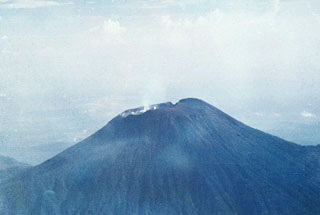
The crater was covered by thick solfataric gas, but no significant changes were observed during fieldwork. Earthquakes associated with gas emissions were recorded an average of 776 times/day.
Information Contacts: W. Modjo, VSI; AP.
Geological Summary. Slamet is one of Java's most active volcanoes. It has a cluster of about three dozen cinder cones on its lower SE-NE flanks and a single cinder cone on the W flank. It is composed of two overlapping edifices, an older basaltic andesite to andesitic volcano on the west and a younger basaltic to basaltic andesite one on the east. Gunung Malang II cinder cone on the upper E flank on the younger edifice fed a lava flow that extends 6 km E. Four craters occur at the summit of Gunung Slamet, with activity migrating to the SW over time. Eruptions recorded since the 18th century have originated from a 150-m-deep, 450-m-wide, steep-walled crater at the western part of the summit and have consisted of explosive eruptions generally lasting a few days to a few weeks.


 Slamet