
Smithsonian Institution
Bulletin of the Global Volcanism Network, vol. 16, no. 4 (April 1991)
Managing Editor: Lindsay McClelland
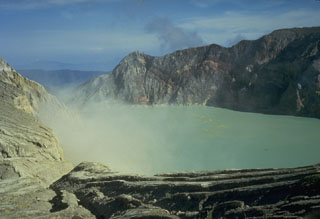
Ijen (Indonesia) Crater lake changes from gray and bubbling to light green
Please cite this report as:
Global Volcanism Program, 1991. Report on Ijen (Indonesia) (McClelland, L, ed.). Bulletin of the Global Volcanism Network, 16:4. Smithsonian Institution. https://doi.org/10.5479/si.GVP.BGVN199104-263350
The crater lake (45°C) was light green in March and April, a change from its previous gray color, when large bubbles were visible on the surface. A total of one deep and two shallow volcanic earthquakes and one tectonic event were recorded. Tremor was recorded on 25, 26, and 28 March.
Information Contacts: W. Modjo, VSI.
Geological Summary. The Ijen volcano complex at the eastern end of Java consists of a group of small stratovolcanoes constructed within the 20-km-wide Ijen (Kendeng) caldera. The north caldera wall forms a prominent arcuate ridge, but elsewhere the rim was buried by post-caldera volcanoes, including Gunung Merapi, which forms the high point of the complex. Immediately west of the Gunung Merapi stratovolcano is the historically active Kawah Ijen crater, which contains a nearly 1-km-wide, turquoise-colored, acid lake. Kawah Ijen is the site of a labor-intensive mining operation in which baskets of sulfur are hand-carried from the crater floor. Many other post-caldera cones and craters are located within the caldera or along its rim. The largest concentration of cones forms an E-W zone across the southern side of the caldera. Coffee plantations cover much of the caldera floor; nearby waterfalls and hot springs are tourist destinations.


 Ijen
Ijen