
Smithsonian Institution
Bulletin of the Global Volcanism Network, vol. 17, no. 5 (May 1992)
Managing Editor: Lindsay McClelland
Kanlaon (Philippines) Small ash emission
Please cite this report as:
Global Volcanism Program, 1992. Report on Kanlaon (Philippines) (McClelland, L, ed.). Bulletin of the Global Volcanism Network, 17:5. Smithsonian Institution. https://doi.org/10.5479/si.GVP.BGVN199205-272020
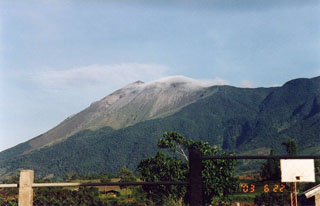
Newspapers reported a 1-km-high ash emission and ashfall at flank towns on 10 June, coinciding with a minor earthquake. There were no reports of injuries.
Information Contacts: Reuters.
Geological Summary. Kanlaon volcano (also spelled Canlaon) forms the highest point on the Philippine island of Negros. The massive andesitic stratovolcano is covered with fissure-controlled pyroclastic cones and craters, many of which are filled by lakes. The largest debris avalanche known in the Philippines traveled 33 km SW from Kanlaon. The summit contains a 2-km-wide, elongated northern caldera with a crater lake and a smaller but higher active vent, Lugud crater, to the south. Eruptions recorded since 1866 have typically consisted of phreatic explosions of small-to-moderate size that produce minor local ashfall.


 Kanlaon