
Smithsonian Institution
Bulletin of the Global Volcanism Network, vol. 21, no. 5 (May 1996)
Managing Editor: Richard Wunderman
Hokkaido-Komagatake (Japan) Steaming activity continues
Please cite this report as:
Global Volcanism Program, 1996. Report on Hokkaido-Komagatake (Japan) (Wunderman, R, ed.). Bulletin of the Global Volcanism Network, 21:5. Smithsonian Institution. https://doi.org/10.5479/si.GVP.BGVN199605-285020
Activity has declined since the eruptive events of March when two vents opened on and near the S side of Showa 4-nen (1929) crater, and a line of vents extending ~200 m N-S formed on the S part of the crater floor. The height of the gas plume remained at 100-200 m. A volcanic earthquake occurred on 15 May. No volcanic tremor was observed.
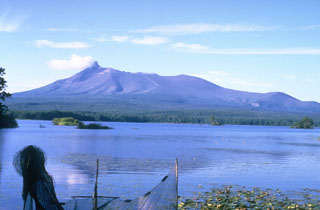
Komaga-take sits 30 km N of Hakodate City (population 320,000). The andesitic stratovolcano has a 2-km-wide horseshoe-shaped caldera open to the E. The volcano has generated large pyroclastic eruptions, including major historical eruptions in 1640, 1856, and 1929. In the 1640 eruption, debris from a partial summit collapse entered the sea resulting in a tsunami that killed 700 people. Although the 1929 eruption was one of the largest 20th century eruptions in Japan, it may not have had clear geophysical precursors.
Information Contacts: Japan Meteorological Agency (JMA), Volcanological Division, Seismological and Volcanological Department, 1-3-4 Ote-machi, Chiyoda-ku, Tokyo 100, Japan.
Geological Summary. Much of the truncated Hokkaido-Komagatake andesitic volcano on the Oshima Peninsula of southern Hokkaido is Pleistocene in age. The sharp-topped summit lies at the western side of a large breached crater that formed as a result of edifice collapse in 1640 CE. Hummocky debris avalanche material occurs at the base of the volcano on three sides. Two late-Pleistocene and two Holocene Plinian eruptions occurred prior to the first historical eruption in 1640, which began a period of more frequent explosive activity. The 1640 eruption, one of the largest in Japan during historical time, deposited ash as far away as central Honshu and produced a debris avalanche that reached the sea. The resulting tsunami caused 700 fatalities. Three Plinian eruptions have occurred since 1640; in 1694, 1856, and 1929.


 Hokkaido-Komagatake