
Smithsonian Institution
Bulletin of the Global Volcanism Network, vol. 23, no. 8 (August 1998)
Managing Editor: Richard Wunderman
Langila (Papua New Guinea) Weak vapor and ash emissions continue
Please cite this report as:
Global Volcanism Program, 1998. Report on Langila (Papua New Guinea) (Wunderman, R, ed.). Bulletin of the Global Volcanism Network, 23:8. Smithsonian Institution. https://doi.org/10.5479/si.GVP.BGVN199808-252010
During July, Crater 2 continued to release weak-to-moderate white vapor with occasional pale-gray ash. During 13-15 and 29 July the pale gray ash emissions changed to dark gray ash clouds that rose 2,000-2,500 m above the summit. Low roaring noises were heard 4-6, 8-9, and 16 July. No activity was reported from Crater 3 during July, and no glow was observed at either crater throughout the month.
During August both Crater 2 and 3 released low-to-moderate volumes of white vapor. There were also small amounts of blue vapor seen at Crater 2. One loud roaring and rumbling sound was heard at Crater 2 on 28 July accompanied by the emission of a dark-gray ash-laden cloud rising 1,000-2,000 m above the summit. This cloud was blown to the NW. The seismograph remained inoperative throughout July and August.
Information Contacts: Ben Talai, RVO.
Geological Summary. Langila, one of the most active volcanoes of New Britain, consists of a group of four small overlapping composite basaltic-andesitic cones on the lower E flank of the extinct Talawe volcano in the Cape Gloucester area of NW New Britain. A rectangular, 2.5-km-long crater is breached widely to the SE; Langila was constructed NE of the breached crater of Talawe. An extensive lava field reaches the coast on the N and NE sides of Langila. Frequent mild-to-moderate explosive eruptions, sometimes accompanied by lava flows, have been recorded since the 19th century from three active craters at the summit. The youngest and smallest crater (no. 3 crater) was formed in 1960 and has a diameter of 150 m.


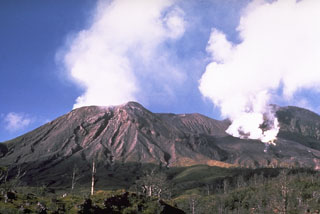 Langila