
Smithsonian Institution
Bulletin of the Global Volcanism Network, vol. 28, no. 12 (December 2003)
Managing Editor: Richard Wunderman
Lamington (Papua New Guinea) Available observations suggest quiet prevails
Please cite this report as:
Global Volcanism Program, 2003. Report on Lamington (Papua New Guinea) (Wunderman, R, ed.). Bulletin of the Global Volcanism Network, 28:12. Smithsonian Institution. https://doi.org/10.5479/si.GVP.BGVN200312-253010
Lamington remained quiet during 10 October-14 December 2003. Cloud cover over the summit area made visual observations difficult, and the earthquake recorder did not function due to technical problems. Although it was difficult to make a reliable prognosis based on very limited data and information, Rabaul Volcano Observatory expected Lamington to remain quiet.
Information Contacts: Ima Itikarai, Rabaul Volcano Observatory (RVO), P.O. Box 386, Rabaul, Papua New Guinea.
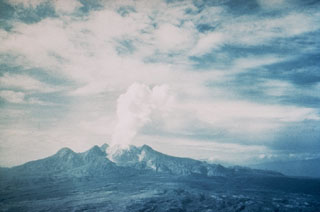
Geological Summary. Lamington is an andesitic stratovolcano with a 1.3-km-wide breached summit crater containing a lava dome that rises above the coastal plain of the Papuan Peninsula of New Guinea north of the Owen Stanley Range. A summit complex of lava domes and crater remnants tops a low-angle base of volcaniclastic deposits dissected by radial valleys. A prominent broad "avalanche valley" extends northward from the breached crater. Ash layers from two early Holocene eruptions have been identified. In 1951 a powerful explosive eruption produced pyroclastic flows and surges that swept all sides of the volcano, killing nearly 3,000 people. The eruption concluded with growth of a 560-m-high lava dome in the summit crater.


 Lamington