
Smithsonian Institution
Scientific Event Alert Network Bulletin, vol. 11, no. 3 (March 1986)
Managing Editor: Lindsay McClelland
Kīlauea (United States) Two brief episodes of high lava fountains feed short flows
Please cite this report as:
Global Volcanism Program, 1986. Report on Kīlauea (United States) (McClelland, L, ed.). Scientific Event Alert Network Bulletin, 11:3. Smithsonian Institution. https://doi.org/10.5479/si.GVP.SEAN198603-332010
Episode 42 was followed by 26 days of repose, before intermittent lava spillovers from Puʻu ʻŌʻō vent began on 21 March at 1330. Summit deflation began at midnight, and continuous lava production of E-43 began at 0450 the next day. Fountains reached their maximum height of ~310 m at 1110. The episode ended at 1556 on 22 March after forming two lava flows, one extending 5 km E of the vent, the second 2.3 km NE toward the older Kahaualeʻa cone. The summit grew 5 m . . . to 255 m above the pre-January 1983 surface.
After E-42 the summit had inflated 12.9 µrad before the onset of E-43 deflation. Deflation, totaling 12.8 µrad, continued until ~2 hours after the end of lava production. Inflation following E-43 amounted to 6.3 µrad by the end of March (figure 43).
The strong tremor associated with E-43 began at 0635 on the 22nd, peaked at 1200, and ended at 1554. Fluctuating low-amplitude tremor continued through the rest of the month near Puʻu ʻŌʻō.
Addendum: By 9 April, the summit had recovered all of the deflation associated with the previous episode. Episode 44's vigorous lava production began 13 April at about 2100, after a few hours of lava spillovers into the main channel. Lava fountains reached heights of 250 m [but see 11:04] by 0200 then stopped at 0756, feeding a few short lava flows to the NE and a longer ʻāʻā flow that extended > 4 km to the ESE.
Information Contacts: C. Heliker, M. Sako, and J. Nakata, HVO.
Geological Summary. Kīlauea overlaps the E flank of the massive Mauna Loa shield volcano in the Island of Hawaiʻi. Eruptions are prominent in Polynesian legends; written documentation since 1820 records frequent summit and flank lava flow eruptions interspersed with periods of long-term lava lake activity at Halemaʻumaʻu crater in the summit caldera until 1924. The 3 x 5 km caldera was formed in several stages about 1,500 years ago and during the 18th century; eruptions have also originated from the lengthy East and Southwest rift zones, which extend to the ocean in both directions. About 90% of the surface of the basaltic shield volcano is formed of lava flows less than about 1,100 years old; 70% of the surface is younger than 600 years. The long-term eruption from the East Rift Zone between 1983 and 2018 produced lava flows covering more than 100 km2, destroyed hundreds of houses, and added new coastline.


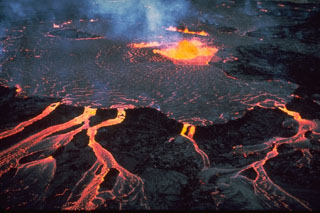 Kīlauea