
Smithsonian Institution
Scientific Event Alert Network Bulletin, vol. 14, no. 2 (February 1989)
Managing Editor: Lindsay McClelland
Cerro Negro (Nicaragua) New fumaroles in recent slump area S of the crater
Please cite this report as:
Global Volcanism Program, 1989. Report on Cerro Negro (Nicaragua) (McClelland, L, ed.). Scientific Event Alert Network Bulletin, 14:2. Smithsonian Institution. https://doi.org/10.5479/si.GVP.SEAN198902-344070
On 10 March, gas temperatures of up to 255°C were measured at fumaroles on the inner wall of the crater, 15-20 m below the N rim, with Minolta Cyclops 33 (bandpass 8-14 µm, 1° field of view) and Cyclops 52 (bandpass 0.8-1.1 µm, 0.33° field of view) infrared thermometers. Temperatures are not corrected for emissivity and atmospheric absorption effects. Since January 1988, a number of concentric slumps have developed S of the crater. New fumaroles with temperatures to 80°C have appeared along a fissure in the slump area.
Information Contacts: C. Oppenheimer and D. Rothery, Open Univ; B. van Vyk de Vries, O. Castellon, and L. Urbina, INETER.
Geological Summary. Nicaragua's youngest volcano, Cerro Negro, was created following an eruption that began in April 1850 about 2 km NW of the summit of Las Pilas volcano. It is the largest, southernmost, and most recent of a group of four youthful cinder cones constructed along a NNW-SSE-trending line in the central Marrabios Range. Strombolian-to-subplinian eruptions at intervals of a few years to several decades have constructed a roughly 250-m-high basaltic cone and an associated lava field constrained by topography to extend primarily NE and SW. Cone and crater morphology have varied significantly during its short eruptive history. Although it lies in a relatively unpopulated area, occasional heavy ashfalls have damaged crops and buildings.


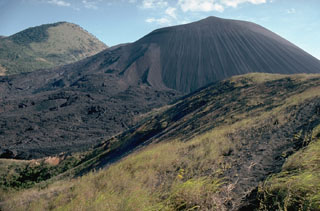 Cerro Negro