
Smithsonian Institution
Scientific Event Alert Network Bulletin, vol. 14, no. 9 (September 1989)
Managing Editor: Lindsay McClelland
Galeras (Colombia) Frequent seismicity continues
Please cite this report as:
Global Volcanism Program, 1989. Report on Galeras (Colombia) (McClelland, L, ed.). Scientific Event Alert Network Bulletin, 14:9. Smithsonian Institution. https://doi.org/10.5479/si.GVP.SEAN198909-351080
Although ash emission declined in May, fumarolic activity and seismicity have generally remained elevated.
In September, energy release and number of volcanic (high- and low-frequency) earthquakes remained stable (figure 9). Energy from long-period events increased slightly early in the month, but rapidly decreased to very low levels. Spasmodic tremor episodes, with periods of 0.25-0.50 seconds, increased slightly from August values. High-frequency events were centered roughly 9 km N of the crater at about 13 km depth until 11 September, when they became concentrated near the crater at 1-5 km depth (figure 10). On 30 September, an M 3 earthquake, 9 km SW of the crater at 8 km depth, was felt in Consacá (~4 km W of the summit). SO2 emissions were moderate, averaging ~800 t/d. Deformation data revealed no significant changes.
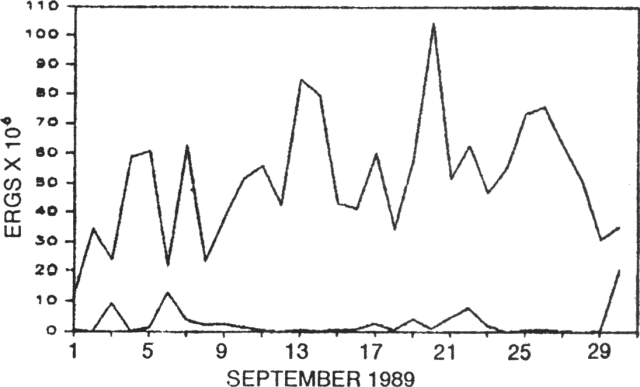 |
Figure 9. Daily energy release of high-frequency (upper curve) and low-frequency (lower curve) seismic events at Galeras, 1-30 September 1989. Courtesy of OVP. |
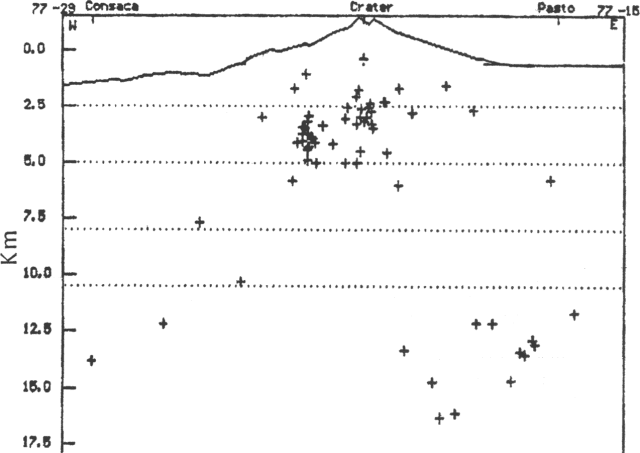 |
Figure 10. E-W cross-section of Galeras showing focal depths of 66 September earthquakes. Courtesy of OVP. |
Information Contacts: INGEOMINAS, Pasto.
Geological Summary. Galeras, a stratovolcano with a large breached caldera located immediately west of the city of Pasto, is one of Colombia's most frequently active volcanoes. The dominantly andesitic complex has been active for more than 1 million years, and two major caldera collapse eruptions took place during the late Pleistocene. Long-term extensive hydrothermal alteration has contributed to large-scale edifice collapse on at least three occasions, producing debris avalanches that swept to the west and left a large open caldera inside which the modern cone has been constructed. Major explosive eruptions since the mid-Holocene have produced widespread tephra deposits and pyroclastic flows that swept all but the southern flanks. A central cone slightly lower than the caldera rim has been the site of numerous small-to-moderate eruptions since the time of the Spanish conquistadors.


 Galeras