
Smithsonian Institution / US Geological Survey
Weekly Volcanic Activity Report, 7 June-13 June 2006
Managing Editor: Sally Sennert
Please cite this report as:
Global Volcanism Program, 2006. Report on Tongariro (New Zealand) (Sennert, S, ed.). Weekly Volcanic Activity Report, 7 June-13 June 2006. Smithsonian Institution and US Geological Survey. https://volcano.si.edu/showreport.cfm?gvpvar=GVP.WVAR20060607-241080
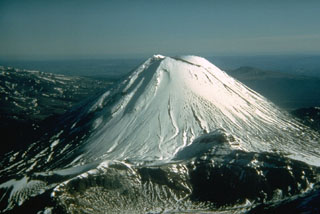
According to GeoNet, the number of small low-frequency earthquakes at Ngāuruhoe (the youngest cone of the Tongariro complex) increased in the past 3 weeks. On 6 June, the Alert Level was raised to 1.
Source: GeoNet
Geological Summary. Tongariro is a large volcanic massif, located immediately NE of Ruapehu volcano, that is composed of more than a dozen composite cones constructed over a period of 275,000 years. Vents along a NE-trending zone extending from Saddle Cone (below Ruapehu) to Te Maari crater (including vents at the present-day location of Ngāuruhoe) were active during several hundred years around 10,000 years ago, producing the largest known eruptions at the Tongariro complex during the Holocene. North Crater stratovolcano is truncated by a broad, shallow crater filled by a solidified lava lake that is cut on the NW side by a small explosion crater. The youngest cone, Ngāuruhoe, is also the highest peak.


 Tongariro