
Smithsonian Institution / US Geological Survey
Weekly Volcanic Activity Report, 3 September-9 September 2008
Managing Editor: Sally Sennert
Please cite this report as:
Global Volcanism Program, 2008. Report on Chaiten (Chile) (Sennert, S, ed.). Weekly Volcanic Activity Report, 3 September-9 September 2008. Smithsonian Institution and US Geological Survey. https://volcano.si.edu/showreport.cfm?gvpvar=GVP.WVAR20080903-358041
SERNAGEOMIN reported that during 3-5 September two moderately vigorous plumes from Chaitén were visible on the web camera and rose to altitudes of 2.1-3.1 km (6,900-10,200 ft) a.s.l. The plumes drifted NW, N, SE, and S. The plume emitted from the S sector was wider and contained more ash than the plume emitted from the N sector. Clouds prevented observations during 7-8 September.
Based on web camera views, analysis of satellite imagery, and information from the Puerto Montt Flight Information Region (FIR), the Buenos Aires VAAC reported that during 3-6 and 8 September, ash plumes rose continuously to altitudes of 1.5-3 km (5,000-10,000 ft) a.s.l. and drifted NW, ESE, and SE.
Sources: Servicio Nacional de Geología y Minería (SERNAGEOMIN), Buenos Aires Volcanic Ash Advisory Center (VAAC)
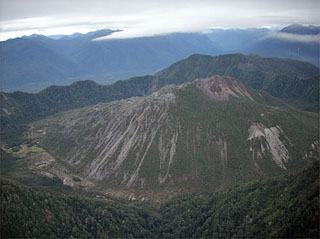
Geological Summary. Chaitén is a small caldera (~3 km in diameter) located 10 km NE of the town of Chaitén on the Gulf of Corcovado. Multiple explosive eruptions throughout the Holocene have been identified. A rhyolitic obsidian lava dome occupies much of the caldera floor. Obsidian cobbles from this dome found in the Blanco River are the source of artifacts from archaeological sites along the Pacific coast as far as 400 km from the volcano to the N and S. The caldera is breached on the SW side by a river that drains to the bay of Chaitén. The first recorded eruption, beginning in 2008, produced major rhyolitic explosive activity and building a new dome and tephra cone on the older rhyolite dome.


 Chaiten