
Smithsonian Institution / US Geological Survey
Weekly Volcanic Activity Report, 5 May-11 May 2010
Managing Editor: Sally Sennert
Please cite this report as:
Global Volcanism Program, 2010. Report on Ketoi (Russia) (Sennert, S, ed.). Weekly Volcanic Activity Report, 5 May-11 May 2010. Smithsonian Institution and US Geological Survey. https://volcano.si.edu/showreport.cfm?gvpvar=GVP.WVAR20100505-290200
SVERT reported that increased fumarolic activity from Ketoi was noted in satellite imagery on 4 May.
Source: Sakhalin Volcanic Eruption Response Team (SVERT)
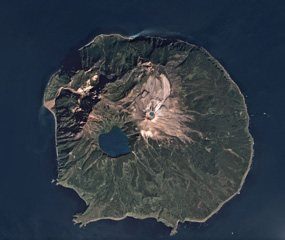
Geological Summary. The circular 10-km-wide Ketoi island, which rises across the 19-km-wide Diana Strait from Simushir Island, hosts of one of the most complex volcanic structures of the Kuril Islands. The rim of a 5-km-wide Pleistocene caldera is exposed only on the NE side. A younger stratovolcano forming the NW part of the island is cut by a horst-and-graben structure containing two solfatara fields. A 1.5-km-wide freshwater lake fills an explosion crater in the center of the island. Pallas Peak, a large andesitic cone in the NE part of the caldera, is truncated by a 550-m-wide crater containing a brilliantly colored turquoise crater lake. Lava flows from Pallas Peak overtop the caldera rim and descend nearly 5 km to the SE coast. The first historical eruption of Pallas Peak, during 1843-46, was its largest.


 Ketoi
Ketoi