
Smithsonian Institution / US Geological Survey
Weekly Volcanic Activity Report, 20 November-26 November 2013
Managing Editor: Sally Sennert
Please cite this report as:
Global Volcanism Program, 2013. Report on Nishinoshima (Japan) (Sennert, S, ed.). Weekly Volcanic Activity Report, 20 November-26 November 2013. Smithsonian Institution and US Geological Survey. https://volcano.si.edu/showreport.cfm?gvpvar=GVP.WVAR20131120-284096
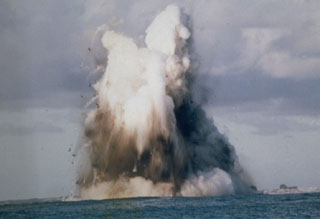
The Japanese Coast Guard reported that a Surtseyan eruption 500 m SE from the coast of Nishimo-shima generated a new island called Niijima on 20 November. The island was about 300 x 200 m, and developed a crater 150m wide. Discolored water surrounded the island. Based on satellite images, as well as accounts from the Japanese Coast Guard and JMA, the Tokyo VAAC reported that a plume rose 600 m. On 22 November the eruption continued and incandescence within the crater was observed. An ash plume rose 900 m and drifted SE. On 24 November lava flows from the crater extended to the coastline of the island, and bombs continued to be ejected.
Sources: Japan Coast Guard, Tokyo Volcanic Ash Advisory Center (VAAC)
Geological Summary. The small island of Nishinoshima was enlarged when several new islands coalesced during an eruption in 1973-74. Multiple eruptions between 2013 and 2023 completely covered the previous exposed surface and continued to enlarge the island. The island is the summit of a massive submarine volcano that has prominent peaks to the S, W, and NE. The summit of the southern cone rises to within 214 m of the ocean surface 9 km SSE.


 Nishinoshima