
Smithsonian Institution / US Geological Survey
Weekly Volcanic Activity Report, 11 June-17 June 2014
Managing Editor: Sally Sennert
Please cite this report as:
Global Volcanism Program, 2014. Report on Nishinoshima (Japan) (Sennert, S, ed.). Weekly Volcanic Activity Report, 11 June-17 June 2014. Smithsonian Institution and US Geological Survey. https://volcano.si.edu/showreport.cfm?gvpvar=GVP.WVAR20140611-284096
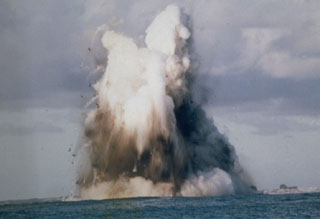
Photographs and video taken from a Japanese Coast Guard helicopter on 11 and 13 June revealed continuing eruptive activity at Nishinoshima. Steaming along the shoreline indicated at least two locations with active, or recently active, lava ocean entries, possibly tube-fed since no surface incandescence was visible. Night video clearly showed an active lava flow and ocean entry being supplied from lava fountaining out of a cinder cone. A significant steam plume was rising from the center of the lava shield from hot tephra deposits over a broad area rather than a crater. However, pulsating tephra ejections and distinctly brown ash plumes were rising from two smaller craters. An incandescent lava lake was visible in one of the small craters on both days.
Similar Coast Guard photos taken on 21 May showed a large ash-bearing plume and Strombolian activity from a larger cinder cone in the center of the island. Minor steaming from two central cinder cones was photographed on 15 April, and incandescent lava could be seen in the crater of one.
Source: Japan Coast Guard
Geological Summary. The small island of Nishinoshima was enlarged when several new islands coalesced during an eruption in 1973-74. Multiple eruptions between 2013 and 2023 completely covered the previous exposed surface and continued to enlarge the island. The island is the summit of a massive submarine volcano that has prominent peaks to the S, W, and NE. The summit of the southern cone rises to within 214 m of the ocean surface 9 km SSE.


 Nishinoshima