
Smithsonian Institution / US Geological Survey
Weekly Volcanic Activity Report, 25 June-1 July 2014
Managing Editor: Sally Sennert
Please cite this report as:
Global Volcanism Program, 2014. Report on Kīlauea (United States) (Sennert, S, ed.). Weekly Volcanic Activity Report, 25 June-1 July 2014. Smithsonian Institution and US Geological Survey. https://volcano.si.edu/showreport.cfm?gvpvar=GVP.WVAR20140625-332010
During 25 June-1 July HVO reported that the circulating lava lake occasionally rose and fell in the deep pit within Kīlauea's Halemaʻumaʻu Crater. Gas emissions remained elevated. The plume from the vent continued to deposit variable amounts of ash, spatter, and Pele's hair onto nearby areas; smaller particles may have been dropped several kilometers away.
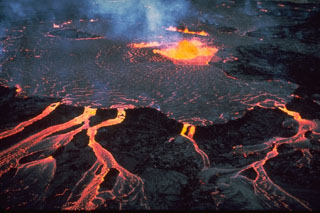
During 25-26 June, lava flows from the N and NE spatter cones at Puʻu ʻŌʻō Crater were active and persistent glow emanated from spatter cones on the N, SE, and S portions of the crater floor, and from a small lava lake in the NE spatter cone. On 27 June the crater floor slowly subsided and new lava erupted on the N flank. During 27-30 June lava flowed from four locations on the NE flank, advancing to about 1 km NE. Spatter cones collapsed varying amounts. A 28 June satellite image showed that the 27 June lava flows had expanded in area and extended no more than 1.6 km NE of Puʻu ʻŌʻō cone. During 25-27 June there were multiple active breakouts in the interior of the Kahaualeʻa 2 flow at the north base of Puʻu ʻŌʻō and distant broad smoke plumes, with multiple glowing points visible at night from both near and distant breakouts. Only one stationary glowing spot was seen during 28-30 June on a nearby breakout from the Kahaualeʻa 2 flow, and little to no smoke from the distal end of that flow, suggesting that the flow was cutoff and dead.
Source: US Geological Survey Hawaiian Volcano Observatory (HVO)
Geological Summary. Kīlauea overlaps the E flank of the massive Mauna Loa shield volcano in the Island of Hawaiʻi. Eruptions are prominent in Polynesian legends; written documentation since 1820 records frequent summit and flank lava flow eruptions interspersed with periods of long-term lava lake activity at Halemaʻumaʻu crater in the summit caldera until 1924. The 3 x 5 km caldera was formed in several stages about 1,500 years ago and during the 18th century; eruptions have also originated from the lengthy East and Southwest rift zones, which extend to the ocean in both directions. About 90% of the surface of the basaltic shield volcano is formed of lava flows less than about 1,100 years old; 70% of the surface is younger than 600 years. The long-term eruption from the East Rift Zone between 1983 and 2018 produced lava flows covering more than 100 km2, destroyed hundreds of houses, and added new coastline.


 Kīlauea