
Smithsonian Institution / US Geological Survey
Weekly Volcanic Activity Report, 7 October-13 October 2015
Managing Editor: Sally Sennert
Please cite this report as:
Global Volcanism Program, 2015. Report on Karymsky (Russia) (Sennert, S, ed.). Weekly Volcanic Activity Report, 7 October-13 October 2015. Smithsonian Institution and US Geological Survey. https://volcano.si.edu/showreport.cfm?gvpvar=GVP.WVAR20151007-300130
KVERT reported that moderate explosive activity at Karymsky continued during 2-9 October. Satellite images showed a thermal anomaly over the volcano on 4 and 8 October, and an ash plume that drifted 50 km SE on 8 October. The Aviation Color Code remained at Orange.
Source: Kamchatkan Volcanic Eruption Response Team (KVERT)
Geological Summary. Karymsky is a symmetrical stratovolcano constructed within a 5-km-wide caldera that formed during the early Holocene. The caldera cuts the S side of the Pleistocene Dvor volcano and is located outside the N margin of the large mid-Pleistocene Polovinka caldera, which contains the smaller Akademia Nauk and Odnoboky calderas. Most seismicity preceding Karymsky eruptions originated beneath Akademia Nauk caldera, located immediately south. The enclosing caldera formed about 7,600-7,700 radiocarbon years ago; construction of the stratovolcano began about 2,000 years later. The latest eruptive period began about 500 years ago, following a 2,300 years of quiescence. Much of the cone is covered by lava flows less than 200 years old. Recorded eruptions have been Vulcanian or Vulcanian-Strombolian with moderate explosive activity and occasional lava flows from the summit crater.


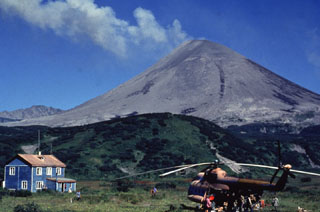 Karymsky