
Smithsonian Institution / US Geological Survey
Weekly Volcanic Activity Report, 4 October-10 October 2017
Managing Editor: Sally Sennert
Please cite this report as:
Global Volcanism Program, 2017. Report on Bezymianny (Russia) (Sennert, S, ed.). Weekly Volcanic Activity Report, 4 October-10 October 2017. Smithsonian Institution and US Geological Survey. https://volcano.si.edu/showreport.cfm?gvpvar=GVP.WVAR20171004-300250
On 6 October KVERT reported that a thermal anomaly at Bezymianny was identified in satellite images during 1-2 and 4-5 October, and that lava probably continued to flow down the W flank of the dome. The Aviation Color Code was lowered to Yellow (the second lowest level on a four-color scale).
Source: Kamchatkan Volcanic Eruption Response Team (KVERT)
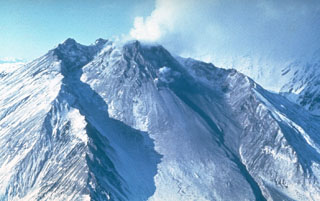
Geological Summary. The modern Bezymianny, much smaller than its massive neighbors Kamen and Kliuchevskoi on the Kamchatka Peninsula, was formed about 4,700 years ago over a late-Pleistocene lava-dome complex and an edifice built about 11,000-7,000 years ago. Three periods of intensified activity have occurred during the past 3,000 years. The latest period, which was preceded by a 1,000-year quiescence, began with the dramatic 1955-56 eruption. This eruption, similar to that of St. Helens in 1980, produced a large open crater that was formed by collapse of the summit and an associated lateral blast. Subsequent episodic but ongoing lava-dome growth, accompanied by intermittent explosive activity and pyroclastic flows, has largely filled the 1956 crater.


 Bezymianny