
Smithsonian Institution / US Geological Survey
Weekly Volcanic Activity Report, 6 June-12 June 2018
Managing Editor: Sally Sennert
Please cite this report as:
Global Volcanism Program, 2018. Report on Ruapehu (New Zealand) (Sennert, S, ed.). Weekly Volcanic Activity Report, 6 June-12 June 2018. Smithsonian Institution and US Geological Survey. https://volcano.si.edu/showreport.cfm?gvpvar=GVP.WVAR20180606-241100
On 5 June GeoNet reported that a new heating cycle at Ruapehu’s summit Crater Lake began, as indicated by a recent rise in the water temperature. The increasing lake temperature began 29 May, at a rate of about 1°C per day. Volcanic tremor also increased, representing a greater flow of hydrothermal fluids into the lake. Many heating and cooling cycles have occurred in the past; the current cycle does not indicate an unusual sign of unrest. The Volcanic Alert Level remained at 1 (minor volcanic unrest) and the Aviation Color Code remained at Green.
Source: GeoNet
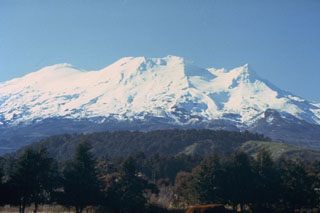
Geological Summary. Ruapehu, one of New Zealand's most active volcanoes, is a complex stratovolcano constructed during at least four cone-building episodes dating to about 200,000 years ago. The dominantly andesitic 110 km3 volcanic massif is elongated in a NNE-SSW direction and surrounded by another 100 km3 ring plain of volcaniclastic debris, including the NW-flank Murimoto debris-avalanche deposit. A series of subplinian eruptions took place between about 22,600 and 10,000 years ago, but pyroclastic flows have been infrequent. The broad summit area and flank contain at least six vents active during the Holocene. Frequent mild-to-moderate explosive eruptions have been recorded from the Te Wai ā-Moe (Crater Lake) vent, and tephra characteristics suggest that the crater lake may have formed as recently as 3,000 years ago. Lahars resulting from phreatic eruptions at the summit crater lake are a hazard to a ski area on the upper flanks and lower river valleys.


 Ruapehu