

Report on Nishinoshima (Japan) — 18 July-24 July 2018
Smithsonian Institution / US Geological Survey
Weekly Volcanic Activity Report, 18 July-24 July 2018
Managing Editor: Sally Sennert.
Please cite this report as:
Global Volcanism Program, 2018. Report on Nishinoshima (Japan) (Sennert, S, ed.). Weekly Volcanic Activity Report, 18 July-24 July 2018. Smithsonian Institution and US Geological Survey.
Nishinoshima
Japan
27.247°N, 140.874°E; summit elev. 100 m
All times are local (unless otherwise noted)
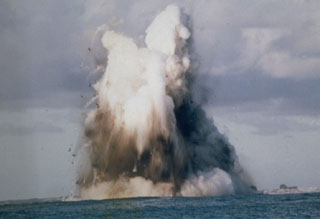
Based on Japan Coast Guard (JCG) observations, JMA reported that a very small eruption at Nishinoshima occurred at 1124 on 12 July, producing a brownish plume that rose from near the crater. During an aerial survey, JCG noted deposits 400 m from the vent. No thermal anomalies were detected. The report warned people to stay at least 500 m away from the crater.
Geological Summary. The small island of Nishinoshima was enlarged when several new islands coalesced during an eruption in 1973-74. Multiple eruptions that began in 2013 completely covered the previous exposed surface and continued to enlarge the island. The island is the summit of a massive submarine volcano that has prominent peaks to the S, W, and NE. The summit of the southern cone rises to within 214 m of the ocean surface 9 km SSE.
