
Smithsonian Institution / US Geological Survey
Weekly Volcanic Activity Report, 6 May-12 May 2020
Managing Editor: Sally Sennert
Please cite this report as:
Global Volcanism Program, 2020. Report on Sangeang Api (Indonesia) (Sennert, S, ed.). Weekly Volcanic Activity Report, 6 May-12 May 2020. Smithsonian Institution and US Geological Survey. https://volcano.si.edu/showreport.cfm?gvpvar=GVP.WVAR20200506-264050
The Darwin VAAC reported that on 10 May a discrete ash emission from Sangeang Api rose to an altitude of 2.1 km (7,000 ft) a.s.l. and drifted E. The Alert Level remained at 2 (on a scale of 1-4).
Sources: Darwin Volcanic Ash Advisory Centre (VAAC), Pusat Vulkanologi dan Mitigasi Bencana Geologi (PVMBG, also known as CVGHM)
Geological Summary. Sangeang Api volcano, one of the most active in the Lesser Sunda Islands, forms a small 13-km-wide island off the NE coast of Sumbawa Island. Two large trachybasaltic-to-trachyandesitic volcanic cones, Doro Api and Doro Mantoi, were constructed in the center and on the eastern rim, respectively, of an older, largely obscured caldera. Flank vents occur on the south side of Doro Mantoi and near the northern coast. Intermittent eruptions have been recorded since 1512, most of them during the 20th century.


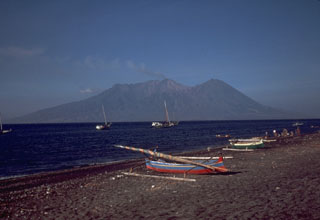 Sangeang Api