
Smithsonian Institution / US Geological Survey
Weekly Volcanic Activity Report, 15 March-21 March 2023
Managing Editor: Sally Sennert
Please cite this report as:
Global Volcanism Program, 2023. Report on Mauna Loa (United States) (Sennert, S, ed.). Weekly Volcanic Activity Report, 15 March-21 March 2023. Smithsonian Institution and US Geological Survey. https://volcano.si.edu/showreport.cfm?gvpvar=GVP.WVAR20230315-332020
HVO reported that Mauna Loa had been quiet since the eruption ended on 13 December 2022 and the number of earthquakes beneath the summit had returned to background levels. Inflation continued as magma replenished the summit reservoir. On 16 March HVO lowered the Volcano Alert Level to Normal (the lowest level on a four-level scale) and the Aviation Color Code to Green (the lowest level on a four-color scale).
Source: US Geological Survey Hawaiian Volcano Observatory (HVO)
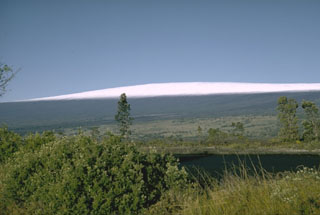
Geological Summary. Massive Mauna Loa is a basaltic shield volcano that rises almost 9 km from the ocean floor to form the world's largest Holocene volcano. Flank eruptions typically occur from the lengthy NE and SW rift zones, and from the Mokuʻāweoweo summit is caldera, which is within an older and larger 6 x 8 km caldera. Two large debris avalanches traveled nearly 100 km; the second of the Alika avalanches was emplaced about 105,000 years ago (Moore et al., 1989). Almost 90% of the surface of the volcano is covered by lavas less than 4,000 years old (Lockwood and Lipman, 1987). Beginning about 1,500 years ago, a series of voluminous overflows from a summit lava lake covered about 25% of the volcano's surface. Over the last 750 years, from shortly after the formation of Mokuʻāweoweo caldera until the present, an additional 25% of the volcano has been covered with lava flows, mainly from summit and NW rift zone vents.


 Mauna Loa