
Smithsonian Institution / US Geological Survey
Weekly Volcanic Activity Report, 26 March-1 April 2025
Managing Editor: Sally Sennert
Please cite this report as:
Global Volcanism Program, 2025. Report on Gaua (Vanuatu) (Sennert, S, ed.). Weekly Volcanic Activity Report, 26 March-1 April 2025. Smithsonian Institution and US Geological Survey. https://volcano.si.edu/showreport.cfm?gvpvar=GVP.WVAR20250326-257020
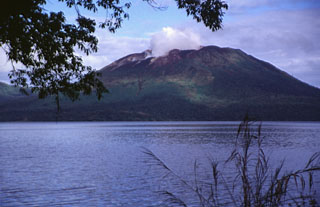
On 27 March the Vanuatu Meteorology and Geohazards (VMGD) reported that volcanic emissions consisting of steam and/or gas continued to be emitted at Gaua based on satellite images. Sulfur dioxide gas was detected in the emissions on 1 March. The Alert Level remained at 2 (on a scale of 0-5) and the public was warned to stay away from the main cone.
Source: Vanuatu Meteorology and Geohazards Department (VMGD)
Geological Summary. The roughly 20-km-diameter Gaua Island, also known as Santa Maria, consists of a basaltic-to-andesitic stratovolcano with an 6 x 9 km summit caldera. Small vents near the caldera rim fed Pleistocene lava flows that reached the coast on several sides of the island; littoral cones were formed where these lava flows reached the ocean. Quiet collapse that formed the roughly 700-m-deep caldera was followed by extensive ash eruptions. The active Mount Garet (or Garat) cone in the SW part of the caldera has three pit craters across the summit area. Construction of Garet and other small cinder cones has left a crescent-shaped lake. Eruptions have been frequent since the onset of activity from a vent high on the SE flank in 1962.


 Gaua
Gaua