
Due to the US Government shutdown, the Smithsonian is temporarily closed. The Global Volcanism Program website will remain available but will not be monitored or updated. Status updates will be available on the Smithsonian homepage.
Logo link to homepage

Image GVP-10178

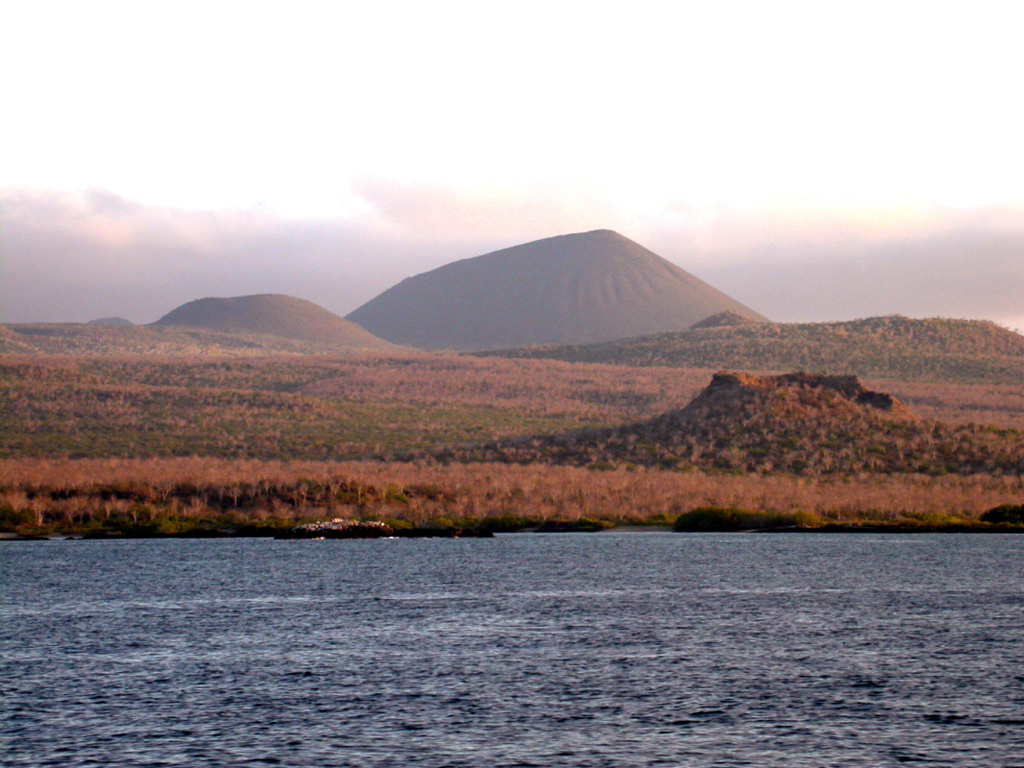
Floreana Island (also known as Charles Island or Santa María Island) is a broad shield volcano whose surface is densely covered with cinder cones.  The most conspicuous of these is Cerro de Pajas, seen here from the north with a spatter cone in the right foreground.  A massive pahoehoe lava flow from Cerro de Pajas, perhaps the youngest on Floreana, reached the SW coast over a broad 6.5 km area.  The youngest lava flow on Floreana, once thought to be Holocene, has a late Pleistocene surface exposure age. Photo by Ed Vicenzi, 2002 (Smithsonian Institution).

Floreana Island (also known as Charles Island or Santa María Island) is a broad shield volcano whose surface is densely covered with cinder cones. The most conspicuous of these is Cerro de Pajas, seen here from the north with a spatter cone in the right foreground. A massive pahoehoe lava flow from Cerro de Pajas, perhaps the youngest on Floreana, reached the SW coast over a broad 6.5 km area. The youngest lava flow on Floreana, once thought to be Holocene, has a late Pleistocene surface exposure age.

Photo by Ed Vicenzi, 2002 (Smithsonian Institution).

Creative Commons Icon This image is made available under the Creative Commons BY-NC 4.0 license terms.

Floreana