
Smithsonian Institution
Bulletin of the Global Volcanism Network, vol. 29, no. 4 (April 2004)
Managing Editor: Edward Venzke
Research and preparation by Don Gruber
Rabaul (Papua New Guinea) Tavurvur cone's eruptions pause or cease, starting 17 February; MODIS data
Please cite this report as:
Global Volcanism Program, 2004. Report on Rabaul (Papua New Guinea) (Venzke, E, ed.). Bulletin of the Global Volcanism Network, 29:4. Smithsonian Institution. https://doi.org/10.5479/si.GVP.BGVN200404-252140
The Rabaul Volcano Observatory has reported that eruptive activity from the Tavurvur crater at Rabaul, which began in early October 2002, ceased on 17 February 2004. Activity during 1-17 February was characterized by emissions of light pale ash clouds with occasional moderate explosions producing thick ash plumes. The plumes rose 1-2 above the summit, resulting in ashfall to the E and NE, including in Duke of York. A slight change in wind direction on 6 and 13-15 February resulted in fine ashfall to the NW over Rabaul city and villages downwind. Occasional weak roaring noises were heard with some of the explosions on 5 and 11 February.
Seismic activity was consistent with the ash emissions, with one high frequency event NE of the caldera on 5 February. The real-time GPS and electronic tilt site on Matupit Island, in the center of the caldera, showed a deflationary trend since the middle of the month, a reversal of the long-term trend of slow gradual uplift reported earlier (BGVN 28:03, 28:09, and 28:11). During 18-29 February Tavurvur released weak white, and occasional blue, vapor.
A review of MODIS data for the year to 11 May 2004 showed thermal alerts recorded at Tavurvur cone, Rabaul, on 12, 21, and 29 October; 1, 8, 15, and 24 November; 1 and 26 December 2003; and 9 and 25 January 2004.
Information Contacts: Ima Itikarai and Herman Patia, Rabaul Volcano Observatory (RVO), P.O. Box 386, Rabaul, Papua New Guinea; Rob Wright, Luke Flynn, and Eric Pilger; MODIS Thermal Alert System, Hawaii Institute of Geophysics and Planetology (HIGP), School of Ocean and Earth Science and Technology, University of Hawaii at Manoa (URL: http://modis.hgip.hawaii.edu/).
Geological Summary. The low-lying Rabaul caldera on the tip of the Gazelle Peninsula at the NE end of New Britain forms a broad sheltered harbor utilized by what was the island's largest city prior to a major eruption in 1994. The outer flanks of the asymmetrical shield volcano are formed by thick pyroclastic-flow deposits. The 8 x 14 km caldera is widely breached on the east, where its floor is flooded by Blanche Bay and was formed about 1,400 years ago. An earlier caldera-forming eruption about 7,100 years ago is thought to have originated from Tavui caldera, offshore to the north. Three small stratovolcanoes lie outside the N and NE caldera rims. Post-caldera eruptions built basaltic-to-dacitic pyroclastic cones on the caldera floor near the NE and W caldera walls. Several of these, including Vulcan cone, which was formed during a large eruption in 1878, have produced major explosive activity during historical time. A powerful explosive eruption in 1994 occurred simultaneously from Vulcan and Tavurvur volcanoes and forced the temporary abandonment of Rabaul city.


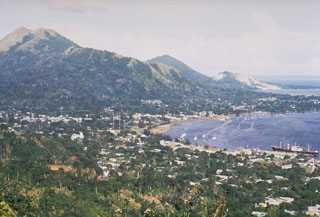 Rabaul