
Smithsonian Institution
Bulletin of the Global Volcanism Network, vol. 42, no. 1 (January 2017)
Managing Editor: Edward Venzke
Research and preparation by Jackie Gluck
Kanlaon (Philippines) Three ash explosions on 18 June 2016; steam plumes through July
Please cite this report as:
Global Volcanism Program, 2017. Report on Kanlaon (Philippines) (Venzke, E, ed.). Bulletin of the Global Volcanism Network, 42:1. Smithsonian Institution. https://doi.org/10.5479/si.GVP.BGVN201701-272020
An ash explosion from Kanlaon on 24 November 2015 was the start of activity that included intermittent ash emissions through December and during 29-31 March 2016 (BGVN: 4014). That activity was followed by decreasing tremor and steam plumes rising to as high as 800 during the first days of April 2016. A short series of explosions on 18 June 2016 were the last ash emissions through 2016, based on Philippine Institute of Volcanology and Seismology (PHIVOLCS) reports. The Alert Level remained at 1 (on a scale of 0-5) throughout the reporting period, indicating low level of volcanic unrest.
PHIVOLCS reported that ground deformation measurements from continuous GPS data as of 2 June 2016 indicated slight inflation of the edifice since December 2015. Weak to moderate emission of white steam plumes that rose 540 m during 15-17 June and drifted SW and NW.
A series of three eruptive events occurred on 18 June, beginning at 0919 and lasting 27 minutes. These events were recorded by the seismic monitoring network as consecutive explosion-type earthquakes that lasted 30, 42, and 29 seconds, respectively. The first event, a steam-and-gas explosion, generated a light gray-to-white ash plume that initially rose 1.5 km above the crater and then later to 3 km (figure 3). The second event, an ash eruption immediately following the first event, produced a dense black ash plume that rose 500 m. Lastly, a grayish ash plume rose 500 m. Minor ashfall was reported to the W in the barangays of Ara-al, San Miguel, and Yubo in La Carlota City (14 km W), Sag-ang in La Castellana (16 km SW), and Ilijan in Bago City (30 km NW). A diffuse sulfur odor was detected in Ara-al.
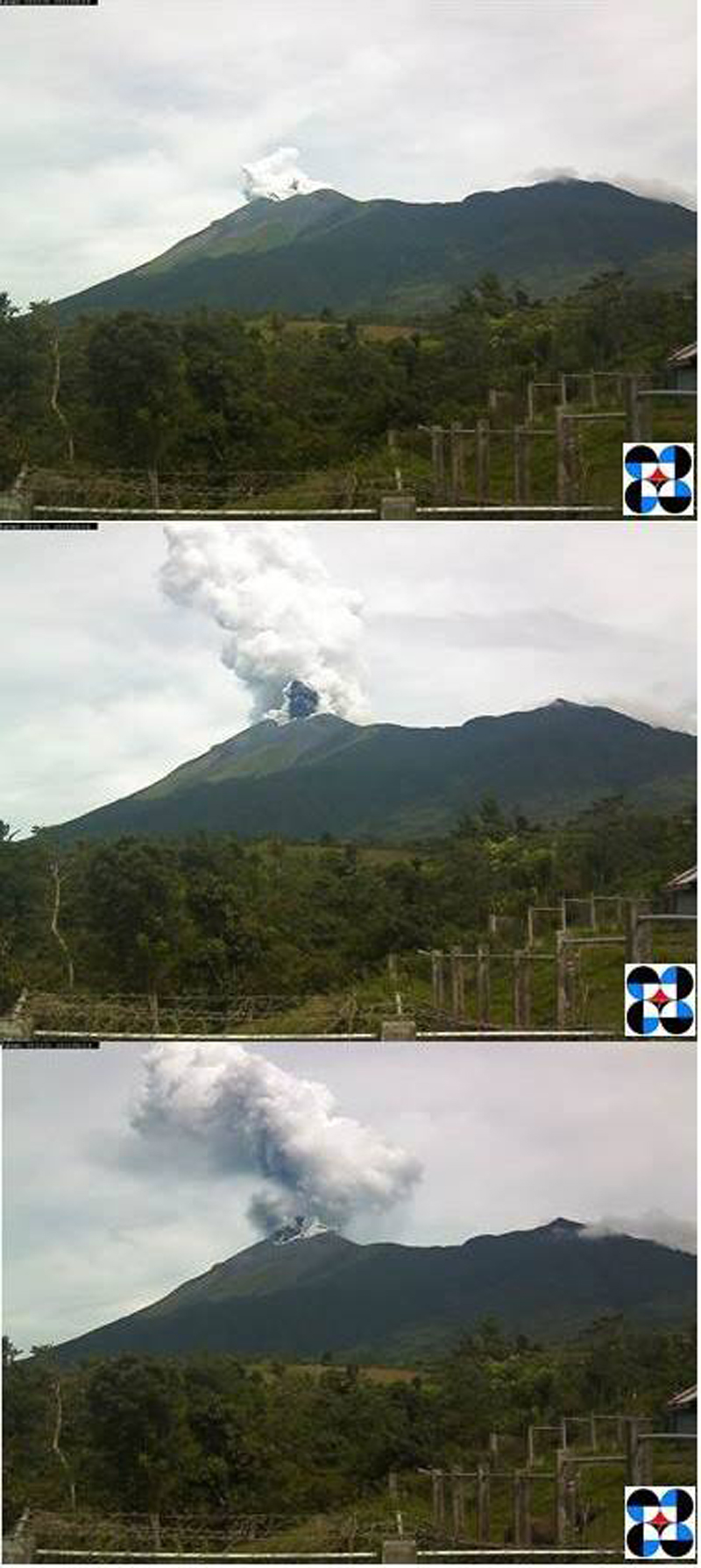 |
Figure 3. Photo sequence showing eruption plumes from Kanlaon at 0919 on 18 June 2016. Courtesy PHIVOLCS. |
PHIVOLCS reported that during 20, 22-23, and 25-26 June white steam plumes rose as high as 800 m and drifted WNW, NW and SW; wispy steam plumes were observed on 27 June. Starting at 1640 on 23 June the seismic network recorded a 4-minute-long, explosion-type signal; weather clouds prevented visual observations of the summit area.
White plumes were again seen during 20-25 July. On 20 July plumes were a dirty-white color; on 21-22 they were of white steam; and on 25 July they rose 200 m and drifted NW and SW. Sulfur dioxide (SO2) emitted at the active vent averaged 234 tonnes/day on 21 July.
Ground deformation data from continuous GPS measurements as of 3 September 2016 indicated no significant change of the edifice since August 2016.
Information Contacts: Philippine Institute of Volcanology and Seismology (PHIVOLCS), Department of Science and Technology, PHIVOLCS Building, C.P. Garcia Avenue, Univ. of the Philippines Campus, Diliman, Quezon City, Philippines (URL: http://www.phivolcs.dost.gov.ph/).
Geological Summary. Kanlaon volcano (also spelled Canlaon) forms the highest point on the Philippine island of Negros. The massive andesitic stratovolcano is covered with fissure-controlled pyroclastic cones and craters, many of which are filled by lakes. The largest debris avalanche known in the Philippines traveled 33 km SW from Kanlaon. The summit contains a 2-km-wide, elongated northern caldera with a crater lake and a smaller but higher active vent, Lugud crater, to the south. Eruptions recorded since 1866 have typically consisted of phreatic explosions of small-to-moderate size that produce minor local ashfall.


 Kanlaon