
Smithsonian Institution
Bulletin of the Global Volcanism Network, vol. 49, no. 3 (March 2024)
Managing Editor: Kadie Bennis
Edited by Edward A. Venzke
Research and preparation by Paul Berger
Krakatau (Indonesia) Ash plumes and thermal anomalies during September-December 2023; minor activity in February 2024
Please cite this report as:
Global Volcanism Program, 2024. Report on Krakatau (Indonesia) (Venzke, E A, and Bennis, K L, eds.). Bulletin of the Global Volcanism Network, 49:3. Smithsonian Institution.
The current eruption period began in May 2021, commonly producing Strombolian activity and ash plumes (BGVN 48:07). Ash explosions occurred occasionally during most of January-September 2023, except for August (BGVN 48:07, 48:10). This report describes activity during September-December 2023, based on information provided by the Indonesian Center for Volcanology and Geological Hazard Mitigation, referred to as Pusat Vulkanologi dan Mitigasi Bencana Geologi (PVMBG), MAGMA Indonesia, and satellite data.
During September and October 2023, PVMBG typically observed diffuse white plumes that rose 5-100 m on most days when weather conditions did not obscure visibility; a few rose as high as 300 m. On 10 September an explosion ejected white, gray, and black plumes that rose 25-1,000 m above the summit. Infrared imagery from Sentinel-2 on 11 September showed a strong thermal anomaly in the crater for the first time since early February. White-and-gray plumes were also observed on 12 and 17 October. In a press release, PVMBG reported that seismicity increased significantly on 28 October, and deformation measurements showed inflation at two stations since April and at another station since September.
White plumes were observed November through the 23rd, typically rising up to 100 m, with some reaching 300 m high. On 24-25 November white-and-gray plumes rose 150 m high. A black plume on 26 November 1 km high, followed by Strombolian activity and gray-to-black plumes on 27-29 November that rose as high as 2 km (figure 142). On 30 November white-and-gray plumes rose 50-200 m. PVMBG issued at least 25 Volcano Observatory Notices for Aviation (VONAs) during 26-28 November. Webcam images showed incandescent ejecta.
 |
Figure 142. Webcam images of Krakatau showing examples of eruption plumes and Strombolian activity during 26-28 November 2023. Courtesy of PVMBG and MAGMA Indonesia. |
Heightened activity continued into December. During 1-16 December a series of ash explosions ejected gray-to-black plumes that rose as high as 2 km above the summit. Observations of incandescent ejecta continued. Due to ash plumes that could affect aviation, PVMBG issued 34 VONAs during 2-7 December along with Volcanic Eruption Notices. Between 8 and 11 December the daily reports from MAGMA Indonesia noted more diffuse white-to-gray plumes rising 50-300 m. An additional 18 VONAs were issued between 12 and 16 December. Based on daily reports, the volcano was relatively quiet after 16 December through the end of the month, with only diffuse white plumes rising 25-100 m.
During the heightened activity in late November and early December, clouds persistently obscured views of the volcano. However, during clear periods thermal anomalies were observed in Sentinel-2 infrared images (figure 143) and recorded by the MIROVA hotspot detection system (figure 144). After the initial thermal anomaly on 11 September, additional distinct thermal signals were seen on 9 and 11 October. Thermal anomalies were then present in every clear image during 16 October through 20 December.
 |
Figure 143. Sentinel-2 infrared satellite images of Krakatau showing a gas-and-steam plume on 9 November (left) and an ash plume on 15 December 2023 (right), as well as a thermal anomaly in the summit crater on both days. Images rendered in False Color, Urban (bands 12, 11, 4). Courtesy of Copernicus Browser. |
 |
Figure 144. Thermal activity at Krakatau for the year ending on 11 March 2024 are shown on this MIROVA (Log Radiative Power) data graph. Low-to-moderate power hotspots stopped briefly in early September 2023, followed by a period of more frequent anomalies during October-December 2023, and then a final short episode during about 8-20 February 2024. Courtesy of MIROVA. |
Clouds prevented satellite observations on many days, but small plumes (ash content uncertain) from the active crater were present on 14 and 22 January and 1 February 2025. A notable thermal anomaly appeared again in a Sentinel-2 image on 8 February 2024 but was weak on 11 February; larger white plumes were also seen on those days. No thermal anomalies were seen in Sentinel-2 images after 11 February, though there were intermittent diffuse plumes visible in satellite images and weak thermal anomalies identified in the MIROVA graph (figure 144).
Information Contacts: Pusat Vulkanologi dan Mitigasi Bencana Geologi (PVMBG, also known as Indonesian Center for Volcanology and Geological Hazard Mitigation, CVGHM), Jalan Diponegoro 57, Bandung 40122, Indonesia (URL: http://www.vsi.esdm.go.id/); MAGMA Indonesia, Kementerian Energi dan Sumber Daya Mineral (URL: https://magma.esdm.go.id/v1); MIROVA (Middle InfraRed Observation of Volcanic Activity), a collaborative project between the Universities of Turin and Florence (Italy) supported by the Centre for Volcanic Risk of the Italian Civil Protection Department (URL: http://www.mirovaweb.it/); Hawai'i Institute of Geophysics and Planetology (HIGP) - MODVOLC Thermal Alerts System, School of Ocean and Earth Science and Technology (SOEST), Univ. of Hawai'i, 2525 Correa Road, Honolulu, HI 96822, USA (URL: http://modis.higp.hawaii.edu/); Copernicus Browser, Copernicus Data Space Ecosystem, European Space Agency (URL: https://dataspace.copernicus.eu/browser/).
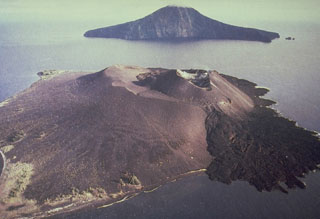
Geological Summary. The renowned Krakatau (frequently misnamed as Krakatoa) volcano lies in the Sunda Strait between Java and Sumatra. Collapse of an older edifice, perhaps in 416 or 535 CE, formed a 7-km-wide caldera. Remnants of that volcano are preserved in Verlaten and Lang Islands; subsequently the Rakata, Danan, and Perbuwatan cones were formed, coalescing to create the pre-1883 Krakatau Island. Caldera collapse during the catastrophic 1883 eruption destroyed Danan and Perbuwatan, and left only a remnant of Rakata. This eruption caused more than 36,000 fatalities, most as a result of tsunamis that swept the adjacent coastlines of Sumatra and Java. Pyroclastic surges traveled 40 km across the Sunda Strait and reached the Sumatra coast. After a quiescence of less than a half century, the post-collapse cone of Anak Krakatau (Child of Krakatau) was constructed within the 1883 caldera at a point between the former Danan and Perbuwatan cones. Anak Krakatau has been the site of frequent eruptions since 1927.


 Krakatau