

Report on Rincon de la Vieja (Costa Rica) — April 1986
Scientific Event Alert Network Bulletin, vol. 11, no. 4 (April 1986)
Managing Editor: Lindsay McClelland.
Rincon de la Vieja (Costa Rica) Tephra and trees down from fall 1985 eruption
Please cite this report as:
Global Volcanism Program, 1986. Report on Rincon de la Vieja (Costa Rica) (McClelland, L., ed.). Scientific Event Alert Network Bulletin, 11:4. Smithsonian Institution. https://doi.org/10.5479/si.GVP.SEAN198604-345020
Rincon de la Vieja
Costa Rica
10.8314°N, 85.3364°W; summit elev. 1729 m
All times are local (unless otherwise noted)
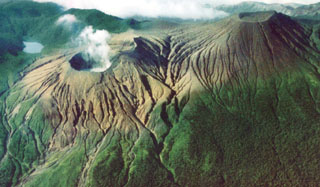
The following reports are from the Observatorio Vulcanológico y Sismologico de Costa Rica (OVSICORI). "After several attempts to climb to the summit of Rincón de la Vieja were turned back by bad weather, we reached the active crater on 19 April with W. Melson of the Smithsonian Institution. During this visit, we were able to confirm that there had been a recent eruption, since we encountered recently erupted material and a devastated area, both SE of the crater.
"At the time of our previous ascent, in August 1985, this tephra had not been deposited. In a photograph taken 25 November 1985 by E. Valverde, it is possible to observe white tephra. In addition, the seismic station at the base of the volcano registered an increase in activity (harmonic tremor and A- and B-type events) between September and November, suggesting that the eruption occurred during that time.
"A fan-shaped area of about 0.25 km3 was affected. The ejecta reached a maximum distance of 500 m SE of the active crater. The erupted material is secondary, including ash, sand, and blocks as much as 20 cm across. On one rock, an ash deposit 6 cm thick was observed. The effect of the eruption on rain forest vegetation was marked about 500 m SE of the crater (in the E bank of the Quebrada Azufrosa) where trees had been knocked down in a radial pattern by the activity. This pattern is unusual in that the fallen trees appeared to radiate from a point near their center, not from the crater. In addition, various plant species in this area were affected by the acid in the pyroclastics and the associated water.
"On 19 April there was a strong and constant emission of gas that affected breathing because of its acidity, and made it difficult to observe the lake in the active crater."
Geological Summary. Rincón de la Vieja is a volcanic complex in the Guanacaste Range of NW Costa Rica. Sometimes referred to as the Rincon de la Vieja-Santa María Volcanic Complex, it consists of a slightly arcuate 20-km-long ridge of 12 craters and pyroclastic cones constructed within the 15-km-wide early Pleistocene Guachipelín caldera, whose rim is exposed on the south side. Sometimes known as the "Colossus of Guanacaste," it has an estimated volume of 130 km3 and contains at least nine major eruptive centers. The Santa María cone, the highest peak of the complex, is located on the E side of the ridge and has a lake within the 400-m-diameter crater. A Plinian eruption producing the 0.25 km3 Río Blanca tephra about 3,500 years ago was the last major magmatic eruption. All subsequent eruptions, including numerous reported eruptions possibly dating back to the 16th century, have been from the active crater, near the center of the complex, with an acidic 300-m-diameter lake.
Information Contacts: J. Barquero and E. Fernández Soto, OVSICORI.
