

Report on Iliamna (United States) — March 1987
Scientific Event Alert Network Bulletin, vol. 12, no. 3 (March 1987)
Managing Editor: Lindsay McClelland.
Iliamna (United States) Large steam plume
Please cite this report as:
Global Volcanism Program, 1987. Report on Iliamna (United States) (McClelland, L., ed.). Scientific Event Alert Network Bulletin, 12:3. Smithsonian Institution. https://doi.org/10.5479/si.GVP.SEAN198703-313020
Iliamna
United States
60.032°N, 153.09°W; summit elev. 3053 m
All times are local (unless otherwise noted)
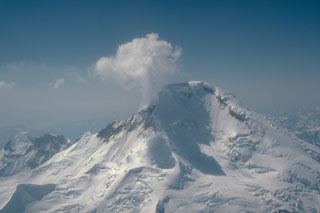
At 0800 on 19 March Reeve Aleutian Airways pilots Edward Livingston and Dale Schram observed a large steam plume rising about 1100 m above the summit. No ash appeared in the plume. Almost 3 hours later Northern Air Cargo pilot Wallace Niles observed a steam plume rising 1,000 m above the summit from a upper S flank vent. The plume drifted NNW. John Reeder noted that minor steam emissions are nearly continuous from Iliamna but a large steam plume is unusual.
Geological Summary. Iliamna is a prominent glacier-covered stratovolcano in Lake Clark National Park on the western side of Cook Inlet, about 225 km SW of Anchorage. Its flat-topped summit is flanked on the south, along a 5-km-long ridge, by the North and South Twin Peaks lava dome complexes. The Johnson Glacier dome complex lies on the NE flank. Steep headwalls on the S and E flanks expose an inaccessible cross-section of the volcano. Major glaciers radiate from the summit, and valleys below the summit contain debris avalanche and lahar deposits. Only a few major Holocene explosive eruptions have occurred from the deeply dissected volcano, which lacks a distinct crater. Most of the reported eruptions may represent plumes from vigorous fumaroles E and SE of the summit, which are often mistaken for eruption columns (Miller et al., 1998). Eruptions producing pyroclastic flows have been dated to 1778-1779 and 1876 CE. Elevated seismicity accompanying dike emplacement beneath the volcano was recorded in 1996.
Information Contacts: J. Reeder, ADGGS.
