

Report on Rincon de la Vieja (Costa Rica) — 23 March-29 March 2022
Smithsonian Institution / US Geological Survey
Weekly Volcanic Activity Report, 23 March-29 March 2022
Managing Editor: Sally Sennert.
Please cite this report as:
Global Volcanism Program, 2022. Report on Rincon de la Vieja (Costa Rica) (Sennert, S, ed.). Weekly Volcanic Activity Report, 23 March-29 March 2022. Smithsonian Institution and US Geological Survey.
Rincon de la Vieja
Costa Rica
10.8314°N, 85.3364°W; summit elev. 1729 m
All times are local (unless otherwise noted)
OVSICORI-UNA reported that several eruptive events at Rincón de la Vieja were recorded during 22-26 March, though none were visible due to weather conditions. A one-minute-long event was recorded at 0350 on 22 March. A series of pulses occurred over a 20-minute period, at 0140, 0146, and 0159 on 23 March, with additional small events at 1045, 1339, 1939, and 2244. According to the Washington VAAC a possible ash emission was visible in satellite images at 1420 drifting W at an altitude of 2.7 km (9,000 ft) a.s.l. OVSICORI-UNA noted that a series of small eruptive events were recorded during 0129-0140 on 25 March. A small eruption with possible two separate pulses was recorded on 26 March.
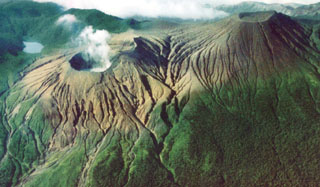
Geological Summary. Rincón de la Vieja is a volcanic complex in the Guanacaste Range of NW Costa Rica. Sometimes referred to as the Rincon de la Vieja-Santa María Volcanic Complex, it consists of a slightly arcuate 20-km-long ridge of 12 craters and pyroclastic cones constructed within the 15-km-wide early Pleistocene Guachipelín caldera, whose rim is exposed on the south side. Sometimes known as the "Colossus of Guanacaste," it has an estimated volume of 130 km3 and contains at least nine major eruptive centers. The Santa María cone, the highest peak of the complex, is located on the E side of the ridge and has a lake within the 400-m-diameter crater. A Plinian eruption producing the 0.25 km3 Río Blanca tephra about 3,500 years ago was the last major magmatic eruption. All subsequent eruptions, including numerous reported eruptions possibly dating back to the 16th century, have been from the active crater, near the center of the complex, with an acidic 300-m-diameter lake.
Sources: Observatorio Vulcanologico y Sismologico de Costa Rica-Universidad Nacional (OVSICORI-UNA), Washington Volcanic Ash Advisory Center (VAAC)
