
Smithsonian Institution / US Geological Survey
Weekly Volcanic Activity Report, 29 January-4 February 2003
Managing Editor: Gari Mayberry
Please cite this report as:
Global Volcanism Program, 2003. Report on Popocatepetl (Mexico) (Mayberry, G, ed.). Weekly Volcanic Activity Report, 29 January-4 February 2003. Smithsonian Institution and US Geological Survey. https://volcano.si.edu/showreport.cfm?gvpvar=GVP.WVAR20030129-341090
Volcanic activity continued at low-to-moderate levels at Popocatépetl during 28 January to 3 February. Activity consisted of small-to-moderate emissions of steam, gas, and small amounts of ash, and sporadic episodes of low-amplitude harmonic tremor. A moderate-sized emission occurred on 2 February at 0826 that produced an ash column to a height of ~2 km above the volcano. In addition, there were episodes of harmonic low-amplitude tremor during 2 hours.
Sources: Washington Volcanic Ash Advisory Center (VAAC), Centro Nacional de Prevencion de Desastres (CENAPRED)
Geological Summary. Volcán Popocatépetl, whose name is the Aztec word for smoking mountain, rises 70 km SE of Mexico City to form North America's 2nd-highest volcano. The glacier-clad stratovolcano contains a steep-walled, 400 x 600 m wide crater. The generally symmetrical volcano is modified by the sharp-peaked Ventorrillo on the NW, a remnant of an earlier volcano. At least three previous major cones were destroyed by gravitational failure during the Pleistocene, producing massive debris-avalanche deposits covering broad areas to the south. The modern volcano was constructed south of the late-Pleistocene to Holocene El Fraile cone. Three major Plinian eruptions, the most recent of which took place about 800 CE, have occurred since the mid-Holocene, accompanied by pyroclastic flows and voluminous lahars that swept basins below the volcano. Frequent historical eruptions, first recorded in Aztec codices, have occurred since Pre-Columbian time.


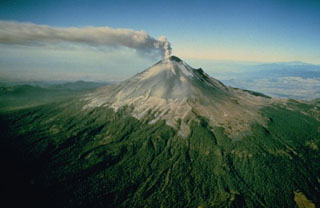 Popocatepetl