
Smithsonian Institution / US Geological Survey
Weekly Volcanic Activity Report, 17 March-23 March 2004
Managing Editor: Gari Mayberry
Please cite this report as:
Global Volcanism Program, 2004. Report on Rabaul (Papua New Guinea) (Mayberry, G, ed.). Weekly Volcanic Activity Report, 17 March-23 March 2004. Smithsonian Institution and US Geological Survey. https://volcano.si.edu/showreport.cfm?gvpvar=GVP.WVAR20040317-252140
Eruptive activity, which began at Rabaul caldera's Tavurvur cone in October 2002, ceased on 17 February. During 1-17 February, emissions of "light-to-pale ash clouds" were accompanied by occasional moderate explosions that produced thick ash plumes. The ash plumes rose 1-2 km above the summit and drifted E and NE, resulting in ashfall in Duke of York, Rabaul Town, and other villages. During 18-29 February there were only weak gas emissions. Ground-deformation measurements showed a deflationary trend during the last half of February.
Source: Rabaul Volcano Observatory (RVO)
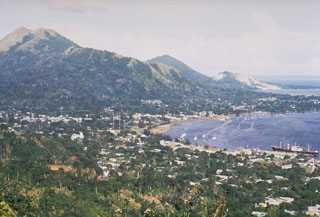
Geological Summary. The low-lying Rabaul caldera on the tip of the Gazelle Peninsula at the NE end of New Britain forms a broad sheltered harbor utilized by what was the island's largest city prior to a major eruption in 1994. The outer flanks of the asymmetrical shield volcano are formed by thick pyroclastic-flow deposits. The 8 x 14 km caldera is widely breached on the east, where its floor is flooded by Blanche Bay and was formed about 1,400 years ago. An earlier caldera-forming eruption about 7,100 years ago is thought to have originated from Tavui caldera, offshore to the north. Three small stratovolcanoes lie outside the N and NE caldera rims. Post-caldera eruptions built basaltic-to-dacitic pyroclastic cones on the caldera floor near the NE and W caldera walls. Several of these, including Vulcan cone, which was formed during a large eruption in 1878, have produced major explosive activity during historical time. A powerful explosive eruption in 1994 occurred simultaneously from Vulcan and Tavurvur volcanoes and forced the temporary abandonment of Rabaul city.


 Rabaul