
Smithsonian Institution / US Geological Survey
Weekly Volcanic Activity Report, 15 February-21 February 2006
Managing Editor: Gari Mayberry
Please cite this report as:
Global Volcanism Program, 2006. Report on Rabaul (Papua New Guinea) (Mayberry, G, ed.). Weekly Volcanic Activity Report, 15 February-21 February 2006. Smithsonian Institution and US Geological Survey. https://volcano.si.edu/showreport.cfm?gvpvar=GVP.WVAR20060215-252140
RVO reported that during 30 January to 15 February, Rabaul caldera's Tavurvur cone continued to be relatively quiet. Variable amounts of gas were emitted from an active fumarole at the summit area on the upper part of the W flank. An average sulfur-dioxide flux of 200 metric tons per day was recorded and seismicity was at low levels. According to the Darwin VAAC, ash from Rabaul was visible on satellite imagery at a height of ~3.7 km (12,100 ft) a.s.l. on 17 February.
Sources: Rabaul Volcano Observatory (RVO), Darwin Volcanic Ash Advisory Centre (VAAC)
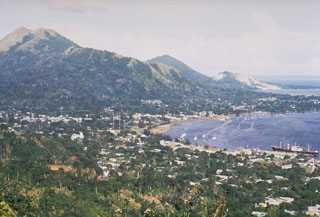
Geological Summary. The low-lying Rabaul caldera on the tip of the Gazelle Peninsula at the NE end of New Britain forms a broad sheltered harbor utilized by what was the island's largest city prior to a major eruption in 1994. The outer flanks of the asymmetrical shield volcano are formed by thick pyroclastic-flow deposits. The 8 x 14 km caldera is widely breached on the east, where its floor is flooded by Blanche Bay and was formed about 1,400 years ago. An earlier caldera-forming eruption about 7,100 years ago is thought to have originated from Tavui caldera, offshore to the north. Three small stratovolcanoes lie outside the N and NE caldera rims. Post-caldera eruptions built basaltic-to-dacitic pyroclastic cones on the caldera floor near the NE and W caldera walls. Several of these, including Vulcan cone, which was formed during a large eruption in 1878, have produced major explosive activity during historical time. A powerful explosive eruption in 1994 occurred simultaneously from Vulcan and Tavurvur volcanoes and forced the temporary abandonment of Rabaul city.


 Rabaul