
Smithsonian Institution / US Geological Survey
Weekly Volcanic Activity Report, 25 February-3 March 2009
Managing Editor: Sally Sennert
Please cite this report as:
Global Volcanism Program, 2009. Report on Koryaksky (Russia) (Sennert, S, ed.). Weekly Volcanic Activity Report, 25 February-3 March 2009. Smithsonian Institution and US Geological Survey. https://volcano.si.edu/showreport.cfm?gvpvar=GVP.WVAR20090225-300090
KVERT reported that during 25 February-4 March seismic activity at Koryaksky was at background levels. Observers reported that during 3-4 March gas plumes containing a small amount of ash rose to an altitude of 3.7 km (12,100 ft) a.s.l. and drifted more than 200 km ENE. Ash deposits were seen at the summit. Ash deposits 1-2 mm thick accumulated in an area between Koryaksky and Avachinsky volcanoes. The Level of Concern Color Code was raised to Orange.
Source: Kamchatkan Volcanic Eruption Response Team (KVERT)
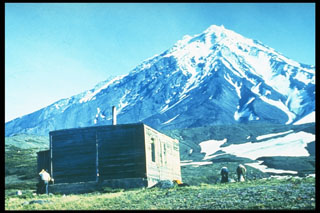
Geological Summary. The large symmetrical Koryaksky stratovolcano is the most prominent landmark of the NW-trending Avachinskaya volcano group, which towers above Kamchatka's largest city, Petropavlovsk. Erosion has produced a ribbed surface on the eastern flanks of the 3430-m-high volcano; the youngest lava flows are found on the upper W flank and below SE-flank cinder cones. Extensive Holocene lava fields on the western flank were primarily fed by summit vents; those on the SW flank originated from flank vents. Lahars associated with a period of lava effusion from south- and SW-flank fissure vents about 3900-3500 years ago reached Avacha Bay. Only a few moderate explosive eruptions have occurred during historical time, but no strong explosive eruptions have been documented during the Holocene. Koryaksky's first historical eruption, in 1895, also produced a lava flow.


 Koryaksky