
Smithsonian Institution / US Geological Survey
Weekly Volcanic Activity Report, 19 February-25 February 2020
Managing Editor: Sally Sennert
Please cite this report as:
Global Volcanism Program, 2020. Report on Ibu (Indonesia) (Sennert, S, ed.). Weekly Volcanic Activity Report, 19 February-25 February 2020. Smithsonian Institution and US Geological Survey. https://volcano.si.edu/showreport.cfm?gvpvar=GVP.WVAR20200219-268030
The Darwin VAAC reported that on 18, 20, and 22 February ash plumes from Ibu rose to 1.8-2.1 km (6,000-7,000 ft) a.s.l. and drifted SE, S, and SW. PVMBG stated that at 1113 on 20 February a white-to-gray ash plume rose at least 400 m above the summit (6,800 ft a.s.l.) and drifted SE. The Alert Level remained at 2 (on a scale of 1-4), and the public was warned to stay at least 2 km away from the active crater, and 3.5 km away on the N side.
Source: Pusat Vulkanologi dan Mitigasi Bencana Geologi (PVMBG, also known as CVGHM)
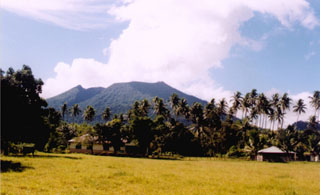
Geological Summary. The truncated summit of Gunung Ibu stratovolcano along the NW coast of Halmahera Island has large nested summit craters. The inner crater, 1 km wide and 400 m deep, has contained several small crater lakes. The 1.2-km-wide outer crater is breached on the N, creating a steep-walled valley. A large cone grew ENE of the summit, and a smaller one to the WSW has fed a lava flow down the W flank. A group of maars is located below the N and W flanks. The first observed and recorded eruption was a small explosion from the summit crater in 1911. Eruptive activity began again in December 1998, producing a lava dome that eventually covered much of the floor of the inner summit crater along with ongoing explosive ash emissions.


 Ibu
Ibu