
Smithsonian Institution / US Geological Survey
Weekly Volcanic Activity Report, 26 January-1 February 2022
Managing Editor: Sally Sennert
Please cite this report as:
Global Volcanism Program, 2022. Report on Callaqui (Chile) (Sennert, S, ed.). Weekly Volcanic Activity Report, 26 January-1 February 2022. Smithsonian Institution and US Geological Survey. https://volcano.si.edu/showreport.cfm?gvpvar=GVP.WVAR20220126-357091
In a special statement issued on 27 January, SERNAGEOMIN reported that a small area of incandescence on the SW part of Callaqui’s summit crater was visible in webcam images overnight beginning at 2155 on 26 January. The glow was persistent and visible during dark hours, and was likely the result of increased temperatures at fumarolic vents. More intense gas emissions from the same area were visible rising 380 m the next day. The report noted that this was the first time incandescence had been recorded since the camera was installed in 2012. The Alert Level remained at Green, the lowest level on a four-color scale.
Source: Servicio Nacional de Geología y Minería (SERNAGEOMIN)
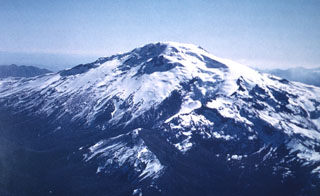
Geological Summary. The late-Pleistocene to Holocene Callaqui stratovolcano has a profile of an overturned canoe, due to its construction along an 11-km-long, SW-NE fissure above a 1.2-0.3 million year old Pleistocene edifice. The ice-capped, basaltic andesite volcano contains well-preserved cones and lava flows, which have traveled up to 14 km. Small craters 100-500 m in diameter are primarily found along a fissure extending down the SW flank. Intense solfataric or fumarolic activity occurs at the southern portion of the summit; in 1966 and 1978, red glow was observed in fumarolic areas (Moreno, 1985 pers. comm.). An explosive eruption was reported in 1751 CE, there were uncertain accounts of eruptions in 1864 and 1937, and a small phreatic ash emission was noted in 1980.


 Callaqui