
Smithsonian Institution / US Geological Survey
Weekly Volcanic Activity Report, 27 August-2 September 2026
Managing Editor: Sally Sennert
Please cite this report as:
Global Volcanism Program, 2026. Report on Krakatau (Indonesia) (Sennert, S, ed.). Weekly Volcanic Activity Report, 27 August-2 September 2026. Smithsonian Institution and US Geological Survey. https://volcano.si.edu/showreport.cfm?gvpvar=GVP.WVAR20260827-262000
The Pusat Vulkanologi dan Mitigasi Bencana Geologi (PVMBG) reported ongoing eruptive activity at Krakatau during 27 August-2 September. Ash-and-gas plumes that were a mixture of white, gray, and black colors rose 100-400 m above the summit and drifted mainly W, NW, N, and NE during 27-31 August. A webcam image on 27 August showed incandescent material being ejected above the crater. White plumes were visible rising as high as 200 m and drifting SW, W, and NW during 1-2 September. The Alert Level remained at 3 (on a scale of 1-4) and the public was advised to stay 3 km away from summit.
Source: Pusat Vulkanologi dan Mitigasi Bencana Geologi (PVMBG, also known as CVGHM)
Geological Summary. The renowned Krakatau (frequently misnamed as Krakatoa) volcano lies in the Sunda Strait between Java and Sumatra. Collapse of an older edifice, perhaps in 416 or 535 CE, formed a 7-km-wide caldera. Remnants of that volcano are preserved in Verlaten and Lang Islands; subsequently the Rakata, Danan, and Perbuwatan cones were formed, coalescing to create the pre-1883 Krakatau Island. Caldera collapse during the catastrophic 1883 eruption destroyed Danan and Perbuwatan, and left only a remnant of Rakata. This eruption caused more than 36,000 fatalities, most as a result of tsunamis that swept the adjacent coastlines of Sumatra and Java. Pyroclastic surges traveled 40 km across the Sunda Strait and reached the Sumatra coast. After a quiescence of less than a half century, the post-collapse cone of Anak Krakatau (Child of Krakatau) was constructed within the 1883 caldera at a point between the former Danan and Perbuwatan cones. Anak Krakatau has been the site of frequent eruptions since 1927.


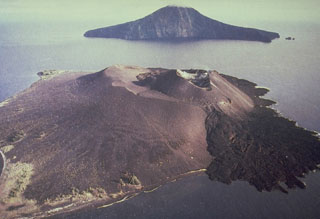 Krakatau