
Smithsonian Institution / US Geological Survey
Weekly Volcanic Activity Report, 2 December-8 December 2009
Managing Editor: Sally Sennert
Please cite this report as:
Global Volcanism Program, 2009. Report on Kīlauea (United States) (Sennert, S, ed.). Weekly Volcanic Activity Report, 2 December-8 December 2009. Smithsonian Institution and US Geological Survey. https://volcano.si.edu/showreport.cfm?gvpvar=GVP.WVAR20091202-332010
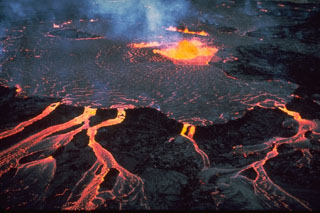
During 2-8 December, HVO reported that lava flowed SE from beneath Kīlauea's Thanksgiving Eve Breakout (TEB) and rootless shield complex through a lava tube system, reaching the ocean at multiple locations between Waikupanaha and an area 700 m farther to the W. Thermal anomalies detected by satellite and visual observations revealed active lava flows on the coastal plain. Incandescence was occasionally seen from Puʻu ʻŌʻō crater; on 2 December, incandescence originated from vents on the E wall. The vent in Halemaʻumaʻu crater continued to produce a white or off-white plume that drifted E, W, and SW, and dropped small amounts of ash downwind. Incandescence originated from multiple spattering holes in the deep floor of the vent cavity.
Source: US Geological Survey Hawaiian Volcano Observatory (HVO)
Geological Summary. Kīlauea overlaps the E flank of the massive Mauna Loa shield volcano in the Island of Hawaiʻi. Eruptions are prominent in Polynesian legends; written documentation since 1820 records frequent summit and flank lava flow eruptions interspersed with periods of long-term lava lake activity at Halemaʻumaʻu crater in the summit caldera until 1924. The 3 x 5 km caldera was formed in several stages about 1,500 years ago and during the 18th century; eruptions have also originated from the lengthy East and Southwest rift zones, which extend to the ocean in both directions. About 90% of the surface of the basaltic shield volcano is formed of lava flows less than about 1,100 years old; 70% of the surface is younger than 600 years. The long-term eruption from the East Rift Zone between 1983 and 2018 produced lava flows covering more than 100 km2, destroyed hundreds of houses, and added new coastline.


 Kīlauea