
Smithsonian Institution / US Geological Survey
Weekly Volcanic Activity Report, 16 October-22 October 2019
Managing Editor: Sally Sennert
Please cite this report as:
Global Volcanism Program, 2019. Report on Karangetang (Indonesia) (Sennert, S, ed.). Weekly Volcanic Activity Report, 16 October-22 October 2019. Smithsonian Institution and US Geological Survey. https://volcano.si.edu/showreport.cfm?gvpvar=GVP.WVAR20191016-267020
PVMBG reported that during 14-20 October lava continued to effuse from Karangetang’s Main Crater (S), traveling as far as 1.8 km down the Nanitu, Pangi, and Sense drainages on the SW and W flanks. Incandescence from both summit craters was visible at night. Sometimes dense white plumes rose to 600 m above the summit. According to the Darwin VAAC minor ash plumes were visible in satellite images rising to 2.4 km (8,000 ft) a.s.l. (600 m above the summit) and drifting W and NW. The Alert Level remained at 2 (on a scale of 1-4).
Sources: Pusat Vulkanologi dan Mitigasi Bencana Geologi (PVMBG, also known as CVGHM), Darwin Volcanic Ash Advisory Centre (VAAC)
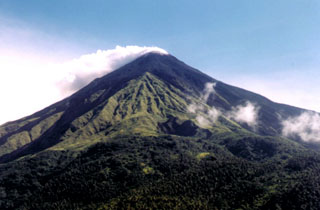
Geological Summary. Karangetang (Api Siau) volcano lies at the northern end of the island of Siau, about 125 km NNE of the NE-most point of Sulawesi. The stratovolcano contains five summit craters along a N-S line. It is one of Indonesia's most active volcanoes, with more than 40 eruptions recorded since 1675 and many additional small eruptions that were not documented (Neumann van Padang, 1951). Twentieth-century eruptions have included frequent explosive activity sometimes accompanied by pyroclastic flows and lahars. Lava dome growth has occurred in the summit craters; collapse of lava flow fronts have produced pyroclastic flows.


 Karangetang