
Smithsonian Institution / US Geological Survey
Weekly Volcanic Activity Report, 30 September-6 October 2020
Managing Editor: Sally Sennert
Please cite this report as:
Global Volcanism Program, 2020. Report on Raung (Indonesia) (Sennert, S, ed.). Weekly Volcanic Activity Report, 30 September-6 October 2020. Smithsonian Institution and US Geological Survey. https://volcano.si.edu/showreport.cfm?gvpvar=GVP.WVAR20200930-263340
PVMBG reported that eruptive activity at Raung continued during 28 September-4 October with white-and-gray plumes rising 100-400 m above the crater rim. The Alert Level remained at 2 (on a scale of 1-4), and the public was warned to remain outside of the 2-km exclusion zone.
Source: Pusat Vulkanologi dan Mitigasi Bencana Geologi (PVMBG, also known as CVGHM)
Geological Summary. Raung, one of Java's most active volcanoes, is a massive stratovolcano in easternmost Java that was constructed SW of the rim of Ijen caldera. The unvegetated summit is truncated by a dramatic steep-walled, 2-km-wide caldera that has been the site of frequent historical eruptions. A prehistoric collapse of Gunung Gadung on the W flank produced a large debris avalanche that traveled 79 km, reaching nearly to the Indian Ocean. Raung contains several centers constructed along a NE-SW line, with Gunung Suket and Gunung Gadung stratovolcanoes being located to the NE and W, respectively.


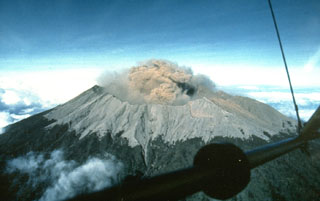 Raung
Raung