

Report on Sangeang Api (Indonesia) — 19 November-25 November 2025
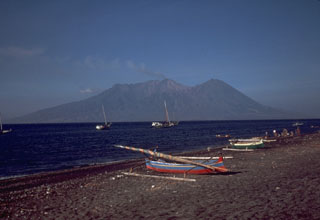
Smithsonian Institution / US Geological Survey
Weekly Volcanic Activity Report, 19 November-25 November 2025
Managing Editor: Sally Sennert.
Please cite this report as:
Global Volcanism Program, 2025. Report on Sangeang Api (Indonesia) (Sennert, S, ed.). Weekly Volcanic Activity Report, 19 November-25 November 2025. Smithsonian Institution and US Geological Survey.
Sangeang Api
Indonesia
8.2°S, 119.07°E; summit elev. 1912 m
All times are local (unless otherwise noted)
The Pusat Vulkanologi dan Mitigasi Bencana Geologi (PVMBG) reported that activity at Sangeang Api increased during 1-22 November. Notably, five tornillo earthquakes were detected and on 18 November there was a significant increase in seismic signals indicating emissions. White, gray, and brown emissions rose as high as 35 m above the crater rim on 20 November, followed by white emissions that rose 15-25 m above the crater rim during 21-22 November. Seismicity intensified further on 22 November, and a new eruption was confirmed by visual observations of emissions that appeared to be rising from a different vent that had been active in 2014. At 0600 the Alert Level was raised to 2 (on a scale of 1-4) and the public was warned to stay 3 km away from the active crater and additionally from an area on the ESE flank than spanned from the crater to the coastline, 6.5 km away. White-and-gray emissions rose 200-300 m above the crater rim on 23 November.
Geological Summary. Sangeang Api volcano, one of the most active in the Lesser Sunda Islands, forms a small 13-km-wide island off the NE coast of Sumbawa Island. Two large trachybasaltic-to-tranchyandesitic volcanic cones, Doro Api and Doro Mantoi, were constructed in the center and on the eastern rim, respectively, of an older, largely obscured caldera. Flank vents occur on the south side of Doro Mantoi and near the northern coast. Intermittent eruptions have been recorded since 1512, most of them during in the 20th century.
Source: Pusat Vulkanologi dan Mitigasi Bencana Geologi (PVMBG, also known as CVGHM)
