

Report on Ambae (Vanuatu) — 3 December-9 December 2025
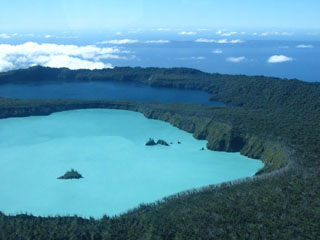
Smithsonian Institution / US Geological Survey
Weekly Volcanic Activity Report, 3 December-9 December 2025
Managing Editor: Sally Sennert.
Please cite this report as:
Global Volcanism Program, 2025. Report on Ambae (Vanuatu) (Sennert, S, ed.). Weekly Volcanic Activity Report, 3 December-9 December 2025. Smithsonian Institution and US Geological Survey.
Ambae
Vanuatu
15.389°S, 167.835°E; summit elev. 1496 m
All times are local (unless otherwise noted)
The Vanuatu Meteorology and Geohazards Department (VMGD) reported eruptive activity at Ambae during the last week of November and the first week of December based on seismic signals, satellite data, and webcam images. Steam, gas, and ash plumes were visible in satellite and webcam observations during 24-30 November and 1-5 December. A low-level thermal anomaly was also detected in satellite images during 30 November and 1-2 December. Ashfall was reported in surrounding communities downwind in late November and during 1-7 December. A webcam image from 8 December showed a plume that may have contained ash rising from the crater. According to the Wellington Volcanic Ash Advisory Center (VAAC) low-level ash plumes rose 1.8-2.4 km (6,000-8,000 ft) a.s.l. and drifted NW during 3-5 December, then rose as high as 3.7 km (12,000 ft) a.s.l. and drifted E during 7-8 December. The Alert Level remained at 2 (on a scale of 0-5), and the public was warned to stay outside of Danger Zone A, defined as a 2-km radius around the active vents in Lake Voui, and to stay away from drainages during heavy rains.
Geological Summary. The island of Ambae, also known as Aoba, is a massive 2,500 km3 basaltic shield that is the most voluminous volcano of the New Hebrides archipelago. A pronounced NE-SW-trending rift zone with numerous scoria cones gives the 16 x 38 km island an elongated form. A broad pyroclastic cone containing three crater lakes (Manaro Ngoru, Voui, and Manaro Lakua) is located at the summit within the youngest of at least two nested calderas, the largest of which is 6 km in diameter. That large central edifice is also called Manaro Voui or Lombenben volcano. Post-caldera explosive eruptions formed the summit craters about 360 years ago. A tuff cone was constructed within Lake Voui (or Vui) about 60 years later. The latest known flank eruption, about 300 years ago, destroyed the population of the Nduindui area near the western coast.
Sources: Vanuatu Meteorology and Geohazards Department (VMGD), Wellington Volcanic Ash Advisory Center (VAAC)
