

Report on Merapi (Indonesia) — 17 December-23 December 2025
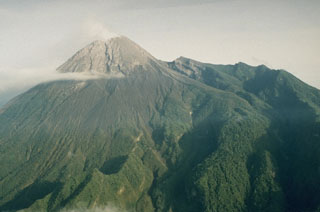
Smithsonian Institution / US Geological Survey
Weekly Volcanic Activity Report, 17 December-23 December 2025
Managing Editor: Sally Sennert.
Please cite this report as:
Global Volcanism Program, 2025. Report on Merapi (Indonesia) (Sennert, S, ed.). Weekly Volcanic Activity Report, 17 December-23 December 2025. Smithsonian Institution and US Geological Survey.
Merapi
Indonesia
7.54°S, 110.446°E; summit elev. 2910 m
All times are local (unless otherwise noted)
The Pusat Vulkanologi dan Mitigasi Bencana Geologi (PVMBG) reported that the eruption at Merapi continued during 10-16 December. The SW lava dome produced 3-36 daily lava avalanches that traveled as far as 1.5 km SW down the Bebeng drainage, 1.8 km down the Sat/Putih drainage, and as far as 1.8 km SW down the Krasak drainage. A pyroclastic flow traveled 1.5 km down the flanks on 20 December. The Alert Level remained at 3 (on a scale of 1-4), and the public was warned to stay 3-7 km away from the summit, based on location.
Geological Summary. Merapi, one of Indonesia's most active volcanoes, lies in one of the world's most densely populated areas and dominates the landscape immediately north of the major city of Yogyakarta. It is the youngest and southernmost of a volcanic chain extending NNW to Ungaran volcano. Growth of Old Merapi during the Pleistocene ended with major edifice collapse perhaps about 2,000 years ago, leaving a large arcuate scarp cutting the eroded older Batulawang volcano. Subsequent growth of the steep-sided Young Merapi edifice, its upper part unvegetated due to frequent activity, began SW of the earlier collapse scarp. Pyroclastic flows and lahars accompanying growth and collapse of the steep-sided active summit lava dome have devastated cultivated lands on the western-to-southern flanks and caused many fatalities.
Source: Pusat Vulkanologi dan Mitigasi Bencana Geologi (PVMBG, also known as CVGHM)
