

Report on Fuego (Guatemala) — 17 December-23 December 2025
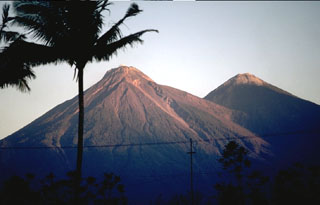
Smithsonian Institution / US Geological Survey
Weekly Volcanic Activity Report, 17 December-23 December 2025
Managing Editor: Sally Sennert.
Please cite this report as:
Global Volcanism Program, 2025. Report on Fuego (Guatemala) (Sennert, S, ed.). Weekly Volcanic Activity Report, 17 December-23 December 2025. Smithsonian Institution and US Geological Survey.
Fuego
Guatemala
14.4748°N, 90.8806°W; summit elev. 3799 m
All times are local (unless otherwise noted)
The Instituto Nacional de Sismología, Vulcanologia, Meteorologia e Hidrología (INSIVUMEH) reported that eruptive activity at Fuego continued during 16-23 December. Daily Strombolian explosions recorded by the seismic network, at rates of 4-12 per hour, generated gas-and-ash plumes that rose as high as 1.1 km above the summit and drifted as far as 30 km in multiple directions. Occasional rumbling sounds, shock waves, and/or sounds associated with gas emissions were reported. Explosions occasionally ejected incandescent material as high as 300 m above the summit and showered the upper flanks with incandescent material. Incandescent block avalanches descended the Las Lajas (SE), Santa Teresa (W), Taniluya (SSW), and Ceniza (SSW) drainages, sometimes reaching vegetated areas. Ashfall was reported in areas downwind including Panimaché I and II (8 km SW), Morelia (10 km SW), and Yepocapa (8 km NW) during 16-17 December, in Panimaché I and II and Finca Paloverde (10 km SW) during 17-18 December, and in San Pedro Yepocapa and other areas on the SW flank during 20-21 December. During the early afternoon on 18 December lahars descended the Ceniza, Zarco, and Mazate drainages, carrying tree branches, trunks, volcanic material, and blocks as large as 3 m in diameter.
Geological Summary. Volcán Fuego, one of Central America's most active volcanoes, is also one of three large stratovolcanoes overlooking Guatemala's former capital, Antigua. The scarp of an older edifice, Meseta, lies between Fuego and Acatenango to the north. Construction of Meseta dates back to about 230,000 years and continued until the late Pleistocene or early Holocene. Collapse of Meseta may have produced the massive Escuintla debris-avalanche deposit, which extends about 50 km onto the Pacific coastal plain. Growth of the modern Fuego volcano followed, continuing the southward migration of volcanism that began at the mostly andesitic Acatenango. Eruptions at Fuego have become more mafic with time, and most historical activity has produced basaltic rocks. Frequent vigorous eruptions have been recorded since the onset of the Spanish era in 1524, and have produced major ashfalls, along with occasional pyroclastic flows and lava flows.
Source: Instituto Nacional de Sismologia, Vulcanologia, Meteorologia, e Hidrologia (INSIVUMEH)
