

Report on Barren Island (India) — 24 December-30 December 2025
Smithsonian Institution / US Geological Survey
Weekly Volcanic Activity Report, 24 December-30 December 2025
Managing Editor: Sally Sennert.
Please cite this report as:
Global Volcanism Program, 2025. Report on Barren Island (India) (Sennert, S, ed.). Weekly Volcanic Activity Report, 24 December-30 December 2025. Smithsonian Institution and US Geological Survey.
Barren Island
India
12.278°N, 93.858°E; summit elev. 354 m
All times are local (unless otherwise noted)
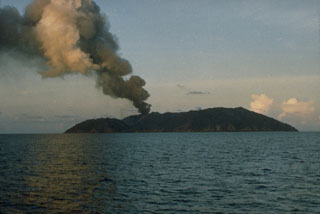
Satellite images of Barren Island acquired on 20, 22, and 25 December showed thermal anomalies over parts of the lower half of the N-flank flows, suggesting that they were hot and active. A thermal anomaly over one vent at the summit was also identified in the images, though weather clouds obscured the summit area on 20 December. The Darwin Volcanic Ash Advisory Centre (VAAC) reported that on 25 December an ash plume was identified in satellite images rising 1.2 km (4,000 ft) a.s.l. and drifting SW.
Geological Summary. Barren Island, a possession of India in the Andaman Sea about 135 km NE of Port Blair in the Andaman Islands, is the only historically active volcano along the N-S volcanic arc extending between Sumatra and Burma (Myanmar). It is the emergent summit of a volcano that rises from a depth of about 2250 m. The small, uninhabited 3-km-wide island contains a roughly 2-km-wide caldera with walls 250-350 m high. The caldera, which is open to the sea on the west, was created during a major explosive eruption in the late Pleistocene that produced pyroclastic-flow and -surge deposits. Historical eruptions have changed the morphology of the pyroclastic cone in the center of the caldera, and lava flows that fill much of the caldera floor have reached the sea along the western coast.
Sources: Copernicus, Darwin Volcanic Ash Advisory Centre (VAAC)
