

Report on Westdahl (United States) — 24 December-30 December 2025
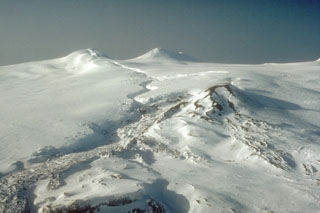
Smithsonian Institution / US Geological Survey
Weekly Volcanic Activity Report, 24 December-30 December 2025
Managing Editor: Sally Sennert.
Please cite this report as:
Global Volcanism Program, 2025. Report on Westdahl (United States) (Sennert, S, ed.). Weekly Volcanic Activity Report, 24 December-30 December 2025. Smithsonian Institution and US Geological Survey.
Westdahl
United States
54.516°N, 164.65°W; summit elev. 1563 m
All times are local (unless otherwise noted)
The Anchorage Volcanic Ash Advisory Center (VAAC) reported that during 28-29 December plumes of unconsolidated ash in the vicinity of Westdahl were visible in satellite images rising to 1.5 km (5,000 ft) a.s.l. The Volcano Alert Level remained at Normal (the lowest level on a four-level scale) and the Aviation Color Code remained at Green (the lowest level on a four-color scale).
Geological Summary. Westdahl is a broad glacier-covered volcano occupying the SW end of Unimak Island. Two peaks protrude from the summit plateau, and a new crater formed in 1978 cuts the summit icecap. The volcano has a somewhat of a shield-like morphology and forms one of the largest volcanoes of the Aleutian Islands. The sharp-topped, conical Pogromni stratovolcano, 6 km N, rises several hundred meters higher than Westdahl, but is moderately glacially dissected and presumably older. Many satellitic cones of postglacial age are located along a NW-SE line cutting across the summit of Westdahl. Some of the historical eruptions attributed to the eroded Pogromni may have originated instead from Westdahl (Miller et al. 1998). The first historical eruption occurred in 1795. An 8-km-long fissure extending east from the summit produced explosive eruptions and lava flows in 1991.
